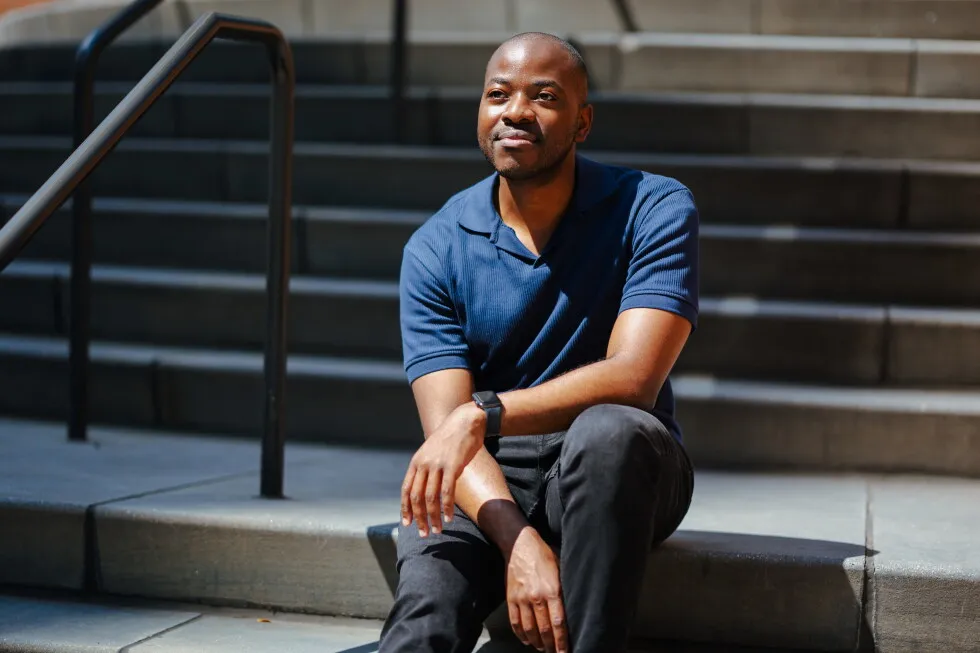
This campaign aims to boost Black nonprofit fundraising by convincing everyday donors of their power 1 of 5 | Floyd Jones, the founder of BackBlack, an initiative that supports underfunded Black-led nonprofits, poses for a portrait in Washington Heights, Wednesday, Aug. 19, 2026, in New York. (AP Photo/Angelina Katsanis) 2 of 5 | Floyd Jones, the founder of BackBlack, an initiative that supports underfunded Black-led nonprofits, poses for a portrait in Washington Heights, Wednesday, Aug. 19, 2026, in New York. (AP Photo/Angelina Katsanis) 3 of 5 | Floyd Jones, the founder of BackBlack, an initiative that supports underfunded Black-led nonprofits, poses for a portrait in Washington Heights, Wednesday, Aug. 19, 2026, in New York. (AP Photo/Angelina Katsanis) 4 of 5 | Floyd Jones, the founder of BackBlack, an initiative that supports underfunded Black-led nonprofits, poses for a portrait in Washington Heights, Wednesday, Aug. 19, 2026, in New York. (AP Photo/Angelina Katsanis) 5 of 5 | Floyd Jones, the founder of BackBlack, an initiative that supports underfunded Black-led nonprofits, poses for a portrait in Washington Heights, Wednesday, Aug. 19, 2026, in New York. (AP Photo/Angelina Katsanis) By James Pollard Updated 2:22 PM MESZ, August 21, 2026 Leer en español Add AP News on Google Add AP News as your preferred source to see more of our stories on Google. Share Share Facebook Copy Link copied Print Email X LinkedIn Bluesky Flipboard Pinterest Reddit New York (AP) — Black nonprofit fundraisers are turning to their own communities for support this month, stressing everyday donors’ power at a time when philanthropy is growing more concentrated among the affluent and some major funders have de-prioritized diversity in their grantmaking. The BackBlack initiative has directed more than $12 million toward Black-led nonprofits over the past three years, according to founder Floyd Jones. A GivingTuesday -style campaign that runs in August, the appeal invites online donation platforms to center typically underfunded, Black-led nonprofits. Last year’s efforts drew more than 130,000 unique donors, according to Jones, with the majority of their gifts falling under $100. This year, for the first time, organizers are also leveraging content creators to reach a new audience: Black Gen Zers. The goal is to show that philanthropy belongs to them, too — not just the historically wealthier and predominantly white charitable institutions that tend to dominate narratives about philanthropy. “Our people have always taken care of our people,” Jones said. “I want people to feel empowered.” The campaign could bring a boost for smaller, Black-led organizations that, according to research released earlier this year, saw no significant changes to their funding after the racial reckoning of 2020. Only a subset of larger nonprofits got temporary increases in the years that followed, according to an analysis by Candid and ABFE. Celebrity giving is evolving: Ariana Grande’s foundation shows how 5 MIN READ Cash-hungry college sports programs are starting nonprofits to make money to stay competitive 2 MIN READ College sports advocates press philanthropy to buffer NIL’s commercial pressure on women’s sports 2 MIN READ BackBlack aims to flip that narrative from one of “deficit” to one of abundance. Jones is heartened by the example of Madam C.J. Walker, a Black beauty entrepreneur widely considered America’s first female self-made millionaire. She supported Black educational efforts such as Booker T. Washington’s Tuskegee Institute and African American branches of the YMCA. She also contributed to the NAACP ‘s anti-lynching fund shortly before her death in 1919. Jones doesn’t care if today’s donors have millions in their bank accounts, though. “It’s about doing your best,” he said. One of BackBlack’s partnering creators pointed to the Free African Society. The nondenominational Philadelphia group, founded in 1787 by Black leaders Richard Allen and Absalom Jones, was one of the country’s first mutual aid organizations. “We’ve always had to pool our money and resources to help each other,” said Ernest Crim III, a former schoolteacher who posts Black history videos for his 118,000 Instagram followers. But, he added, allies must also pitch in — especially in communities that “might not have the sustainable market or income to consistently give.” Crim is asking followers to support Black nonprofits that work on issues of youth employment. Other participating pages are focused on nonprofits providing sports access, improving health outcomes and ensuring civil rights. Matching up to $6,000 in donations is For Good, a charitable giving platform that helps move money from more than 20,000 donor-advised funds to over a million nonprofits filtered by ZIP code. GivingTuesday manages BackBlack’s data, Jones said. Other partners include online fundraising platforms GiveButter, Every.org, Bonterra and Fundraise Up. For Good provides back end infrastructure for consumer-based campaigns including YouTube’s fundraising pages and Patagonia’s point-of-sale donations. The creator-driven donation strategy stemmed from the platform’s success with YouTubers who launch fundraisers for the issues they discuss in their videos. Grassroots fundraisers face competing headwinds, according to For Good interim president Tamara Mahal. The concentration of wealth has increased the share of high net worth individuals in the donor pool. But, she said, there are more ways than ever to give locally from the bottom up. She welcomes the BackBlack campaign’s efforts to include more small-dollar givers so that nonprofits aren’t overly beholden to any one individual benefactor. “The cause is important in and of itself. Find a nonprofit that’s doing work in your community,” she said. “And that will actually help us to diversify.” Kaci Patterson is the founder of Social Good Solutions, a social impact consulting firm that works with funders to build support for Black-led organizations outside of “trend funding.” She finds that Black philanthropy Month, celebrated in August, is a reminder that philanthropy is more than just “institutional” giving “held within the walls of wealth and power.” It was fish fries and chicken dinners, she noted, that funded alternative transportation systems during the Montgomery Bus Boycott. Growing up, her own family received groceries from their community during times of hardship. “That was philanthropy. That was someone else looking at us and investing in us and wanting us to be whole and wanting us to be well,” she said. “We’ve always had this kind of ‘we got us’ philanthropy. Let’s step into that role more confidently.” Associated Press coverage of philanthropy and nonprofits receives support through the AP’s collaboration with The Conversation US, with funding from Lilly Endowment Inc. The AP is solely responsible for this content. For all of AP’s philanthropy coverage, visit https://apnews.com/hub/philanthropy. James Pollard Pollard covers philanthropy for The Associated Press with a focus on Gen Z’s giving habits and technology’s uses in charitable work. He is based in New York. twitter mailto
SRCAssociated Press (AP)
LANGEN
LEANCenter
WORDS1 099
ENT10
FRI · 2026-08-21 · 12:53 GMTBRIEF NSR-2026-0821-104545
NSR-2026-0821-104545News Report·EN·Social Justice
This campaign aims to boost Black nonprofit fundraising by convincing everyday donors of their power
The BackBlack initiative is running an August campaign to boost fundraising for Black-led nonprofits, emphasizing the power of everyday donors. Founder Floyd Jones stated that the initiative has directed over $12 million to these organizations in the past three years.
Associated Press (AP)Filed 2026-08-21 · 12:53 GMTLean · CenterRead · 5 min
Associated Press (AP)FIG 01
Reading time
5min
Word count
1 099words
Sources cited
2cited
Entities identified
10entities
Quality score
100%
§ 01
Briefing Summary
AI-generatedNEWSAR · AI
The BackBlack initiative is running an August campaign to boost fundraising for Black-led nonprofits, emphasizing the power of everyday donors. Founder Floyd Jones stated that the initiative has directed over $12 million to these organizations in the past three years. This year's campaign, similar to GivingTuesday, is leveraging content creators to engage Black Gen Zers and highlight that philanthropy is accessible to them. The effort aims to counter the trend of concentrated wealth in philanthropy and a de-prioritization of diversity by some funders, which has left many smaller Black-led nonprofits with stagnant funding since 2020. The campaign encourages community support, drawing parallels to historical mutual aid efforts.
Confidence 0.90Sources 2Claims 5Entities 10
§ 02
Article analysis
Model · rule-basedFraming
Social Justice
Human Interest
Tone
Measured
AI-assessed
CalmNeutralAlarmist
Factuality
0.70 / 1.00
Factual
LowHigh
Sources cited
2
Limited
FewMany
§ 03
Key claims
5 extracted01
Last year's BackBlack campaign drew more than 130,000 unique donors, with the majority of gifts under $100.
statisticFloyd Jones
Confidence
0.90
02
The BackBlack initiative has directed more than $12 million toward Black-led nonprofits over the past three years.
statisticFloyd Jones
Confidence
0.90
03
The campaign aims to show that philanthropy belongs to Black Gen Zers, not just historically wealthier and predominantly white charitable institutions.
factual
Confidence
0.85
04
Research released earlier this year showed Black-led nonprofits saw no significant changes to their funding after the racial reckoning of 2020.
statisticCandid and ABFE
Confidence
0.85
05
Philanthropy is growing more concentrated among the affluent, and some major funders have de-prioritized diversity in their grantmaking.
factual
Confidence
0.80
§ 04
Full report
5 min read · 1 099 words§ 05
Entities
10 identifiedKey playerOppositionContextPositiveNeutralNegative
Organizations2
§ 06
Keywords & salience
8 termsblack nonprofit fundraising
1.00
everyday donors
0.90
backblack initiative
0.80
underfunded nonprofits
0.70
community support
0.60
philanthropy
0.50
gen z
0.40
donation platforms
0.40
§ 07
Topic connections
Interactive graph No topic relationship data available yet. This graph will appear once topic relationships have been computed.