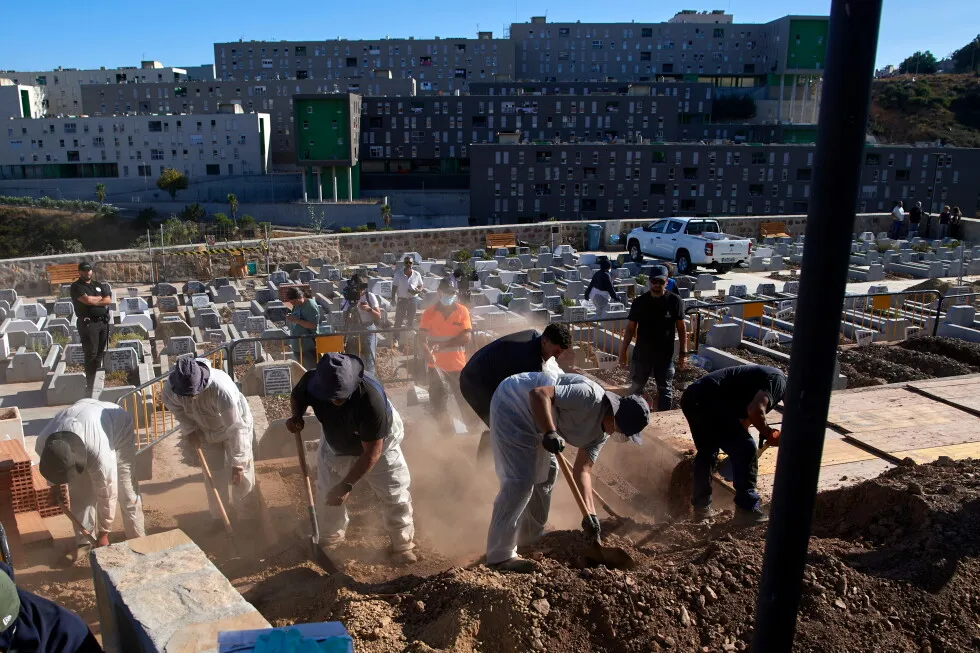
Ceuta begins burials for migrants who died attempting to cross into the Spanish territory 1 of 4 | funeral workers bury migrants who died while trying to cross from Morocco into the Spanish exclave of Ceuta, Friday, Aug. 21, 2026. (AP Photo/Antonio Sempere) 2 of 4 | A man, accompanied by funeral workers, prays over bodies of migrants who died while trying to cross from Morocco into the Spanish exclave of Ceuta, Friday, Aug. 21, 2026. (AP Photo/Antonio Sempere) 3 of 4 | funeral workers gather the bodies of migrants who died while trying to cross from Morocco into the Spanish exclave of Ceuta, Friday, Aug. 21, 2026. (AP Photo/Antonio Sempere) 4 of 4 | funeral workers prepare to bury the body of a migrant who died while trying to cross from Morocco into the Spanish exclave of Ceuta, Friday, Aug. 21, 2026. (AP Photo/Antonio Sempere) 1 of 4 | funeral workers bury migrants who died while trying to cross from Morocco into the Spanish exclave of Ceuta, Friday, Aug. 21, 2026. (AP Photo/Antonio Sempere) 1 of 4 funeral workers bury migrants who died while trying to cross from Morocco into the Spanish exclave of Ceuta, Friday, Aug. 21, 2026. (AP Photo/Antonio Sempere) Add AP News on Google Add AP News as your preferred source to see more of our stories on Google. Share 2 of 4 | A man, accompanied by funeral workers, prays over bodies of migrants who died while trying to cross from Morocco into the Spanish exclave of Ceuta, Friday, Aug. 21, 2026. (AP Photo/Antonio Sempere) 2 of 4 A man, accompanied by funeral workers, prays over bodies of migrants who died while trying to cross from Morocco into the Spanish exclave of Ceuta, Friday, Aug. 21, 2026. (AP Photo/Antonio Sempere) Add AP News on Google Add AP News as your preferred source to see more of our stories on Google. Share 3 of 4 | funeral workers gather the bodies of migrants who died while trying to cross from Morocco into the Spanish exclave of Ceuta, Friday, Aug. 21, 2026. (AP Photo/Antonio Sempere) 3 of 4 funeral workers gather the bodies of migrants who died while trying to cross from Morocco into the Spanish exclave of Ceuta, Friday, Aug. 21, 2026. (AP Photo/Antonio Sempere) Add AP News on Google Add AP News as your preferred source to see more of our stories on Google. Share 4 of 4 | funeral workers prepare to bury the body of a migrant who died while trying to cross from Morocco into the Spanish exclave of Ceuta, Friday, Aug. 21, 2026. (AP Photo/Antonio Sempere) 4 of 4 funeral workers prepare to bury the body of a migrant who died while trying to cross from Morocco into the Spanish exclave of Ceuta, Friday, Aug. 21, 2026. (AP Photo/Antonio Sempere) Add AP News on Google Add AP News as your preferred source to see more of our stories on Google. Share Updated [hour]:[minute] [AMPM] [timezone], [monthFull] [day], [year] Ceuta, Spain (AP) — Against the murmur of prayers, body bags were lowered into graves marked only with numbers. Gravediggers placed the first four victims in cinderblock plots while a small group of locals watched at a cemetery on the tip of North Africa.The dead, whose identities are unknown, were among the more than 90 migrants who lost their lives during Spain’s deadliest border crisis three weeks ago. Fueled by misinformation, poverty and a lack of opportunities, more than 72,000 people poured into Ceuta, a Spanish territory that neighbors Morocco. At a Muslim cemetery in Ceuta, 18 migrants were laid to rest on Friday. An Islamic cleric read prayers and chants praising God while funeral workers worked quickly to lower the white body bags and cover them with soil. More migrants are expected to be buried soon.The Moroccan Association for Human Rights, a left-leaning nongovernmental organization, called for the burials in Ceuta to be halted until every effort had been made to identify the bodies and repatriate them to Morocco, the country of origin for most of the migrants who made the perilous journey. Many of those who died drowned or were killed in a stampede to cross a breakwater barrier near a border checkpoint.In a statement, the NGO asked Morocco’s foreign ministry to ensure that “the bodies are returned to the families so they can be buried with dignity.” 4 MIN READ 4 MIN READ 4 MIN READ It called the burials in Ceuta a “new human tragedy,” adding to the “disaster of displacement and missing persons.” A spokesperson for Ceuta’s city government said last week the paperwork to repatriate the bodies of the deceased was complete, but that Morocco’s government hadn’t accepted it. Morocco’s foreign ministry didn’t respond to questions from The Associated Press about the burials that started on Friday in Ceuta or suggestions that Morocco is blocking the repatriation of identified migrant bodies.While most of those who crossed into Ceuta in late July returned to Morocco almost immediately, local authorities say that up to 10,000 migrants — including women and children — could still be in the small Spanish city, prolonging a humanitarian crisis as authorities and locals struggle to shelter and attend to them. Spain’s national government cites a lower figure of around 5,000 people. Moroccan and Spanish authorities have blamed social media rumors and human smuggling networks for the deadly event, while migrants cited unemployment and low wages as reasons for why they made the journey.All of those buried on Friday were men, said Said Mohammed, the cemetery’s acting manager. The graves were marked with numbered stones in case families claim the bodies in the future, he said.Under Islamic custom, a body is placed in a grave facing Mecca, as was the case with the migrants buried in Ceuta. Just across the sea lay mainland Europe — their desired destination.Suman Naishadham reported from Madrid. Akram Oubachir contributed to this report from Casablanca, Morocco.
SRCAssociated Press (AP)
LANGEN
LEANCenter
WORDS986
ENT8
FRI · 2026-08-21 · 19:53 GMTBRIEF NSR-2026-0821-104656
NSR-2026-0821-104656News Report·EN·Human Interest
Ceuta begins burials for migrants who died attempting to cross into the Spanish territory
In Ceuta, Spain, funeral workers began burying an estimated 18 migrants who died attempting to cross into the Spanish territory from Morocco. These individuals were among over 90 who perished during a recent border crisis.
By
SUMAN NAISHADHAM and ANTONIO SEMPEREAssociated Press (AP)Filed 2026-08-21 · 19:53 GMTLean · CenterRead · 4 min
Associated Press (AP)FIG 01
Reading time
4min
Word count
986words
Sources cited
0cited
Entities identified
8entities
Quality score
100%
§ 01
Briefing Summary
AI-generatedNEWSAR · AI
In Ceuta, Spain, funeral workers began burying an estimated 18 migrants who died attempting to cross into the Spanish territory from Morocco. These individuals were among over 90 who perished during a recent border crisis. The bodies, whose identities are unknown, were interred in numbered graves at a Muslim cemetery. The Moroccan Association for Human Rights has called for the burials to be halted, urging efforts to identify and repatriate the bodies to Morocco for dignified burial with their families. Ceuta's government stated that repatriation paperwork is complete, but Morocco's government has not accepted it. The situation highlights an ongoing humanitarian crisis, with thousands of migrants remaining in Ceuta.
Confidence 0.90Claims 4Entities 8
§ 02
Article analysis
Model · rule-basedFraming
Human Interest
Social Justice
Tone
Measured
AI-assessed
CalmNeutralAlarmist
Factuality
0.90 / 1.00
Factual
LowHigh
Sources cited
0
No named sources
FewMany
§ 03
Key claims
4 extracted01
Gravediggers placed the first four victims in cinderblock plots.
factual
Confidence
1.00
02
Body bags were lowered into graves marked only with numbers.
factual
Confidence
1.00
03
Migrants died while trying to cross from Morocco into the Spanish exclave of Ceuta.
factual
Confidence
1.00
04
Ceuta has begun burying migrants who died while attempting to cross into the Spanish territory.
factual
Confidence
1.00
§ 04
Full report
4 min read · 986 words§ 05
Entities
8 identifiedKey playerOppositionContextPositiveNeutralNegative
Organizations2
Events1
Topics1
§ 06
Keywords & salience
7 termsmigrant deaths
1.00
ceuta
0.90
burials
0.80
migration crisis
0.70
spanish territory
0.60
morocco
0.50
funeral workers
0.40
§ 07
Topic connections
Interactive graph Network visualization showing 49 related topics
View Full Graph Person Organization Location Event|Click node to navigate|Edge numbers = shared articles