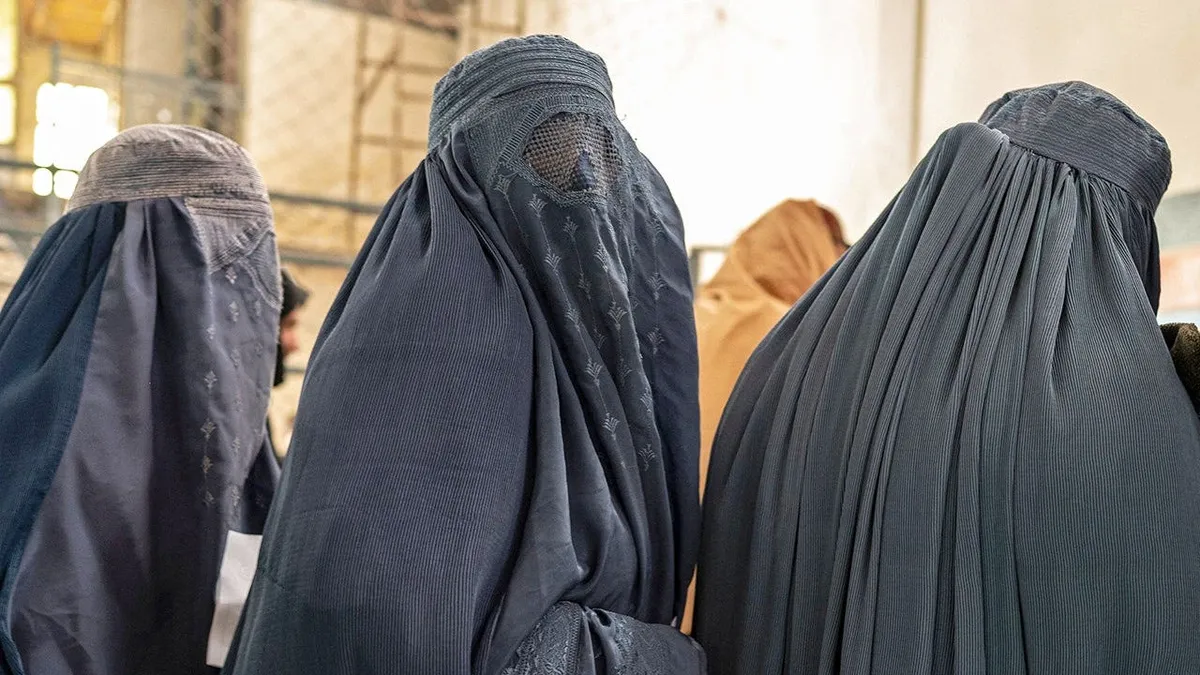
Portuguese President António José Seguro has enacted a measure that largely prohibits individuals from covering up their faces while out in public, a restriction broadly viewed as aimed at Muslim women, according to AFP . But the report noted various carve-outs to the prohibition, including for health, professional, artistic or weather-linked issues and for when people are at locations of worship, diplomatic missions or aboard planes. Those who fail to comply could be slapped with fines of 150 euros to 3,000 euros, according to the outlet. Those figures convert to around $175 and $3,500. MS RACHEL POSTS SUPPORT FOR HIJAB-WEARING KINDERGARTNERS AFTER TRUMP POST The final edition of the measure, which has been characterized by local media as the "burqa law" in reference to the body and face covering that some Muslim women wear, was adopted by the Portuguese parliament last month, according to AFP. The law bans sporting coverings meant to hide a person's face or block identification in public areas and bans requiring someone to cloak their face due to gender, religion , age or origin, the report states. EL-SAYED BOOKED FOR MAJOR ISLAMIC CONVENTION ALONGSIDE CLERICS WITH RADICAL PASTS "For the president of the republic, the uncovered face constitutes a structuring dimension of social trust, a characteristic of Portuguese society," according to an English translation of a Portuguese-language press release . "Social integration, non-discrimination based on gender and the security resulting from similar decisions by the European Court of Human Rights underpin this decision. The president of the republic shares this court's conviction that the face is central to human identity and communication, serving as a minimum element for mutual recognition among fellow citizens. PASTOR UNLEASHES ON DEARBORN AS RELIGIOUS TENSIONS ERUPT AT CITY COUNCIL MEETING: 'ENOUGH IS ENOUGH' "And to admit that women, and only women, must hide their entire faces implies an asymmetry incompatible with the values of parity and equal dignity between men and women, values that shape European democracies," the release added.
SRCFox News - World
LANGEN
LEANCenter-Right
WORDS329
ENT8
FRI · 2026-08-21 · 18:13 GMTBRIEF NSR-2026-0821-104669
NSR-2026-0821-104669News Report·EN·Human Rights
Portugal enacts 'burqa law' largely prohibiting face coverings in public
Portugal has enacted a law largely prohibiting face coverings in public, a measure widely seen as targeting Muslim women. The law, characterized as the "burqa law," bans coverings that hide a person's face or impede identification in public areas.
Fox News - WorldFiled 2026-08-21 · 18:13 GMTLean · Center-RightRead · 2 min
Fox News - WorldFIG 01
Reading time
2min
Word count
329words
Sources cited
2cited
Entities identified
8entities
Quality score
100%
§ 01
Briefing Summary
AI-generatedNEWSAR · AI
Portugal has enacted a law largely prohibiting face coverings in public, a measure widely seen as targeting Muslim women. The law, characterized as the "burqa law," bans coverings that hide a person's face or impede identification in public areas. However, exceptions exist for health, professional, artistic, or weather-related reasons, as well as in places of worship, diplomatic missions, and on planes. Non-compliance can result in fines ranging from 150 to 3,000 euros. Portuguese President António José Seguro stated the decision is based on the importance of the uncovered face for social trust, integration, non-discrimination, and mutual recognition, aligning with European Court of Human Rights convictions.
Confidence 0.90Sources 2Claims 5Entities 8
§ 02
Article analysis
Model · rule-basedFraming
Human Rights
Social Justice
Tone
Measured
AI-assessed
CalmNeutralAlarmist
Factuality
0.80 / 1.00
Factual
LowHigh
Sources cited
2
Limited
FewMany
§ 03
Key claims
5 extracted01
The law bans requiring women to hide their entire faces, deeming it incompatible with parity and equal dignity.
quotePortuguese President António José Seguro
Confidence
1.00
02
The uncovered face is a structuring dimension of social trust and a characteristic of Portuguese society.
quotePortuguese President António José Seguro
Confidence
1.00
03
Non-compliance can result in fines of 150 euros to 3,000 euros.
factualAFP
Confidence
1.00
04
The law includes carve-outs for health, professional, artistic, weather, places of worship, diplomatic missions, and aboard planes.
factualAFP
Confidence
1.00
05
Portugal enacted a law largely prohibiting face coverings in public.
factualAFP
Confidence
1.00
§ 04
Full report
2 min read · 329 words§ 05
Entities
8 identifiedKey playerOppositionContextPositiveNeutralNegative
Organizations3
Topics1
§ 06
Keywords & salience
9 termsface coverings
1.00
burqa law
0.90
public prohibition
0.80
muslim women
0.70
gender discrimination
0.60
social trust
0.60
human identity
0.50
european democracies
0.40
portugal
0.40
§ 07
Topic connections
Interactive graph Network visualization showing 44 related topics
View Full Graph Person Organization Location Event|Click node to navigate|Edge numbers = shared articles