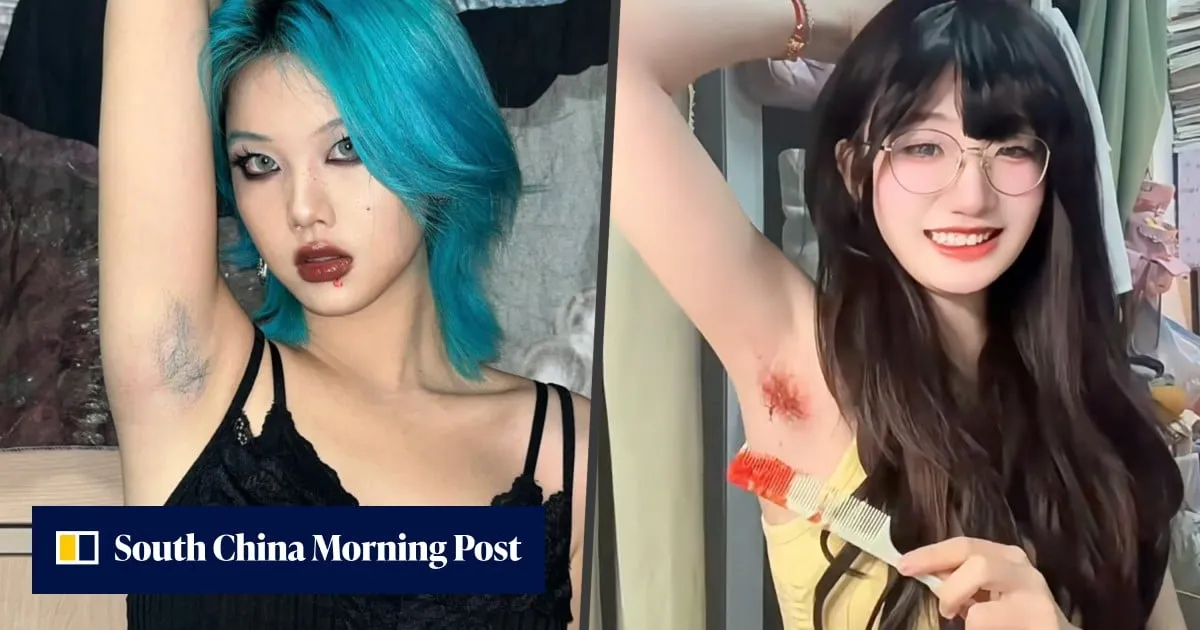
Some young women in China are dyeing their armpit hair, transforming a once-stigmatised trait into both a fashion statement and an assertion of bodily autonomy.The trend is not without precedent. Lady Gaga made headlines with green underarm hair in 2011, while brightly dyed armpit hair and “glitter pits” – underarms embellished with glitter – have since surfaced on social media worldwide.In recent years, Chinese social media has played a pivotal role in popularising the trend among younger demographics. On RedNote, the nation’s favoured lifestyle platform, users showcase their underarm hair in eye-catching colours.Some proudly display their newly dyed blue armpit hair, while others share tutorials detailing the bleaching and colouring processes. Additionally, there are cautionary posts highlighting potential risks, from skin irritation to rapid colour fading.Xiaokui, a pseudonymous young woman, recounted her discomfort with armpit hair from primary school when a friend questioned the hair growing under her arms. This remark left her feeling profoundly embarrassed.The global shift traces back to Lady Gaga’s iconic green underarms at the 2011 MuchMusic Video Awards, a watershed moment for unconventional self-expression. Photo: George Pimentel/WireImageAccording to the mainland media outlet 36Kr, this incident intensified her negative view of underarm hair as “unattractive, dirty, and smelly.”She removed it for years until an influencer sporting dragon-fruit-pink armpit hair inspired her to try something new. Xiaokui dyed her hair blonde and shared the results online, receiving praise from friends that significantly boosted her body confidence.Another woman, Shanshan, was inspired to dye her armpit hair yellow after seeing Lady Gaga’s green underarm hair. Reports indicate that each of her three dye jobs brought her closer to fully embracing her authentic self.In China, the stigma surrounding armpit hair developed relatively recently.Traditional Confucian thought emphasises that “the body is received from one’s parents,” discouraging casual alteration. Song dynasty (960–1279) paintings frequently depicted women with openly visible underarms.This modern trend directly subverts traditional Confucian beliefs, which dictate that since the body is a gift from one’s parents, it should remain unaltered. Photo: QQ.comMoreover, visible armpit hair was not uncommon in films. In Ang Lee’s film Lust, Caution, actress Tang Wei appears elegantly in a qipao, showcasing her natural underarm hair – a detail that startled some viewers.Further ReadingTo more accurately reflect the beauty standards of 1930s Shanghai, Tang reportedly allowed her armpit hair to grow out for eight months before filming.Some cultural studies scholars suggest that China’s “armpit-hair shame” may be an imported phenomenon.As Western films, television shows, and fashion magazines gained traction in China during the 1980s and 1990s, an aesthetic ideal emerged that equated femininity with smooth, hairless skin. Advertising for razors and other depilatory products further solidified this norm.Across RedNote and Weibo, hair-dye tutorials now share digital space with viral feminist campaigns challenging traditional beauty standards. Photo: QQ.comIn recent years, however, that conventional thinking has begun to wane. The global body-positivity movement has fostered greater acceptance of natural features, including body hair, body shape, and skin conditions.In China, social media has amplified discussions surrounding bodily autonomy, creating a fertile environment for the dyed-armpit-hair trend.As one online observer aptly noted: “Dyeing armpit hair has never been about ‘shame,’ but about ‘choice.’ Some remove it, some keep it, and some dye it. Ultimately, what a woman’s armpits look like should be her decision.”
SRCSouth China Morning Post
LANGEN
LEANCenter-Right
WORDS543
ENT10
SAT · 2026-08-22 · 01:00 GMTBRIEF NSR-2026-0822-104720
NSR-2026-0822-104720News Report·EN·Human Interest
Young Chinese women dye armpit hair as fashion statement and expression of bodily autonomy
Young women in China are dyeing their armpit hair as a fashion statement and an expression of bodily autonomy, a trend popularized on Chinese social media platforms like RedNote. This practice challenges historical stigmas and recent Western-influenced beauty standards that promoted hair removal.
Zoey ZhangSouth China Morning PostFiled 2026-08-22 · 01:00 GMTLean · Center-RightRead · 3 min
South China Morning PostFIG 01
Reading time
3min
Word count
543words
Sources cited
3cited
Entities identified
10entities
Quality score
100%
§ 01
Briefing Summary
AI-generatedNEWSAR · AI
Young women in China are dyeing their armpit hair as a fashion statement and an expression of bodily autonomy, a trend popularized on Chinese social media platforms like RedNote. This practice challenges historical stigmas and recent Western-influenced beauty standards that promoted hair removal. Inspired by global figures like Lady Gaga and social media influencers, Chinese women are using vibrant colors to embrace their natural features. The movement reflects a broader global body-positivity trend and a growing emphasis on individual choice regarding personal appearance, with online discussions highlighting that the decision to dye armpit hair is about "choice" rather than "shame."
Confidence 0.90Sources 3Claims 5Entities 10
§ 02
Article analysis
Model · rule-basedFraming
Human Interest
Social Justice
Tone
Measured
AI-assessed
CalmNeutralAlarmist
Factuality
0.60 / 1.00
Mixed
LowHigh
Sources cited
3
Well sourced
FewMany
§ 03
Key claims
5 extracted01
Traditional Confucian thought emphasizes not altering the body, which is received from parents.
factual
Confidence
0.90
02
Lady Gaga popularized brightly dyed armpit hair and 'glitter pits' on social media starting in 2011.
factual
Confidence
0.90
03
Young women in China are dyeing their armpit hair as a fashion statement and an expression of bodily autonomy.
factual
Confidence
0.90
04
Chinese social media platforms like RedNote are key to the trend's popularity among younger demographics.
factual
Confidence
0.80
05
The stigma surrounding visible armpit hair in China may be a recent, imported phenomenon influenced by Western media.
factual
Confidence
0.70
§ 04
Full report
3 min read · 543 words§ 05
Entities
10 identifiedKey playerOppositionContextPositiveNeutralNegative
Organizations2
Locations1
§ 06
Keywords & salience
8 termsarmpit hair
1.00
bodily autonomy
1.00
fashion statement
0.90
self-expression
0.80
china
0.70
social media
0.60
confucian beliefs
0.50
lady gaga
0.40
§ 07
Topic connections
Interactive graph Network visualization showing 51 related topics
View Full Graph Person Organization Location Event|Click node to navigate|Edge numbers = shared articles