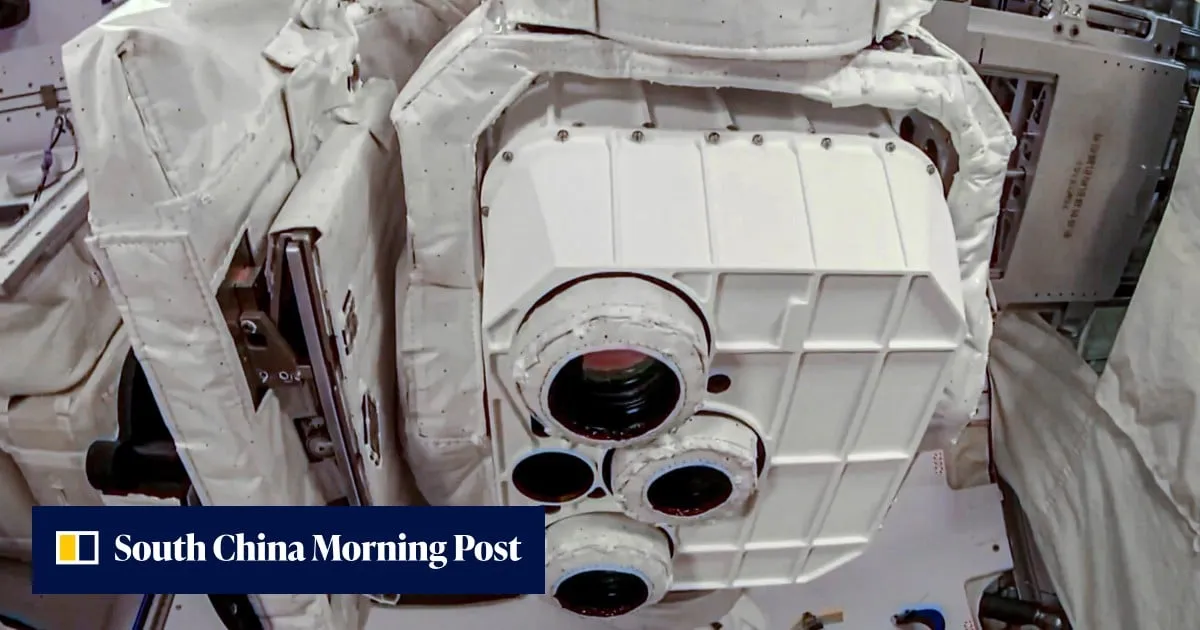
A greenhouse gas monitoring instrument developed by a university in Hong Kong is operating successfully aboard Tiangong space station and is expected to contribute to sustainable development, the city’s technology minister has said.Secretary for Innovation, Technology and Industries Sun Dong also revealed more details on Saturday about the life of the city’s first astronaut, Lai Ka-ying, who he said had a tight schedule at the space station.In his web blog, Sun said the Multi‑Spectral Imaging Carbon Observatory (MUSICO), developed by a team led by scientists at the Hong Kong University of Science and Technology and funded by the city government, had been deployed to China’s Tiangong space station.“The four sensors of MUSICO to detect carbon dioxide, methane, oxygen and aerosol had successfully captured images with good clarity and were functioning well,” he said.“The device will provide automatic, controllable and highly accurate greenhouse gas – carbon dioxide and methane – emission monitoring data in the coming two years or even longer, contributing to the world’s response to climate change and sustainable development.”MUSICO is considered the world’s first lightweight, high-resolution, high-precision synergistic observatory for the two gases.
SRCSouth China Morning Post
LANGEN
LEANCenter-Right
WORDS185
ENT12
SAT · 2026-08-22 · 11:22 GMTBRIEF NSR-2026-0822-104822
NSR-2026-0822-104822News Report·EN·Technology
Hong Kong-built greenhouse gas tracker device ‘functioning well’ on space station
A greenhouse gas monitoring instrument named MUSICO, developed by the Hong Kong University of Science and Technology with government funding, is successfully operating on China's Tiangong space station. The device, described as the world's first lightweight, high-resolution observatory for carbon dioxide and methane, has had its four sensors capture clear images and is functioning well.
Leopold ChenSouth China Morning PostFiled 2026-08-22 · 11:22 GMTLean · Center-RightRead · 1 min
South China Morning PostFIG 01
Reading time
1min
Word count
185words
Sources cited
1cited
Entities identified
12entities
Quality score
100%
§ 01
Briefing Summary
AI-generatedNEWSAR · AI
A greenhouse gas monitoring instrument named MUSICO, developed by the Hong Kong University of Science and Technology with government funding, is successfully operating on China's Tiangong space station. The device, described as the world's first lightweight, high-resolution observatory for carbon dioxide and methane, has had its four sensors capture clear images and is functioning well. Hong Kong's Secretary for Innovation, Technology and Industries, Sun Dong, stated that MUSICO will provide accurate emission monitoring data for the next two years or more. This data is expected to contribute to global efforts in combating climate change and promoting sustainable development. Additionally, Sun Dong shared details about the busy schedule of Hong Kong's first astronaut, Lai Ka-ying, aboard the station.
Confidence 0.90Sources 1Claims 4Entities 12
§ 02
Article analysis
Model · rule-basedFraming
Technology
Environmental
Tone
Measured
AI-assessed
CalmNeutralAlarmist
Factuality
0.80 / 1.00
Factual
LowHigh
Sources cited
1
Limited
FewMany
§ 03
Key claims
4 extracted01
The MUSICO device has four sensors to detect carbon dioxide, methane, oxygen and aerosol and has successfully captured images with good clarity.
factualSun Dong
Confidence
1.00
02
A greenhouse gas monitoring instrument developed by a university in Hong Kong is operating successfully aboard Tiangong space station.
factualcity’s technology minister
Confidence
1.00
03
MUSICO is considered the world’s first lightweight, high-resolution, high-precision synergistic observatory for carbon dioxide and methane.
factualarticle
Confidence
0.90
04
The device will provide automatic, controllable and highly accurate greenhouse gas emission monitoring data in the coming two years or even longer.
predictionSun Dong
Confidence
0.90
§ 04
Full report
1 min read · 185 words§ 05
Entities
12 identifiedKey playerOppositionContextPositiveNeutralNegative
Locations3
§ 06
Keywords & salience
10 termsgreenhouse gas
1.00
space station
0.90
musico
0.90
climate change
0.80
sustainable development
0.80
hong kong
0.70
methane
0.60
carbon dioxide
0.60
tiangong space station
0.50
technology minister
0.40
§ 07
Topic connections
Interactive graph Network visualization showing 51 related topics
View Full Graph Person Organization Location Event|Click node to navigate|Edge numbers = shared articles