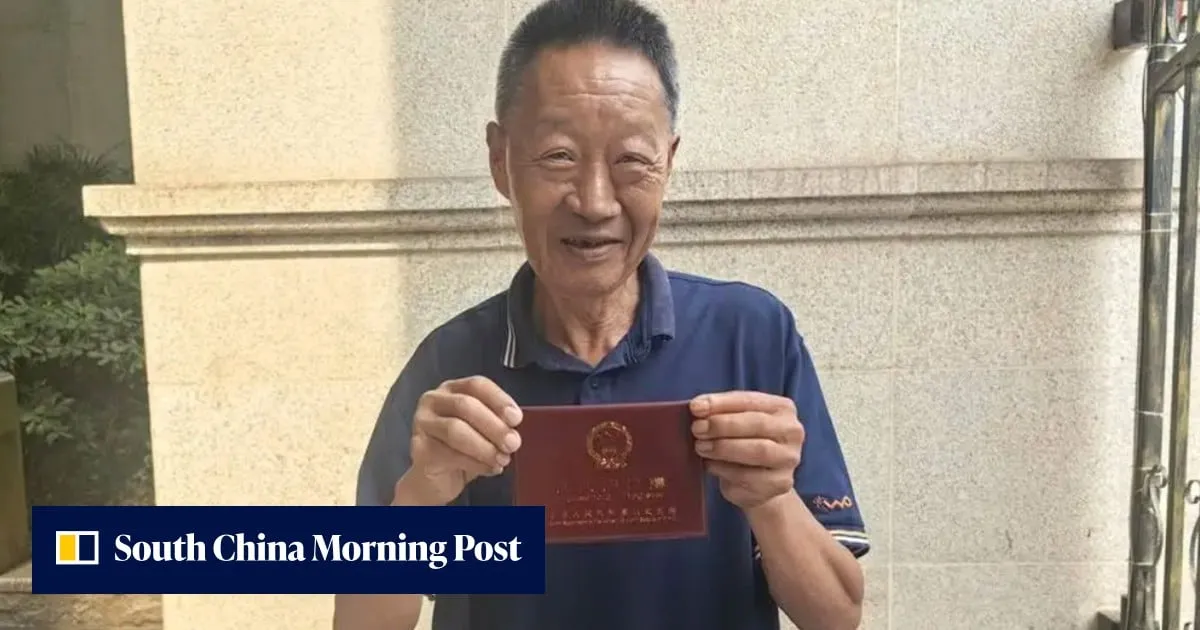
A Chinese man in his 60s has finally reunited with his family after spending 25 years in isolation to care for a house deep in the mountains, even after the owner had forgotten about it.Li Guoyou, 63, recently received his renewed hukou booklet, China’s official household registration, at a police station in Pingtan, a town in southwestern Sichuan province. This marked his official identity registration in his hometown after nearly three decades away.Li left home at the age of 24 in 1987, moving to Guangzhou in southern China in search of better work opportunities. Over time, he gradually lost contact with his two brothers, his only family after their parents died.He returned home once in 1997, but did not meet his brothers, who were both working elsewhere. He left behind a landline number, which his family tried to dial repeatedly in the years that followed, but to no avail.The winter streets of Harbin City are pictured above. In 1998, Li migrated to Harbin, Heilongjiang province's capital, where he met highway restaurant owner Lin and later promised to watch her house. Photo: ShutterstockIn 1998, Li migrated to Harbin, the capital of Heilongjiang province in northern China, where he met a highway restaurant owner named Lin. Lin took Li in as an employee, providing him with a means to make a living.Three years later, the highway closed, and Lin had to shut down her restaurant. Concerned for Li, who would soon be homeless, she asked him to look after her house deep in the mountains, assuring him he could “feel free to leave anytime.”Over the next 25 years, Lin operated businesses in Beijing and even Russia, returning to the mountain house only in May, when she intended to sell it. To her shock, she discovered that Li had remained there, honouring a promise she had long forgotten.“I thought he wouldn’t stay long. It was my one sentence that kept him there,” she admitted, expressing regret.During his time in isolation, Li lived off the land, growing corn, raising livestock, and fishing, with the nearest grocery store a staggering 3 kilometres away.Li’s initial identity card expired in 2005, when China transitioned to second-generation ID cards featuring computer chips and digital encryption. Obtaining the new ID required him to return to his household registration in Sichuan, but he lacked the funds to make the trip.Li’s identity card expired in 2005 when China upgraded to chip-embedded second-generation IDs. He is pictured above going through the new card application process. Photo: thecover.cnWhen Li finally reunited with Lin after 25 years, he expressed his desire to “go home and see my brothers.” Understanding his longing, Lin assisted him in returning home.Further ReadingSince Li did not possess an ID card – necessary for buying train or flight tickets in China’s ID-based booking system – Lin contacted police offices in both Harbin and Pingtan. They helped Li secure a train ticket from Harbin to Chongqing, the municipality neighbouring Sichuan.The journey took 40 hours. Upon arriving in Chongqing, Pingtan police officers and government staff picked Li up and escorted him back home, where he finally reunited with his brothers.The journey took 40 hours. Upon arriving in Chongqing, Pingtan police and government staff escorted Li, second from left, home, where he finally reunited with his brothers. Photo: Dongxing District Public Security BureauLi expressed his intention to move back to his hometown. Lin accompanied him throughout the journey, pleased for his reunion, and vowed to treat him like family, promising to check in on him again soon.“Li is a man of honour. He stayed at the house for 25 years just to keep a promise,” remarked one online observer.“While the cornered man had nowhere to go but the borrowed house, the drifting woman provided him refuge – and in return, he cared for her property. It’s pointless to argue who owes who,” noted another.
SRCSouth China Morning Post
LANGEN
LEANCenter-Right
WORDS641
ENT10
SAT · 2026-08-22 · 10:00 GMTBRIEF NSR-2026-0822-104828
NSR-2026-0822-104828News Report·EN·Human Interest
Chinese man reunites with family after 25 years in total isolation to honour a promise
Li Guoyou, a 63-year-old Chinese man, has reunited with his family after 25 years of isolation. In 1998, he promised to care for a house in the mountains for a restaurant owner named Lin.
Fran LuSouth China Morning PostFiled 2026-08-22 · 10:00 GMTLean · Center-RightRead · 3 min
South China Morning PostFIG 01
Reading time
3min
Word count
641words
Sources cited
2cited
Entities identified
10entities
Quality score
100%
§ 01
Briefing Summary
AI-generatedNEWSAR · AI
Li Guoyou, a 63-year-old Chinese man, has reunited with his family after 25 years of isolation. In 1998, he promised to care for a house in the mountains for a restaurant owner named Lin. He remained there, living off the land, even after Lin moved away and forgot about the arrangement. Li's identity card expired in 2005, preventing him from obtaining a new one due to lack of funds for travel. When Lin returned in May to sell the house, she found Li still there. Lin helped Li obtain a train ticket and police escorted him back to his hometown in Sichuan province, where he reunited with his brothers. Li intends to move back home.
Confidence 0.90Sources 2Claims 5Entities 10
§ 02
Article analysis
Model · rule-basedFraming
Human Interest
Legal & Judicial
Tone
Measured
AI-assessed
CalmNeutralAlarmist
Factuality
0.80 / 1.00
Factual
LowHigh
Sources cited
2
Limited
FewMany
§ 03
Key claims
5 extracted01
Li's initial identity card expired in 2005, preventing him from buying travel tickets without a new one.
factual
Confidence
1.00
02
Lin expressed regret, stating, 'I thought he wouldn’t stay long. It was my one sentence that kept him there.'
quoteLin
Confidence
1.00
03
In 1998, Li migrated to Harbin and promised to watch a house for restaurant owner Lin.
factual
Confidence
1.00
04
Li left home at 24 in 1987, lost contact with his brothers, and returned once in 1997 without meeting them.
factual
Confidence
1.00
05
Li Guoyou, 63, reunited with family after 25 years of isolation caring for a house.
factual
Confidence
1.00
§ 04
Full report
3 min read · 641 words§ 05
Entities
10 identifiedKey playerOppositionContextPositiveNeutralNegative
§ 06
Keywords & salience
10 termsisolation
1.00
reunification
1.00
honouring a promise
0.90
family reunion
0.90
household registration
0.80
identity card
0.70
rural living
0.60
long-term commitment
0.50
sichuan province
0.40
heilongjiang province
0.40
§ 07
Topic connections
Interactive graph No topic relationship data available yet. This graph will appear once topic relationships have been computed.