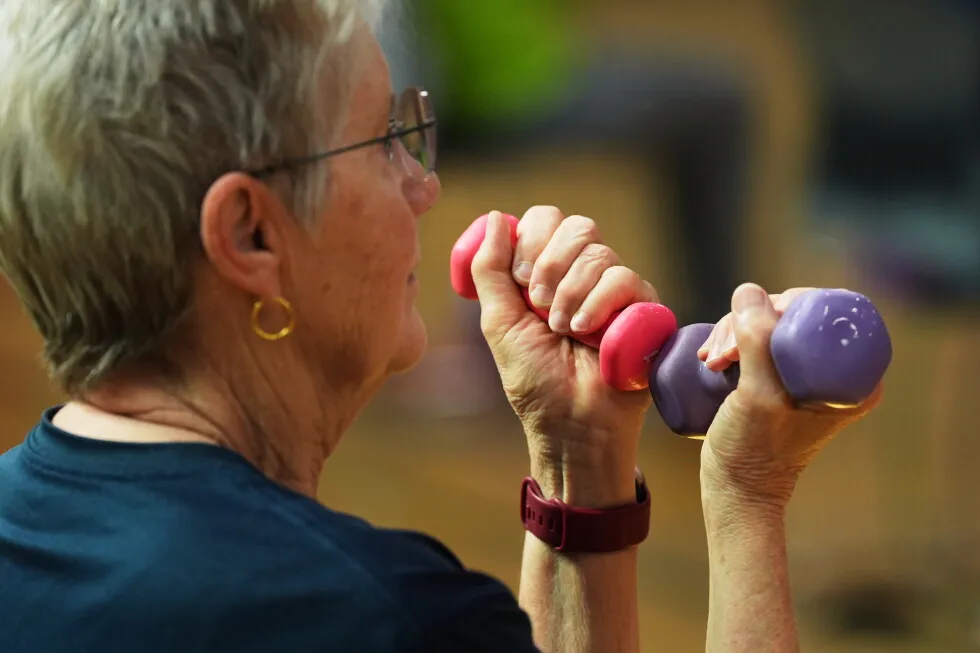
A participant uses light weights during a class for older adults at the Dale Turner Family YMCA in Shoreline, Wash., April 30, 2026. (AP Photo/Lindsey Wasson, File) By Devi Shastri Updated 2:41 PM MESZ, August 22, 2026 Add AP News on Google Add AP News as your preferred source to see more of our stories on Google. Share Share Facebook Copy Link copied Print Email X LinkedIn Bluesky Flipboard Pinterest Reddit Hand grip strength. Balance tests. Standing up from a seated position on the floor. These physical challenges are often touted as measurements of healthy aging and even predictors of longevity. They can provide valuable indications of your stamina and strength. They can estimate the risk of falls, which increase older adults ' risk of death. And they’re useful to doctors who work to address aging or people with injuries. “A poor or declining result is a reason for a health professional to investigate why function is changing, rather than gauging how long someone will live,” said Auriel Willette, an expert on brain aging at Rutgers University. Here’s a look at what mobility tests entail and how to apply the results to your health. “Sit-to-stand” tests come in several forms. The U.S. Centers for Disease Control and Prevention’s 30-second chair-stand test is designed for patients older than 60, to see how many times they can stand up in that time period. Another test, popularized on social media, asks someone to move from standing, to sitting cross-legged on the ground, and then back up to standing. Making your way down to the floor is worth 5 points, as is standing up, for a total score of 10. You lose a point for each support you use (such as a hand or knee) and half a point if you’re unsteady. The score is zero if you’re unable to sit or stand without external help. Doctors said they haven’t seen the test used with older U.S. adults, but researchers in Brazil published studies in 2020 and 2025 that concluded middle-aged people who scored higher were less likely to die within about a decade. Many American doctors use a test called “Timed Up and Go,” or TUG. It requires the patient to get up from a chair, walk 10 feet (3 meters) and come back to their seat. That allows doctors to evaluate a person’s balance, mobility and lower extremity strength all at once. More from Be Well Autoimmune diseases can strike any part of the body, and mostly affect women. Here’s what to know 14 Calisthenics are making a comeback. Is body weight enough to get a good workout? 24 Gut microbiome tests are everywhere. Should you get one? 14 Dr. George Hennawi, who treats older adults at MedStar health in Baltimore, said all the tests are meant to pinpoint specific weaknesses and narrow down their underlying cause, whether that’s knee pain, slow reflexes, poor balance or feeling winded or dizzy because of cardiovascular issues. “The key to react to it is to understand where did we not do well,” he said. Tests like the viral sit-to-stand one are what doctors call screening tools. They’re helpful in narrowing down issues, but they don’t provide enough information for a full diagnosis. Other popular tests for a person’s “physiological age,” or how your body is aging, include tests of grip strength, walking speed, gait steadiness and balance. Such tests look at how hard your hand can squeeze something, whether you favor one side while walking, how long and well can you stand on one leg and how far forward can you reach without becoming unsteady. Many doctors also use these challenges to understand a person’s risk for “frailty,” a medical condition that means the body is less able to handle strain from illness or injury. Doctors sometimes use a 10-minute assessment called the Short Physical Performance Battery, which includes several tests including gait, balance and strength. It was developed by the National Institute on Aging and large clinical trials have shown it predicts mortality, disability and more. At the University of California, Los Angeles’ Multidisciplinary Falls Clinic, Dr. David Lee said it’s important to look across multiple tests in combination. Grip strength, for example, is predictive of many different things, but it can be affected by arthritis, stroke or even simply not conditioning those muscles. Experts note that strength and mobility are just one part of healthy aging. Tests of cognition, memory, hearing, eyesight and many other measures are key to evaluating how someone is aging. They also cautioned against training to pass a test. Instead, keep the big picture in mind. Exercise your whole body. Eat nutritious meals. Address stress in a healthy way. Prioritize your sleep. Take care of your heart. Finally, experts said it’s important to know the context in which a test has been studied and verified. If it’s shown to predict an outcome for one age group, the performance standards won’t necessarily apply to others. If you score poorly in a mobility test and are concerned about your fall risk, or have recently fallen, talk to your doctor. The test results are the first step in determining if you need an assistive device, physical therapy, a change in medications or something else, said Emily Nabors, a falls prevention expert with The National Council on Aging. She cited one estimate that more than a quarter of older adults fall each year, but most of them don’t tell their doctor about it. “If you’ve fallen, you might feel fine,” she said, “but you might not be fine at all.” The Associated Press health and Science Department receives support from the Howard Hughes Medical Institute’s Department of Science Education and the Robert Wood Johnson Foundation. The AP is solely responsible for all content. Devi Shastri Shastri is a public health reporter for The Associated Press, based in Milwaukee. She covers housing access, the social safety net, medical misinformation and other topics that influence the health of communities broadly. twitter mailto
SRCAssociated Press (AP)
LANGEN
LEANCenter
WORDS997
ENT10
SAT · 2026-08-22 · 12:53 GMTBRIEF NSR-2026-0822-104848
NSR-2026-0822-104848News Report·EN·Public Health
Mobility tests can offer insights, but they aren’t a crystal ball
Mobility tests like the sit-to-stand and Timed Up and Go (TUG) can offer valuable insights into stamina, strength, and fall risk in older adults. While these tests can help healthcare professionals identify specific weaknesses and investigate underlying causes, they are not definitive predictors of longevity.
Associated Press (AP)Filed 2026-08-22 · 12:53 GMTLean · CenterRead · 4 min
Associated Press (AP)FIG 01
Reading time
4min
Word count
997words
Sources cited
2cited
Entities identified
10entities
Quality score
100%
§ 01
Briefing Summary
AI-generatedNEWSAR · AI
Mobility tests like the sit-to-stand and Timed Up and Go (TUG) can offer valuable insights into stamina, strength, and fall risk in older adults. While these tests can help healthcare professionals identify specific weaknesses and investigate underlying causes, they are not definitive predictors of longevity. Experts emphasize that poor or declining results warrant further investigation by health professionals rather than being used to gauge lifespan. These tests are screening tools that help pinpoint issues but do not provide a complete health diagnosis. For a comprehensive understanding of aging, it is important to consider a range of factors beyond physical mobility, including cognition, memory, and overall lifestyle.
Confidence 0.90Sources 2Claims 5Entities 10
§ 02
Article analysis
Model · rule-basedFraming
Public Health
Human Interest
Tone
Measured
AI-assessed
CalmNeutralAlarmist
Factuality
0.70 / 1.00
Factual
LowHigh
Sources cited
2
Limited
FewMany
§ 03
Key claims
5 extracted01
Mobility tests are meant to pinpoint specific weaknesses and narrow down their underlying cause.
quoteDr. George Hennawi
Confidence
1.00
02
A poor or declining mobility test result is a reason for a health professional to investigate why function is changing.
quoteAuriel Willette
Confidence
1.00
03
The Timed Up and Go (TUG) test evaluates a person’s balance, mobility, and lower extremity strength.
factual
Confidence
0.90
04
Mobility tests can provide valuable indications of stamina and strength, and estimate the risk of falls in older adults.
factual
Confidence
0.90
05
Middle-aged people who scored higher on a sit-to-stand test were less likely to die within about a decade, according to Brazilian studies.
statisticresearchers in Brazil
Confidence
0.80
§ 04
Full report
4 min read · 997 words§ 05
Entities
10 identifiedKey playerOppositionContextPositiveNeutralNegative
People3
Organizations3
Topics1
§ 06
Keywords & salience
10 termsmobility tests
1.00
healthy aging
0.90
physical challenges
0.80
risk of falls
0.70
sit-to-stand test
0.60
timed up and go
0.60
hand grip strength
0.50
balance tests
0.50
health professional
0.40
older adults
0.40
§ 07
Topic connections
Interactive graph Network visualization showing 51 related topics
View Full Graph Person Organization Location Event|Click node to navigate|Edge numbers = shared articles