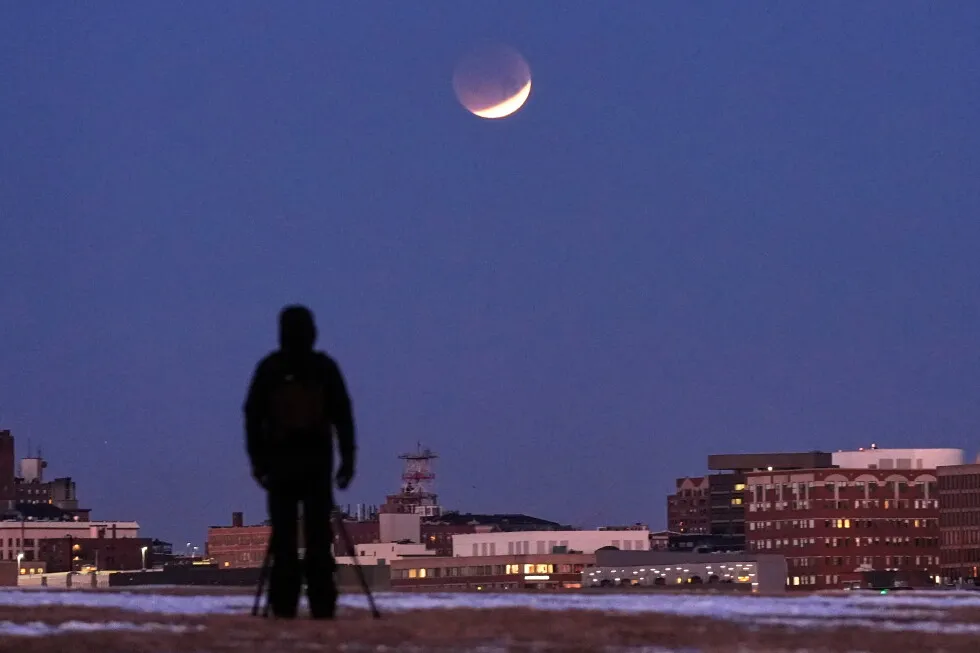
A man views the lunar eclipse, Tuesday, March 3, 2026, in South Portland, Maine. (AP Photo/Robert F. Bukaty, File) Updated [hour]:[minute] [AMPM] [timezone], [monthFull] [day], [year] CAPE CANAVERAL, Fla. (AP) — Now it’s the Moon’s turn to pull a disappearing act.After being shut out of this month’s total solar eclipse, the Americas will have the best seats in the celestial house when Earth’s shadow briefly envelops the Moon. Almost the entire lunar surface will be masked Thursday night into Friday — a whopping 96% — making this an especially deep partial eclipse.The Moon is already in the spotlight. NASA sent the Artemis II astronauts on a record-breaking lunar flyby in April, the prelude to eventually landing on the surface and building a base swarming with people and robots over the next several years.“This is a great time to be part of the space program, right? We’re not slowing down,” NASA astronaut Jack Hathaway told The Associated Press from the International Space Station last week.It’s the second act of the greatest show in the solar system, coming two weeks after a total solar eclipse paraded through Greenland, Iceland and Spain. Eclipses always travel in pairs as the sun, Moon and Earth align so precisely that one obscures the other. That’s because the Moon is 400 times smaller than the sun, which is 400 times farther away, making them appear the same size — a cosmic coincidence and gift from the universe.Unfolding at a more leisurely pace, the upcoming lunar eclipse will have a much bigger audience than Europe’s solar show. The eclipsed Moon will be visible to billions across North and South America, Europe, Africa and the Middle East, provided the skies are clear. 2 MIN READ 2 MIN READ 1 MIN READ The lunar eclipse may also be visible to Hathaway and the nine other people living off the planet — seven astronauts at the International Space Station and three aboard China’s orbiting outpost. Space provides a “unique perspective” for viewing cosmic wonders like eclipses and auroras, said the space station’s commander, Jessica Meir.In this case, Earth will pass between the Moon and the sun, casting a reddish-orange shadow onto our closest neighbor. Because this is a partial eclipse, the lineup won’t be perfect and it won’t be a true blood Moon. The partial phase of the eclipse will last more than three hours. But the entire eclipse, from the time the full Moon enters the faintest, outermost edge of Earth’s shadow until it leaves, will stretch 5 ½ hours. The eclipse will peak just after midnight EDT.Nearly 1 billion people in the U.S., Canada, and Central and South America will have front-row views for the entire eclipse. More than 3 billion people — 44% of the world’s population — will be in position to catch at least part of it.The eclipsed Moon will be setting in Europe, Africa and the Middle East, cutting the show short. It will be rising in Hawaii, getting the eastern Pacific off to a late start along with northwestern sections of the U.S. and Canada.This is the year’s second lunar eclipse and the fourth eclipse overall. A total lunar eclipse graced the skies over the Americas, Australia and eastern Asia in March. The next complete lunar blackout won’t be until New Year’s Eve 2028, with Asia and Australia at center stage. And it will be 2029 before stargazers across North and South America are treated to another full eclipse of the Moon.___The Associated Press Health and Science Department receives support from the Howard Hughes Medical Institute’s Department of Science Education and the Robert Wood Johnson Foundation. The AP is solely responsible for all content.
SRCAssociated Press (AP)
LANGEN
LEANCenter
WORDS610
ENT12
SAT · 2026-08-22 · 12:23 GMTBRIEF NSR-2026-0822-104849
NSR-2026-0822-104849News Report·EN·Human Interest
Near-total lunar eclipse is coming up with the Americas in prime position
A deep partial lunar eclipse, obscuring 96% of the moon's surface, will be visible across the Americas, Europe, Africa, and the Middle East on Thursday night into Friday. This event follows a recent total solar eclipse and is part of a pair of eclipses due to the precise alignment of the sun, moon, and Earth.
By
MARCIA DUNNAssociated Press (AP)Filed 2026-08-22 · 12:23 GMTLean · CenterRead · 3 min
Associated Press (AP)FIG 01
Reading time
3min
Word count
610words
Sources cited
2cited
Entities identified
12entities
Quality score
100%
§ 01
Briefing Summary
AI-generatedNEWSAR · AI
A deep partial lunar eclipse, obscuring 96% of the moon's surface, will be visible across the Americas, Europe, Africa, and the Middle East on Thursday night into Friday. This event follows a recent total solar eclipse and is part of a pair of eclipses due to the precise alignment of the sun, moon, and Earth. While not a total "blood moon," the partial phase will last over three hours, with the entire eclipse spanning 5.5 hours. Nearly a billion people in North and Central America will have prime viewing for the full event, with billions more able to see at least part of it. This is the second lunar eclipse of the year, and the next total lunar eclipse visible in the Americas won't occur until 2029.
Confidence 0.90Sources 2Claims 5Entities 12
§ 02
Article analysis
Model · rule-basedFraming
Human Interest
Technology
Tone
Measured
AI-assessed
CalmNeutralAlarmist
Factuality
0.80 / 1.00
Factual
LowHigh
Sources cited
2
Limited
FewMany
§ 03
Key claims
5 extracted01
More than 3 billion people (44% of the world's population) will be able to see at least part of the eclipse.
statistic
Confidence
1.00
02
Nearly 1 billion people in the U.S., Canada, and Central and South America will have front-row views for the entire eclipse.
statistic
Confidence
1.00
03
The partial phase of the eclipse will last over three hours, with the entire event stretching 5.5 hours.
factual
Confidence
1.00
04
The Americas will have the best viewing position for the lunar eclipse.
factual
Confidence
1.00
05
A near-total lunar eclipse will occur, masking 96% of the lunar surface.
factual
Confidence
1.00
§ 04
Full report
3 min read · 610 words§ 05
Entities
12 identifiedKey playerOppositionContextPositiveNeutralNegative
Organizations1
Locations9
§ 06
Keywords & salience
8 termslunar eclipse
1.00
solar eclipse
0.70
earth's shadow
0.60
celestial house
0.50
space program
0.50
international space station
0.40
artemis ii
0.40
cosmic coincidence
0.40
§ 07
Topic connections
Interactive graph Network visualization showing 21 related topics
View Full Graph Person Organization Location Event|Click node to navigate|Edge numbers = shared articles