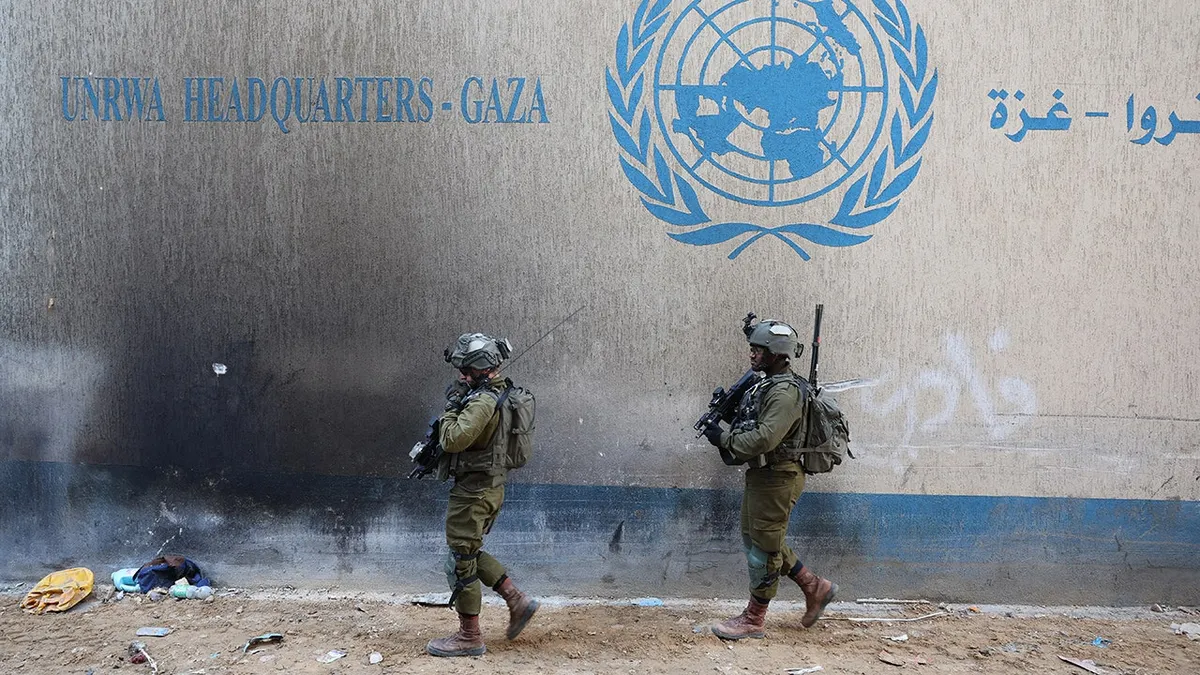
EXCLUSIVE: As Israeli bulldozers razed structures at the UNRWA headquarters on Tuesday after Israel enacted legislation last year banning the agency’s operations on Israeli territory, a new documentary sheds light on the controversial U.N. agency for its close relationship with Hamas terrorists, and its lax controls of allowing antisemitism to be taught to generations of its students. UNRWA Commissioner-General Philippe Lazzarini condemned the move against the UNRWA buildings, calling it a violation of international law, while Israeli officials said the compound had not been in active use and that the demolition was carried out in accordance with Israeli law. The development comes weeks after the United Nations General Assembly voted to renew UNRWA’s mandate through 2029, despite growing opposition and abstentions from several Western countries. The renewal followed months of controversy surrounding the agency after Israeli authorities provided videos that show UNRWA employees participating in the Hamas-led Oct. 7, 2023 massacre. Those allegations remain under investigation, and UNRWA has said it dismissed several staff members following the claims. TRUMP ADMIN WEIGHS TERRORISM SANCTIONS AGAINST UN PALESTINIAN AID AGENCY OVER Hamas ALLEGATIONS During the war in Gaza, the Israeli military has also discovered weapons, tunnel shafts and other Hamas infrastructure in UNRWA facilities, including schools. Fox News Digital reported last week that UNRWA USA acknowledged reports that the Trump administration is considering designating UNRWA as a foreign terrorist organization and that agency officials urged congressional staffers to oppose the move. Last October, Secretary of State Marco Rubio, talking to reporters in Israel, reiterated the Trump administration's policy to the U.N. and UNRWA. "The United Nations is here. They’re on the ground. We’re willing to work with them if they can make it work, but not UNRWA. UNRWA became a subsidiary of Hamas." The new documentary titled "UNraveling UNRWA" is now drawing renewed attention to the agency’s structure, history and political role. The film examines UNRWA from its establishment in 1949 to its operations today. It features interviews with refugees, Arab and Israeli voices, as well as former UNRWA officials. Participants in the film argue that UNRWA has long promoted U.N. General Assembly Resolution 194, a 1948 measure Palestinians interpret as granting refugees and their descendants the right to return to homes inside Israel, an idea the documentary shows has helped perpetuate refugee status rather than resolve it. Zlatko Zigic, former director of the U.N. migration agency from 1997 to 2017, says in the film that "the problem of UNRWA is the concept of endless struggle of Palestinians to return," adding that maintaining a right of return to Israel has "become a tool to perpetuate the conflict." The documentary also includes scenes filmed inside UNRWA schools, showing classroom lessons in which children are taught that they will one day return to land inside Israel. In one scene presented in the film, Jews are referred to as "the wolves," and a teacher asks elementary school students, "What did the Jews do to us?" before telling them they were expelled and deported, that their families were killed, and they should be grateful to UNRWA, who built refugee camps for them. In an interview with Fox News Digital, former UNRWA legal adviser James Lindsay, who also appears in the film, said that dynamic lies at the heart of what he believes is a systemic problem. "The main problem in oversight has to do, I’m pretty sure, likely at the ground level where the local authorities, in this case we’re talking about Gaza, so we’re talking about Hamas, " Lindsay said. "The people who work for UNRWA are subject, yes, to UNRWA, but they are even more importantly subject to the local authorities," in this case Hamas. RUBIO SLAMS UNRWA AS A 'SUBSIDIARY OF Hamas,' VOWS IT WILL NOT 'PLAY ANY ROLE' IN DELIVERING AID TO GAZA Lindsay said that while donor governments may see detailed paperwork and reporting, the reality on the ground can look very different. He said UNRWA leadership historically did not attempt to bar Hamas members from employment, arguing that the organization viewed Hamas as part of Palestinian political life. "UNRWA has made no effort to keep Hamas out," Lindsay said. "The position for the commissioners-general has been that UNRWA does not have a problem with Hamas." He described an environment in which local staff and contractors faced severe pressure from Hamas, creating incentives to comply with demands rather than risk retaliation. Israel SAYS UN MISLEADS WORLD AS GAZA AID STOLEN AND DIVERTED FROM CIVILIANS "If Hamas comes to you and says, we would like maybe 5% of the concrete you’re using, or maybe you need to show 5% more food was distributed than actually was, you’re not going to say no," he said. "If you don’t do what Hamas says, you’re not going to get fired. You’re going to have very bad things happen to you." Lindsay said those realities rarely reach senior international staff, who make up only a small fraction of UNRWA’s workforce in Gaza. "In Gaza you’re talking about maybe 12,000 -13,000 total staff members, of whom maybe 25 are actual internationals," he said. He said that over time, many humanitarian workers developed what the U.S. State Department refers to as "clientitis," a phenomenon in which aid organizations begin to identify politically with the populations they serve. "Humanitarian organizations have begun to identify with the people to whom they’re providing humanitarian aid," Lindsay said. "In that case, that means identifying with one strain of the Palestinian political scene, which is Hamas." Lindsay said he initially believed UNRWA could be reformed but later concluded the agency’s structure made meaningful reform impossible. "It can’t be reformed in the sense that it’s not allowed to reform by the governmental people in charge," he said. "It’s also difficult to reform UNRWA because the members of UNRWA have become what the State Department calls clientitis." He also criticized the agency’s handling of educational content, saying teachers in UNRWA schools were subject to the same threats and coercion as other staff. "What are people going to do under a murderous totalitarian government like Hamas?" Lindsay said. "They’re not going to take their chances." Following the General Assembly’s recent vote to renew UNRWA’s mandate, Lindsay said the agency views the outcome as a vote of confidence but noted that opposition is growing. "In 2022, there was one vote against renewing the mandate and 10 abstentions," he said. "Most recently, there were 10 votes against and 18 abstentions. The movement is against UNRWA because of the things that have been brought out over the last few years, particularly since Oct.7 of 2023." He added that while UNRWA enjoys broad support among U.N. member states, those countries are not the agency’s primary funders. "The vast majority of countries in the U.N. are anti-West and are certainly pro-UNRWA," Lindsay said. "But donors are the ones that count because the money all comes from voluntary donations, largely by Western countries, the same countries that are becoming nervous. And that is, I think, a real threat to the continuation of UNRWA."
SRCFox News - World
LANGEN
LEANCenter-Right
WORDS1 171
ENT9
SUN · 2026-01-25 · 17:43 GMTBRIEF NSR-2026-0125-10492
NSR-2026-0125-10492News Report·EN·Political Strategy
How the Oct 7 Hamas terror attacks exposed long-running concerns about UNRWA, new film charges
A new documentary is highlighting concerns about UNRWA's ties to Hamas and alleged antisemitism in its schools, amidst ongoing controversy surrounding the UN agency. This comes as Israel demolished structures at UNRWA's headquarters after banning its operations, citing Israeli law.
Efrat LachterFox News - WorldFiled 2026-01-25 · 17:43 GMTLean · Center-RightRead · 5 min
Fox News - WorldFIG 01
Reading time
5min
Word count
1 171words
Sources cited
5cited
Entities identified
9entities
Quality score
100%
§ 01
Briefing Summary
AI-generatedNEWSAR · AI
A new documentary is highlighting concerns about UNRWA's ties to Hamas and alleged antisemitism in its schools, amidst ongoing controversy surrounding the UN agency. This comes as Israel demolished structures at UNRWA's headquarters after banning its operations, citing Israeli law. The demolition occurred weeks after the UN General Assembly renewed UNRWA's mandate through 2029, despite opposition following allegations that UNRWA employees participated in the October 7th Hamas attacks. The Israeli military has also discovered weapons and Hamas infrastructure in UNRWA facilities during the Gaza war. The documentary, "UNraveling UNRWA," examines the agency's history and operations, featuring interviews with various perspectives, and argues that UNRWA promotes a resolution interpreted as granting Palestinian refugees the right to return to their homes.
Confidence 0.90Sources 5Claims 5Entities 9
§ 02
Article analysis
Model · rule-basedFraming
Political Strategy
Conflict
Tone
Mixed Tone
AI-assessed
CalmNeutralAlarmist
Factuality
0.70 / 1.00
Factual
LowHigh
Sources cited
5
Well sourced
FewMany
§ 03
Key claims
5 extracted01
Secretary of State Marco Rubio reiterated the Trump administration's policy to the U.N. and UNRWA: UNRWA became a subsidiary of Hamas.
quoteMarco Rubio
Confidence
1.00
02
Israeli officials said the compound had not been in active use and that the demolition was carried out in accordance with Israeli law.
quoteIsraeli officials
Confidence
1.00
03
UNRWA Commissioner-General Philippe Lazzarini condemned the move against the UNRWA buildings, calling it a violation of international law.
quotePhilippe Lazzarini
Confidence
1.00
04
Israeli bulldozers razed structures at the UNRWA headquarters after Israel banned the agency’s operations on Israeli territory.
factualArticle
Confidence
1.00
05
Israeli authorities provided videos that show UNRWA employees participating in the Hamas-led Oct. 7, 2023 massacre.
factualIsraeli authorities
Confidence
0.90
§ 04
Full report
5 min read · 1 171 words§ 05
Entities
9 identifiedKey playerOppositionContextPositiveNeutralNegative
Organizations4
§ 06
Keywords & salience
9 termsunrwa
1.00
hamas
0.90
terrorism
0.70
antisemitism
0.60
israeli-palestinian conflict
0.60
united nations
0.50
oct 7 attacks
0.50
foreign terrorist organization
0.40
unrwa mandate
0.40
§ 07
Topic connections
Interactive graph Network visualization showing 18 related topics
View Full Graph Person Organization Location Event|Click node to navigate|Edge numbers = shared articles