The ruinous fires that overran parts of France this summer have burned more land than ever recorded, forced more people from their homes than at any point since the Second World War and caused what scientists suspect is the country’s first firestorm thundercloud. The smoke from France’s biggest inferno in nearly 80 years choked Limoges, a city 125 miles (200km) from the flames, with more toxic dust than Delhi residents inhaled on the city’s worst day of smog last year.The blaze that tore through forests outside Bordeaux in late July took just a few weeks to reforge France’s relationship with fire, but the conditions behind it were centuries in the making.In the 18th century, the coastal wetlands of south-western France were so swampy that shepherds used stilts to cross them in winter. When a 1857 decree from NapoleonIII forced landowners to drain the marsh and populate it with maritime pines, the water-logged landscape was converted into Europe’s largest human-made forest. It has since become a regional economic engine running on timber that employs 30,000 people.It is also a firefighter’s nightmare. The pines that make up 90% of the trees in the Landes forest hold resin that burns like petrol, needles that carpet the ground with flammable material and cones that whiz in the wind like grenades, spreading flames across breaks in vegetation that should act as barriers. Without the diversity offered by broad-leafed species, which retain more moisture and have shady canopies that stop vegetation from drying, the dense monoculture can burn with fury when sparks catch.Pine trees burn near Marcheprime outside Bordeaux on 26 July. Photograph: Emma Da Silva/APThat is what happened in 1949, when a blaze that began in a saw mill burned 50,000 hectares. Gorging on plentiful fuel and with few breaks to impede their spread, the flames killed 82 people, most of them volunteers racing to put out the fire. It remains Europe’s deadliest Wildfire.Firefighting capacity has vastly improved since, but the potential for disaster has continued to increase. Humanity has fouled the atmosphere with 1.85tn tonnes of planet-baking carbon since the 1857 decree, warming Europe by 2.4C and increasing the risk of hot and dry extremes that were once unthinkable.A strikingly wet winter in western Europe this year helped plants grow tall, only for relentless heatwaves to later strip them of moisture, creating a large fuel surplus for fires to devour. By mid-July, temperatures across France had reached record highs and soil moisture had fallen to record lows, setting the stage for the Gironde inferno.Not long after noon on 22 July, after three straight weeks of more than 30C heat, smoke rose from the tightly packed pine stands near Saumos, a village 20 miles west of Bordeaux. The source of ignition is under investigation, but workers contracted by Enedis, a utility company that manages France’s electricity distribution, were active in the area and reported having sparked a fire with a faulty machine. The Bordeaux public prosecutor, which has identified the machine as its leading line of inquiry, did not respond to requests for comment. Enedis declined to answer specific questions because of the continuing investigation.Most wildfires are started by humans through actions such as dropping cigarette butts, failing to properly extinguish campfires or dispose of barbecues. Public awareness campaigns to discourage reckless behaviour are thought to have contributed to a fall in the number of fires in southern Europe since the 1980s but preventing arson is much harder. French police have arrested nearly 500 people on suspicion of starting fires since the start of the summer, about 70% of which are thought to have been deliberate.Once a fire has begun, it is weather and geography that dictate whether it will quickly wither or morph into a hellish blaze. Outside Saumos, it was immediately clear that firefighters were facing the latter. The fire engulfed several hundreds of hectares in a matter of hours and reached the outskirts of La Porge, which would lose one in 10 homes to the flames in the days that followed. Within 24 hours of the initial spark, southerly winds had pushed the fire’s southern front to Cap Ferret, an upmarket peninsula known as the Hamptons of France, nine miles away.Helping the fire’s rapid spread was its location in an area that had been flattened by a powerful storm in 1999 and then swiftly replanted, resulting in a uniform tree height that created a continuous fuel load. But the response in those crucial early hours has also been criticised. Local forestry workers told Le Monde that firefighters had rejected their recommendation to quickly set a controlled burn, while residents of La Porge claim resources were taken from their village to protect the wealthier Cap Ferret. The Gironde fire service, which did not respond to requests for comment, has said it had done all it could to stop the fire and rejected allegations that it abandoned La Porge.Bruno Lafon, the head of the regional forest fire prevention service, an association of forestry workers who work with firefighters to prevent blazes, said he could understand that volunteers who saw their livelihoods go up in flames wanted more help to have come. But, he said, the powerful combination of drought, heat and wind made the initial spread extremely hard to stop. “The men on the ground did what they could, though I think it would have taken a greater number of planes from the beginning,” he said. The French government has also been criticised because maintenance work meant only seven of its 12 water-bombing planes were available at the peak of the fire.Wildfires evacuees at an exhibition centre in Bordeaux. Photograph: Alain Jocard/AFP/Getty ImagesAs the fire torched more land, authorities acted quickly to get people to safety. The first evacuations began on the afternoon of 22 July, when 100 residents of the north-eastern quarter of La Porge were taken to shelter in a community hall. Overnight, that number rose to more than 10,000, and just a few days later it had reached nearly 220,000. Across France and neighbouring Spain, which was also battling extreme wildfires, evacuation orders covered more than 300,000 people, a peacetime displacement unprecedented in Europe.Some residents returned to charred possessions, burnt-out homes and shells of cars, but the evacuations proved hugely successful. Not a single person died as a direct result of the Gironde fire, though four firefighters lost their lives tackling separate blazes across the country last month.skip past newsletter promotionafter newsletter promotionA resident of Le Porge inspects damage caused by the fire. Photograph: Julien de Rosa/AFP/Getty ImagesAmong the evacuees was Hervé Jactel, a forest scientist at INRAE, a public research institute, who was forced to flee twice in two days. Watching Nasa maps with apprehension as the fire drew near, he lost a 20-year experiment investigating the diversity of forest trees as a result of burning biomass that jumped a cornfield. He said the fire had not come as a surprise.“From an ecological and forest management point of view, everything was in place to increase the risk of a very large fire,” he said. “Not only because of the climate, but because of the amount and homogeneity of the fuel.”Scientists suspect those conditions resulted in the extreme levels of energy that generated a firecloud, a powerful chimney of smoke stretching into the atmosphere that creates its own weather system. Known as a pyrocumulonimbus cloud, , it can spit lightning, and rain down burning embers that spark new blazes and spread the fire further. Nasa has described them as fire-breathing dragons.The true danger, however, lay not in the apocalyptic fire cloud but in the pollutants that it dispersed.Studies have found Wildfire smoke to be responsible for 1.5 million deaths around the world each year, making it one of the deadliest environmental threats to human health. Initially, much of the smoke blew straight out over the Atlantic Ocean, but a shift in wind direction caused it to choke Bordeaux, which was nervously watching the approaching inferno, before drifting over Angoulême and Limoges.It clogged the air with so much soot and ash that daily concentrations of airway-inflaming particles hit highs rarely seen, even in cities as polluted as Delhi.A shift in the weather helped firefighters halt the advance of the blaze at 42,000 hectares of burned area at the end of July. In the days since, they have continued to put out small flare-ups and smouldering “zombie fires” underground that they say could continue to return for months.Scientists fear for the forest’s short-term recovery. Fire can trigger outbreaks of bark beetles, which attack damaged trees and increase the fuel load for the next fire – a vicious cycle already well documented in California. The burned wood also attracts the invasive pine nematode, a microscopic worm that had arrived in south-west France in November. It blocks the flow of sap in trees, causing them to wilt and die within months.The greatest threats to the forest, however, are yet to come. Fire weather is projected to become increasingly severe across Europe as carbon pollution continues to heat the planet. Without action to improve fire management, the burned area in Europe is predicted to rise by 39% even in a best-scenario scenario for cutting pollution. In a worst-case scenario, it could nearly triple.Experts have called for rapid cuts to greenhouse gas emissions and better management of the land, such as breaking up continuous tracts of forest and diversifying tree species.
SRCThe Guardian - World News
LANGEN
LEANCenter-Left
WORDS1 564
ENT10
SUN · 2026-08-23 · 11:00 GMTBRIEF NSR-2026-0823-105052
NSR-2026-0823-105052Analysis·EN·Environmental
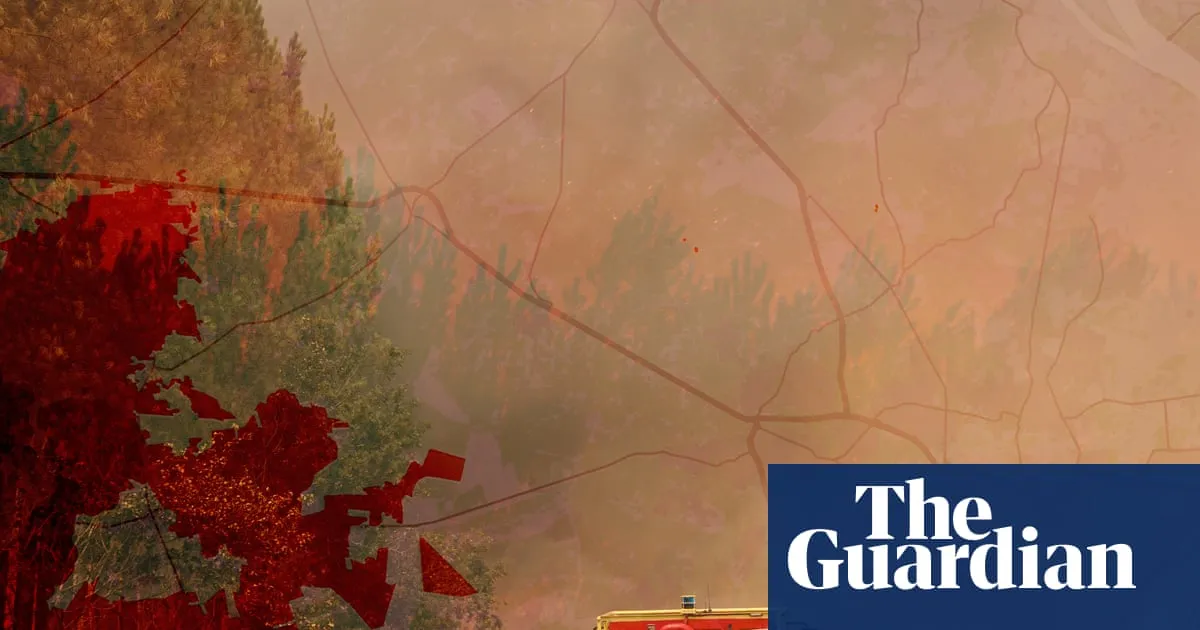
Pine-cone grenades and planet-baking carbon: the French fires 170 years in the making – a visual guide
This summer's devastating French fires, the worst on record, were fueled by a combination of historical land management and climate change. A 1857 decree led to the draining of swamps and planting of maritime pines in southwestern France, creating a vast, flammable monoculture forest.
Ajit Niranjan with graphics by Lucy Swan, Harvey Symons and Paul ScrutonThe Guardian - World NewsFiled 2026-08-23 · 11:00 GMTLean · Center-LeftRead · 7 min
The Guardian - World NewsFIG 01
Reading time
7min
Word count
1 564words
Sources cited
1cited
Entities identified
10entities
Quality score
100%
§ 01
Briefing Summary
AI-generatedNEWSAR · AI
This summer's devastating French fires, the worst on record, were fueled by a combination of historical land management and climate change. A 1857 decree led to the draining of swamps and planting of maritime pines in southwestern France, creating a vast, flammable monoculture forest. These pines, with resinous wood and abundant needles, act as ideal fuel. Global warming has exacerbated the situation, leading to hotter, drier conditions and increased fire risk. The recent fires, potentially ignited by faulty equipment, spread rapidly through the dense pine stands, overwhelming firefighting efforts. The fires forced mass evacuations and caused significant environmental damage, highlighting the long-term consequences of past decisions and current climate trends.
Confidence 0.90Sources 1Claims 5Entities 10
§ 02
Article analysis
Model · rule-basedFraming
Environmental
Human Interest
Tone
Mixed Tone
AI-assessed
CalmNeutralAlarmist
Factuality
0.80 / 1.00
Factual
LowHigh
Sources cited
1
Limited
FewMany
§ 03
Key claims
5 extracted01
A 1857 decree by Napoleon III forced landowners to drain coastal wetlands and plant maritime pines, creating Europe's largest human-made forest.
factual
Confidence
1.00
02
The fires forced more people from their homes than at any point since WWII.
statistic
Confidence
1.00
03
French fires this summer burned more land than ever recorded.
statistic
Confidence
1.00
04
Humanity has added 1.85tn tonnes of carbon to the atmosphere since 1857, warming Europe by 2.4C.
statistic
Confidence
0.90
05
The smoke from France's biggest inferno in nearly 80 years choked Limoges with more toxic dust than Delhi's worst smog day.
statistic
Confidence
0.90
§ 04
Full report
7 min read · 1 564 words§ 05
Entities
10 identifiedKey playerOppositionContextPositiveNeutralNegative
Organizations1
Locations5
§ 06
Keywords & salience
9 termsfrench fires
1.00
climate change
0.90
maritime pines
0.80
monoculture forest
0.70
firestorm thundercloud
0.60
historical context
0.50
wildfire
0.50
land management
0.40
carbon emissions
0.40
§ 07
Topic connections
Interactive graph Network visualization showing 51 related topics
View Full Graph Person Organization Location Event|Click node to navigate|Edge numbers = shared articles