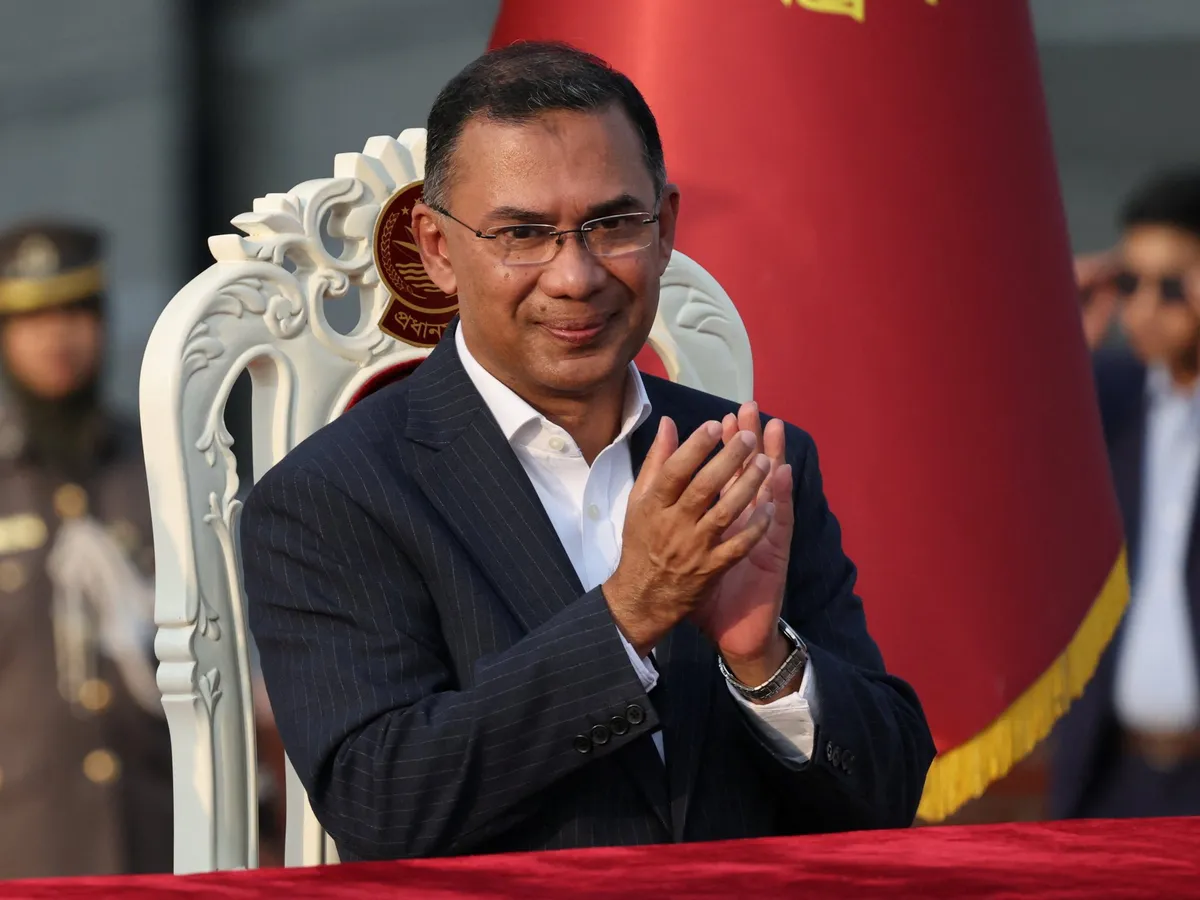
EXPLAINERNew Delhi and Dhaka have not been able to move past the contentious question of Sheikh Hasina, the ousted Bangladeshi leader now living in exile in India.Bangladesh’s newly sworn-in Prime Minister Tarique Rahman claps during an oath-taking ceremony at the National Parliament Building, following the landslide victory of the Bangladesh-nationalist-party" class="entity-link entity-organization" data-entity-id="5960" data-entity-type="organization">Bangladesh Nationalist Party (BNP) in the national polls, in Dhaka, Bangladesh, February 17, 2026 [Mohammad Ponir Hossain/Reuters]Published On 23 Aug 2026New Delhi, India – Bangladesh’s Prime Minister Tarique Rahman’s first trip to India has been put on hold, highlighting the strained ties between the two South Asian neighbours since the July 2024 student-led uprising that forced Prime Minister Sheikh Hasina to flee the country.Since coming to power in February, Rahman – the son of Hasina’s archrival, the late Khaleda Zia – has aimed to improve ties with India. But a press conference conducted by Hasina, who lives in India in exile, has riled Bangladesh.Dhaka says that the August 5 press conference has “vitiated” the atmosphere, adding that “a propitious environment needs to be created for the visit” of Prime Minister Rahman.For now, Rahman’s trip looks uncertain, as Bangladesh’s Foreign Ministry said officials from both countries have been engaged in talks for “several weeks” to work out a possible solution.Here is everything you need to know about the latest diplomatic turbulence between the South Asian neighbours.Vehicles move past a mural of Bangladesh’s ousted Prime Minister Sheikh Hasina, at the University of Dhaka, in Dhaka, Bangladesh, June 29, 2026 [Mohammad Ponir Hossain/Reuters]What’s up with Rahman’s India visit?New Delhi had extended an invitation to Rahman for a stand-alone visit to India this month, ahead of next month’s scheduled BRICS summit. BRICS is a grouping of major emerging economies, currently chaired by India.Since Rahman took office, there have been several exchanges between top ministers and diplomats from both sides. India appointed Dinesh Trivedi, a former minister and member of Prime Minister Narendra Modi’s Bharatiya Janata Party (BJP), as its envoy to Dhaka in a rare political appointment to the key post.Last Tuesday, Trivedi appealed to Rahman’s government, arguing that the Indian mission is not asking Dhaka “to forget the past”, in an apparent reference to Hasina’s exile in India. “Keep the past and sort out the differences of the past. But move on. Don’t get stagnant,” he added.At a reception hosted by the Indian High Commission in Dhaka, Trivedi said that Modi wanted Rahman’s visit to be “memorable”.But those plans for a visit were already derailed after Dhaka took offence to Hasina virtually addressing a presser at the Foreign Correspondents’ Club in New Delhi on August 5, marking two years of her ouster.India clarified that it had nothing to do with the event, but to no avail.Bangladesh’s Prime Minister Tarique Rahman arrives for a meeting with Chinese President Xi Jinping at the Great Hall of the People in Beijing, China, June 26, 2026 [Tingshu Wang/Reuters]What have both countries said?Both capitals have been tight-lipped about Rahman’s visit. “I have nothing to say right now,” said India’s Foreign Ministry spokesperson Randhir Jaiswal, responding to a question about Rahman’s visit.Speaking at an event on Saturday, India’s Foreign Minister Subrahmanyam Jaishankar said India and Bangladesh’s bilateral ties must meet the “test of mutual interest”.“It has to work for them, it has to work for us,” he said.“There has to be a reasonable degree of my recognising and respecting what is their interest, just as I expect them also to do so,” Jaishankar said.Rahman’s foreign affairs adviser, Humayun Kabir, told a Bangladeshi news agency that there is “no rush” in Dhaka to facilitate the prime minister’s visit to India.Kabir added that Dhaka is still ascertaining what kind of relationship India wants with the newly elected government in Bangladesh.“The neighbouring country must properly understand the reality of Bangladesh’s July Mass Uprising, which took place through the sacrifices of more than 1,500 people,” he said, referring to India sitting on the request for Hasina’s extradition.Earlier this month, New Delhi had said that it was considering Hasina’s extradition request based on the established procedure. Both countries have an extradition treaty, but with an exception for political cases.What are the points of tension?Bangladesh has made Hasina’s extradition a major issue. Hasina’s government was seen as especially close to India, and New Delhi’s backing of her authoritarian rule also angered Bangladeshis.Dhaka has been seeking the extradition of Hasina, who was handed a death sentence in absentia in November 2025. Some analysts have accused New Delhi of using it as a diplomatic bargaining chip.Bangladesh has expressed its displeasure with India for hosting Hasina and sees Hasina’s political speeches as an interference in its internal affairs. During the August 5 presser, Hasina said she would return to Bangladesh.“We have requested Indian authorities to expeditiously act on our request to extradite Sheikh Hasina and other fugitive criminals,” the Bangladesh Foreign Ministry said in an X post on August 16.“We reiterate that we will continue to pursue our ‘Bangladesh First’ policy to promote friendly bilateral relations with other countries, including our neighbours, on the basis of sovereign equality, national dignity, non-interference in each other’s internal affairs and mutual benefit.”For New Delhi, Dhaka inching closer to Pakistan after decades of strained ties is a major diplomatic setback. India played a major role in the formation of Bangladesh from Pakistan in 1971.Shakil Ahmed, an assistant professor of government and politics at Dhaka’s Jahangirnagar University, noted that domestic politics tends to influence foreign policy at times.“Relations between India and Bangladesh are constrained by their domestic politics, especially in Dhaka,” he said.“People in Bangladesh want that any relation with India should be based on self-respect and mutual interests,” he said, adding that Rahman’s government has been diversifying its friendships with foreign countries, including the US, China, and Pakistan.“New Delhi saw Bangladesh as one of India’s foreign policy followers,” Ahmed said, noting that that is not the case anymore. “Hasina gave India a blank cheque in foreign relations, which is not happening anymore.”India’s Hindu nationalist government’s push to fence the 4,096km-long (2,545-mile) border with Bangladesh has also strained ties. Anti-Bangladesh rhetoric by ruling party officials has further antagonised Dhaka.India has been deporting what it calls undocumented Bangladeshi immigrants across its borders. Dhaka has accused New Delhi of pushing people extrajudicially into Bangladesh without diplomatic verification.What’s ahead for India-Bangladesh ties?Sanjay Bhardwaj, a professor of South Asian studies at the Jawaharlal Nehru University in Delhi, told Al Jazeera that Bangladesh’s Prime Minister Rahman is playing to the gallery by stalling his maiden India visit.Hasina’s case is one of political persecution, said Bhardwaj, as her own government chased Rahman – who lived for the last 17 years in London, the United Kingdom, including all of Hasina’s years in power – with several criminal cases.“India has been positive to cultivate and have a developmental partnership with Bangladesh, with no reluctance to develop the economic participation,” he added. “But Rahman is interested in politics and not thinking about the development of Bangladesh.”Hasina’s extradition is a contentious issue, he said, adding that both capitals must move beyond this to maintain a productive bilateral relationship.Sreeradha Datta, a professor specialising in South Asian studies at India’s OP Jindal Global University, said that both countries need to talk, since “there is no alternative”.As neighbours, “they do not have a choice to disengage”, she said, adding that merely the passage of time will not repair the relations.India is concerned about the Mecca defence pact, Datta told Al Jazeera, “But how can one have any control when there is no dialogue and engagement?”“The initial warmth diluted in nationalistic noise on both sides,” Datta said, referring to initial interactions, including an Indian delegation led by Jaishankar visiting Dhaka last year for the funeral of Rahman’s mother, Khaleda Zia.Datta argued that New Delhi needs to come to terms with a new reality that the government of Bangladesh may not share the same warmth as the one under Hasina did. “But that doesn’t matter,” she said. “These are neighbours, and a relationship based on objectives or interests is what will take it forward.”
SRCAl Jazeera
LANGEN
LEANCenter
WORDS1 335
ENT12
SUN · 2026-08-23 · 14:17 GMTBRIEF NSR-2026-0823-105107
NSR-2026-0823-105107Analysis·EN·Diplomatic
PM Tarique Rahman’s trip stalled: What it means for Bangladesh-India ties
Bangladesh Prime Minister Tarique Rahman's planned visit to India has been postponed due to ongoing diplomatic tensions. The primary point of contention is the presence of ousted Bangladeshi Prime Minister Sheikh Hasina, who is living in exile in New Delhi.
Yashraj SharmaAl JazeeraFiled 2026-08-23 · 14:17 GMTLean · CenterRead · 6 min
Al JazeeraFIG 01
Reading time
6min
Word count
1 335words
Sources cited
2cited
Entities identified
12entities
Quality score
100%
§ 01
Briefing Summary
AI-generatedNEWSAR · AI
Bangladesh Prime Minister Tarique Rahman's planned visit to India has been postponed due to ongoing diplomatic tensions. The primary point of contention is the presence of ousted Bangladeshi Prime Minister Sheikh Hasina, who is living in exile in New Delhi. Dhaka is displeased with Hasina's recent press conference, viewing it as interference in its internal affairs and stating that a conducive environment is needed for Rahman's visit. India has clarified it was not involved in Hasina's press conference and has urged Bangladesh to move past past differences. Bangladesh is seeking Hasina's extradition, though India is considering the request based on established procedures, noting an exception for political cases in their extradition treaty. The postponement highlights the strained relationship between the two nations since the July 2024 student-led uprising.
Confidence 0.90Sources 2Claims 5Entities 12
§ 02
Article analysis
Model · rule-basedFraming
Diplomatic
Political Strategy
Tone
Measured
AI-assessed
CalmNeutralAlarmist
Factuality
0.60 / 1.00
Mixed
LowHigh
Sources cited
2
Limited
FewMany
§ 03
Key claims
5 extracted01
India clarified it had no involvement in Hasina's press conference.
factualIndia
Confidence
1.00
02
India appointed Dinesh Trivedi, a former minister from the BJP, as its envoy to Dhaka.
factual
Confidence
1.00
03
Dhaka states that Hasina's press conference "vitiated" the atmosphere for Rahman's visit.
quoteBangladesh's government
Confidence
1.00
04
Bangladesh's Prime Minister Tarique Rahman's trip to India has been put on hold.
factual
Confidence
1.00
05
The trip was stalled due to a press conference held by ousted Bangladeshi leader Sheikh Hasina in India.
factual
Confidence
0.90
§ 04
Full report
6 min read · 1 335 words§ 05
Entities
12 identifiedKey playerOppositionContextPositiveNeutralNegative
People5
Organizations3
§ 06
Keywords & salience
8 termstarique rahman
1.00
bangladesh-india ties
1.00
sheikh hasina
0.90
exile
0.80
diplomatic turbulence
0.70
student-led uprising
0.60
brics summit
0.50
bnp
0.40
§ 07
Topic connections
Interactive graph Network visualization showing 51 related topics
View Full Graph Person Organization Location Event|Click node to navigate|Edge numbers = shared articles