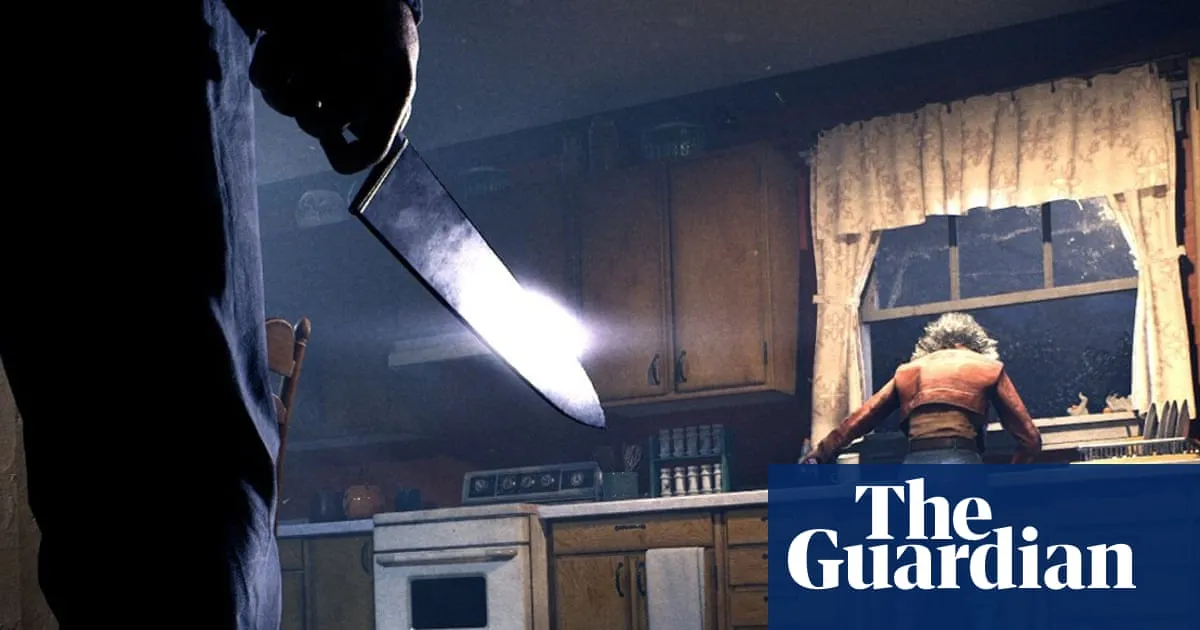
Halloween’s Michael Myers is one of film’s most feared boogeymen, responsible for some of the most brutal on-screen deaths in horror cinema. US video game developer Illfonic looked to reproduce those terrors in its upcoming title Halloween: The Game, with gruesome killings a major focus of the gameplay: for instance, you can stomp another player’s head through a toilet seat, or fry their brain by throwing them through a television screen.But Australians will not be able to play Halloween: The Game, because it has been refused classification by the Classification Board, which means it is banned from sale within the country. And it’s not because of the violence or murders.In the game, players can smoke marijuana to see the location of Michael Myers in order to avoid being killed – a use of drugs that Australia’s Classification Board has deemed a “gameplay advantage”. Under the Guidelines for the Classification of Computer Games 2023, video games are refused classification if they contain “illicit or proscribed drug use related to incentives or rewards”.“Halloween: The Game contains illicit drug use that is linked to an incentive or reward, in that use of the drug provides a gameplay advantage to the player. It is on this basis that the game has been refused classification, as required under the Code and Guidelines,” the board wrote in a recent statement.In the wake of the decision, Illfonic’s social media accounts have been flooded with comments from irate Australians. An FoI officer said the Classification Board had received more than 500 complaints in relation to Halloween: The Game.The uproar has resurfaced longstanding grievances about how games are classified in Australia compared to film and television, and the inability for adults to access games widely available in other parts of the world.Claire Henry, associate professor in screen at Flinders University and an Australian Research Council Decra fellow, says the board enforced the guidelines correctly but the controversy around the decision highlights “a mismatch between the community standards and the classification standards”.The decision on Halloween: The Game follows several high-profile cases that have seen games such as State of Decay, Wasteland 3 and Saints Row IV banned in Australia for the same reason: incentivised drug use. All of these games were later reclassified after censoring aspects of their gameplay.Saints Row IV. The game was initially refused classification in Australia, and could not be released. The game was later released after a particular mission was removed. Photograph: Deep SilverDan Golding, professor of media at Monash University, says that two assumptions have been baked into the classifying of games in Australia. “Games have always been regulated based on the assumption there is something more impactful about doing, in a game, than there is about watching, in a film,” he says.“A second assumption is that games are for kids – or at least the regulation system exists to protect kids.”Ron Curry has battled these assumptions in skirmishes with the Classification Board over his nearly two decades as CEO of the Interactive Games & Entertainment Association (IGEA). Alongside a dogged public campaign and a cadre of journalists, the IGEA helped introduce an R18+ category for video games in 2013, the absence of which had stopped several games being released in Australia before.After the R18+ classification was brought in, Curry noted the job was not finished – the trade-off for introducing the category was that video games were still seen as a distinct form of media, with greater risks attached.“It still very clearly said games are different to all other media, it’s more dangerous, and we need to treat it more carefully,” says Curry.Interactivity – the doing Golding refers to – has always underlined this belief. The guidelines for games, introduced alongside the R18+ rating, state that “as a general rule computer games may have a higher impact than similarly themed depictions of the classifiable elements in film, and therefore greater potential for harm or detriment, particularly to minors”.Curry points to the Australian government’s own research that has suggested interactivity may not increase the impact of video games, particularly in regards to violent content, and there has been limited research on interactivity around drug use, sex, gambling and nudity.Margaret Anderson, a former director of the Classification Board, says the huge focus on interactivity in games drove her nuts during her seven years on the board. She points to decades of research showing games are predominantly played by adults.skip past newsletter promotionafter newsletter promotion“Can we stop pretending that the way we classify games in this country, in 2026, is appropriate for adults? Because it’s not,” Anderson says.Academics have shown the current classification system isn’t just preventing access to games, however. Often, the standards are incoherent.Marcus Carter, founder of the Sydney Games and Play Lab at the University of Sydney, recently led a study – yet to be peer reviewed – that showed inconsistencies across the classifications of mobile games in the Apple App Store and Google Play Store. In 18 separate cases across the 31 top-grossing mobile games, four different age ratings were included for a single game.Carter describes the current system as “not fit for purpose”.The worry, for experts like Carter and Henry, is that the inconsistent standards have a negative impact on how the community views classifications and age ratings.“Inconsistencies can kind of undermine public confidence in the classification system,” says Henry. “It is a good system in many ways, and we’ve got to maintain that trust.”The Australian government is undertaking a review of the classification guidelines with the aim of delivering a simpler, more consistent approach across films, games and publications. Among a raft of proposals – including introducing a PG13 rating and adjusting the MA15+ classification to MA16+ – one idea is to “remove the harsher judgement of video games’ interactivity”. IGEA and Henry have submitted to the review.In a statement to the Guardian, a spokesperson from the Department of Infrastructure, Transport, Regional Development, Communications, Sport and the Arts said: “The Australian Government is working to modernise the National Classification Scheme to ensure it remains aligned with community standards and helps Australians make informed decisions about what they read, watch and play. This work is ongoing.”Illfonic has shown no sign it will censor Halloween: The Game and have its classification reviewed in Australia. Illfonic and the game’s co-publisher Gun Interactive did not respond to requests for comment.Though the instances of Australia banning games has been a rare occurrence, one future decision looms large: how will Grand Theft Auto VI, the latest instalment in a franchise packed with sex, drugs and violence, be rated?For Anderson, the way forward is simple.“The foundational pillar of classification in Australia is that adults should be able to read, hear, see, play what they want,” she says. “Can we please respect that fact?”
SRCThe Guardian - World News
LANGEN
LEANCenter-Left
WORDS1 125
ENT11
SUN · 2026-08-23 · 15:00 GMTBRIEF NSR-2026-0823-105108
NSR-2026-0823-105108News Report·EN·Legal & Judicial
Illicit deeds have just gotten a new Halloween video game banned in Australia – and it’s not because of the violence
Australia has banned the video game "Halloween: The Game" from sale, not due to its violent content, but because players can use marijuana to gain a gameplay advantage. The Classification Board cited guidelines prohibiting "illicit or proscribed drug use related to incentives or rewards." This decision has sparked significant backlash and renewed debate about Australia's classification standards for video games, which academics argue are outdated and inconsistent compared to film and television.
Jackson RyanThe Guardian - World NewsFiled 2026-08-23 · 15:00 GMTLean · Center-LeftRead · 5 min
The Guardian - World NewsFIG 01
Reading time
5min
Word count
1 125words
Sources cited
2cited
Entities identified
11entities
Quality score
100%
§ 01
Briefing Summary
AI-generatedNEWSAR · AI
Australia has banned the video game "Halloween: The Game" from sale, not due to its violent content, but because players can use marijuana to gain a gameplay advantage. The Classification Board cited guidelines prohibiting "illicit or proscribed drug use related to incentives or rewards." This decision has sparked significant backlash and renewed debate about Australia's classification standards for video games, which academics argue are outdated and inconsistent compared to film and television. Critics suggest the system operates under the assumption that games are more impactful than other media and are primarily for children, despite evidence of adult gaming audiences. Previous games have faced similar bans for incentivized drug use, often leading to censorship for reclassification.
Confidence 0.90Sources 2Claims 5Entities 11
§ 02
Article analysis
Model · rule-basedFraming
Legal & Judicial
Human Interest
Tone
Mixed Tone
AI-assessed
CalmNeutralAlarmist
Factuality
0.70 / 1.00
Factual
LowHigh
Sources cited
2
Limited
FewMany
§ 03
Key claims
5 extracted01
Games are regulated in Australia with the assumption that 'doing' in a game is more impactful than 'watching' in a film.
quoteDan Golding
Confidence
1.00
02
The decision highlights a mismatch between community standards and classification standards in Australia.
quoteClaire Henry
Confidence
1.00
03
Australian Classification Board guidelines state games are refused classification if they contain 'illicit or proscribed drug use related to incentives or rewards'.
factualClassification Board
Confidence
1.00
04
The game was banned not due to violence, but because players can smoke marijuana for a gameplay advantage.
factualClassification Board
Confidence
1.00
05
The video game 'Halloween: The Game' has been refused classification and banned in Australia.
factualClassification Board
Confidence
1.00
§ 04
Full report
5 min read · 1 125 words§ 05
Entities
11 identifiedKey playerOppositionContextPositiveNeutralNegative
Organizations3
Locations1
§ 06
Keywords & salience
10 termsillicit drug use
1.00
gameplay advantage
1.00
video game ban
1.00
classification board
0.90
australia
0.80
incentivised drug use
0.70
community standards
0.60
halloween: the game
0.50
horror cinema
0.40
saints row iv
0.40
§ 07
Topic connections
Interactive graph Network visualization showing 51 related topics
View Full Graph Person Organization Location Event|Click node to navigate|Edge numbers = shared articles