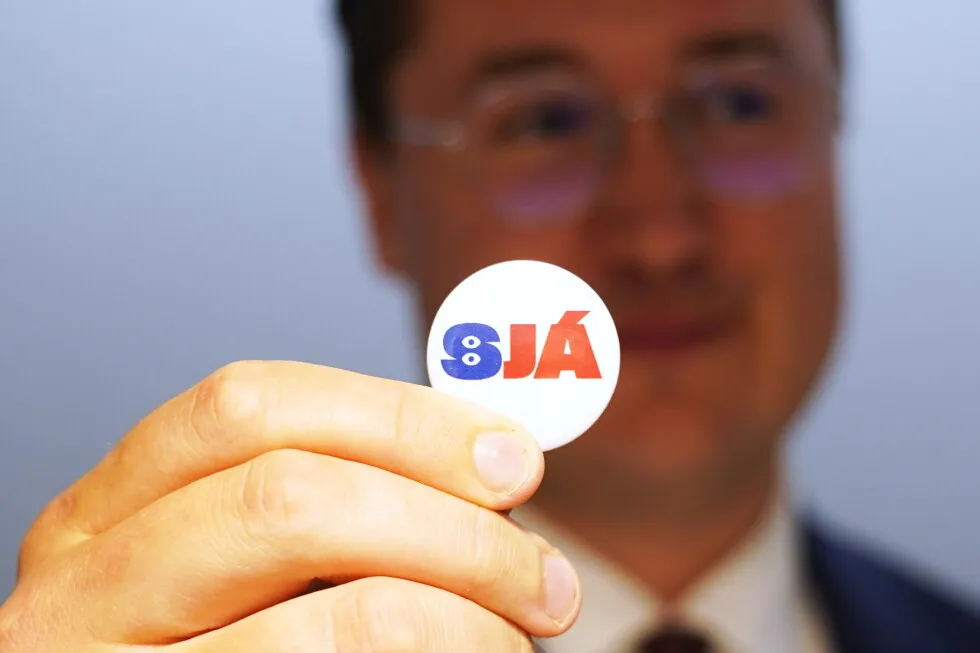
What to know about Iceland’s vote on whether to restart talks to join the EU 1 of 5 | A man holds a badge reading “See”, at the opening of the “Yes” campaign’s office in Reykjavik, Iceland, Friday, Aug. 7, 2026. (AP Photo/James Brooks) 2 of 5 | A supporter holds a t-shirt reading, “Yes to see”, at the opening of the “Yes” campaign’s office in Reykjavik, Iceland, Friday, Aug. 7, 2026. (AP Photo/James Brooks) 3 of 5 | Workers process fish at Visir’s fish processing facility in Grindavik, Iceland, Friday, Aug. 14, 2026. (AP Photo/James Brooks) 4 of 5 | An Icelandic flag waves in the wind at Reykjavik Harbor in Reykjavik, Iceland, Sunday, Aug. 9, 2026. (AP Photo/James Brooks) 5 of 5 | A fishing boat moored at Reykjavik Harbor in Reykjavik, Iceland, Sunday, Aug. 9, 2026. (AP Photo/James Brooks) By Brian Melley and James Brooks Updated 6:11 AM MESZ, August 24, 2026 Add AP News on Google Add AP News as your preferred source to see more of our stories on Google. Share Share Facebook Copy Link copied Print Email X LinkedIn Bluesky Flipboard Pinterest Reddit Reykjavik, Iceland (AP) — When U.S. President Donald Trump said he wanted a “piece of ice, cold and poorly located,” the people of Iceland had every reason to worry even if he was referring to Greenland. Their concern was not only that the object of Trump’s desire was their nearest big neighbor, but that he repeatedly called it Iceland — four times. That gaffe, as Trump continued to press for control of Greenland earlier this year, could help push the fiercely independent Iceland and its 400,000 people closer to Europe as voters decide Saturday whether to restart talks to join the European Union. “We can’t really trust the U.S. anymore,” said Hildur Knútsdóttir, a horror fiction writer who plans to vote in favor of EU membership. “Trump was not joking about Greenland. There was a lot of fear here in Iceland because if he takes Greenland with force, we’re probably going to be next.” Iceland’s decision is whether to continue going it alone successfully and maintain control of precious natural resources like its lucrative and well-managed fisheries, or to strengthen ties with Europe to better insulate the country from geopolitical instability and gain economic benefits such as the more stable euro currency and lower interest rates and inflation. Iceland, which is a member of NATO, already participates in the EU’s single market through the European Economic Area and is part of the Schengen free-travel zone. For both sides of the debate, it’s really a matter of sovereignty, said Hulda Thorisdottir, a political science professor at the University of Iceland. Opponents argue that the nation that won its independence from Denmark in 1944 enjoys all the benefits of European integration with no drawbacks. Why surrender that when they’re doing so well? she said. EU lays out $11.4 billion for 7 AI gigafactories as it aims to catch up with US and China 1 MIN READ EU to crack down on AI deepfakes, illicit imagery and hacking with new team in Brussels 2 MIN READ 52 Mexican governor indicted by the US seeks leave again after contentious return to office 2 MIN READ 52 “The independence of Iceland is the most precious resource that we have,” said Haraldur Olafsson, a physics professor who is chairman of Heimssýn, a Euroskeptic group that opposes EU membership. “The possibility of making your own law and deciding how things are done is essential.” EU proponents, however, see it through the lens of a rapidly changing world in which shifting alliances pose a security risk. Being outside the EU makes Iceland vulnerable and that threatens its sovereignty, Thorisdottir said. Foreign and Defense Minister Thorgerdur Katrín Gunnarsdóttir, who supports joining the EU, said when she asks people from smaller countries such as Ireland, Finland or Luxembourg, whether they feel they’ve lost their sovereignty, “they look at me like I’m a crazy woman” and say membership has made them stronger. This is not the first time Iceland has considered joining the EU Prime Minister Kristrun Frostadottir’s center-left coalition government was elected in 2024 on a platform that called for a vote on EU membership. Icelanders did not vote on the decision to apply for EU membership in 2009, after the country’s debt-burdened banking sector collapsed during the 2008 global financial crisis. Accession talks were suspended in 2013 after a center-right government came to power, and they formally ended in 2015. The referendum is a first step to potentially joining the 27-nation bloc. Voters will answer a simple yes-or-no question: Should Iceland resume accession negotiations with the European Union? If voters reject the proposal, the issue would be put to rest. A yes vote would lead to a yearslong negotiating process with the European Commission assessing 35 sets of criteria from financial systems to fisheries, transport networks, agricultural regulations, and freedoms such as speech and religion. Any agreement would need to be approved by all current EU member nations and then voters in Iceland would have the final say on whether to join. The descendants of Vikings who settled Iceland have been living off the sea for centuries, and fishing remains part of the country’s cultural identity. They fought the so-called Cod Wars with Britain to win control of their fishing grounds in the 1970s. Their rich North Atlantic fishing grounds have always been a key sticking point to joining the EU over concerns they would have to join the Common Fisheries Policy that would allow Spanish, Dutch and other trawlers into their waters. Any deal with the EU that doesn’t protect Iceland’s fishing rights is seen as dead in the water, but Gunnarsdóttir and other officials are confident any deal will offer an exemption for Iceland’s fisheries. “We are a superpower when it comes to fisheries,” she said. “We will not sign any agreement which will not underline our sovereignty and full control of our fisheries.” Heiðrun Lind Marteinsdóttir, the CEO of Fisheries Iceland, said the seafood trade organization doesn’t oppose joining the EU if there is a permanent opt-out from the fisheries policy, but she said that would be unprecedented. “I think we need to be very realistic on the negotiation process and what we can get out of the negotiations,” she said. “To be honest, I think, we’re aiming high.” Others in the industry are more skeptical that any protection of Icelandic fisheries would be lasting — especially for open water species like herring, capelin and mackerel that migrate between different fishing zones. “We are going to see European fishing vessels here in Iceland,” Einar Sigurdsson, chairman of Isfelag fishing company, predicted. Trump’s Greenland obsession sped up election timetable The government had planned to hold the vote by next year but moved it up after Trump’s repeated overtures about taking over Greenland, a self-governing territory of Denmark, a longtime U.S. ally. The U.S. State Department reassured Iceland officials that Trump meant Greenland during his repeated slip of the tongue at the World Economic Forum in Davos, Switzerland, Gunnarsdóttir, the foreign minister, said. It didn’t help that William Long, the newly arrived U.S. ambassador in Reykjavik, once joked that Iceland would become the 52nd U.S. state and he’d be its governor. He apologized, but the remark prompted thousands of Icelanders to sign a petition urging the prime minister to reject his appointment. Gunnarsdóttir said Trump’s saber-rattling emphasized the importance of the EU’s collection of small and large nations standing as one with Greenland and Denmark. “That is so important for us to see a group of like-minded nations stand together on principles and values,” she said. “That is also what I’m looking at when I see the European Union in this volatile world.”
SRCAssociated Press (AP)
LANGEN
LEANCenter
WORDS1 294
ENT11
MON · 2026-08-24 · 04:23 GMTBRIEF NSR-2026-0824-105236
NSR-2026-0824-105236News Report·EN·Political Strategy
What to know about Iceland’s vote on whether to restart talks to join the EU
Icelanders are voting on whether to restart accession negotiations with the European Union. The decision comes amid concerns about geopolitical instability, highlighted by U.S.
Associated Press (AP)Filed 2026-08-24 · 04:23 GMTLean · CenterRead · 6 min
Associated Press (AP)FIG 01
Reading time
6min
Word count
1 294words
Sources cited
2cited
Entities identified
11entities
Quality score
100%
§ 01
Briefing Summary
AI-generatedNEWSAR · AI
Icelanders are voting on whether to restart accession negotiations with the European Union. The decision comes amid concerns about geopolitical instability, highlighted by U.S. President Trump's repeated misidentification of Iceland with Greenland. Proponents argue EU membership would strengthen Iceland's security and economy, while opponents emphasize preserving national sovereignty and control over resources like fisheries. Iceland already participates in the EU's single market and Schengen Area. Past accession talks were suspended in 2013 and formally ended in 2015. A "yes" vote would initiate a lengthy negotiation process, with any final agreement requiring approval from all EU member states and Icelandic voters. The fishing industry remains a key concern, with fears of losing control over lucrative fishing grounds.
Confidence 0.90Sources 2Claims 5Entities 11
§ 02
Article analysis
Model · rule-basedFraming
Political Strategy
Diplomatic
Tone
Measured
AI-assessed
CalmNeutralAlarmist
Factuality
0.60 / 1.00
Mixed
LowHigh
Sources cited
2
Limited
FewMany
§ 03
Key claims
5 extracted01
Some Icelanders believe they can no longer trust the U.S. and that this could push them closer to Europe.
quoteHildur Knútsdóttir
Confidence
1.00
02
Icelanders are voting on whether to restart talks to join the European Union.
factual
Confidence
1.00
03
Iceland already participates in the EU's single market and the Schengen free-travel zone.
factual
Confidence
1.00
04
Iceland's decision involves weighing continued independence and control of resources against strengthening ties with Europe for stability and economic benefits.
factual
Confidence
0.90
05
U.S. President Donald Trump repeatedly referred to Greenland as Iceland, causing concern in Iceland.
factualAP News
Confidence
0.90
§ 04
Full report
6 min read · 1 294 words§ 05
Entities
11 identifiedKey playerOppositionContextPositiveNeutralNegative
People4
Organizations3
§ 06
Keywords & salience
9 termsiceland
1.00
eu membership
1.00
restart talks
0.90
geopolitical instability
0.80
european union
0.70
economic benefits
0.60
fisheries
0.50
trump
0.40
greenland
0.40
§ 07
Topic connections
Interactive graph Network visualization showing 51 related topics
View Full Graph Person Organization Location Event|Click node to navigate|Edge numbers = shared articles