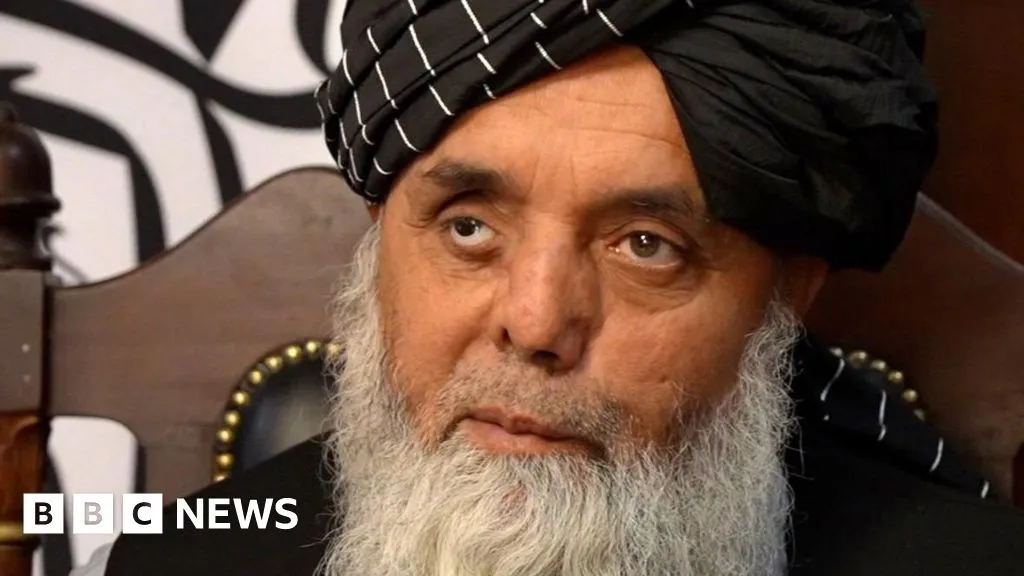
Kawoon KhamooshBBC World Service, Sheberghan, Kabul and KandaharBBCThe governor of Jawzjan province, Abdullah Sarhadi, who fought for the Taliban was held in US detention in Guantanamo Bay for several years Governor Abdullah Sarhadi gives money to treat a boy's broken arm and hands out funds for a local mosque - then, in his office in northern Afghanistan, an astonishing exchange unfolds.A young woman tells the grey-bearded former Taliban commander that she wants to divorce her husband, who she accuses of months of abuse and beatings.She will not take no for an answer.In a country where girls are banned from secondary education, the 18-year-old argues her case calmly and confidently, her face completely hidden behind a full-face veil and sunglasses."If there was any chance to live together, I wouldn't be here… I have taken my decision," she says.After trying to persuade her to avoid divorce, the governor later comments that women are "mindless" and "deficient in intellect", to laughter from the male officials, bodyguards and elders around him.The moment gives a rare glimpse into the day-to-day realities of the Taliban's rule, five years after they swept aside the US-backed government in 2021.In that time, women have been excluded from most workplaces, banned from universities and may not travel alone or visit parks and leisure centres.In encounters spread over two years, the BBC gained unusual access to influential figures in the extreme Islamist movement, spending time with men who once planned suicide attacks or spent years in underground hideouts, but are now officials and soldiers.The Taliban came into power saying they had changed, but many of their policies are similar to the hard-line interpretation of Sharia - Islamic religious law - they imposed in the 1990s.The men we met seemed to want to present themselves as reasonable, yet were not keen to discuss their past violence. And we saw moments of unease between the rulers and those they rule.Governor Sarhadi says Tuba – not her real name – should stay in the marriage."Ask yourself: 'Who would marry me after I get my divorce?'" says Sarhadi. "You'll have to compromise a lot or you'll lose your dignity and honour.""Mr Governor, my honour and dignity have already been ruined," she responds.Her husband listens, awaiting his turn to speak.Under Sharia, a woman requesting that her husband agrees to a divorce may have to return some or all of the money given to her by him when they married. A financial settlement is often agreed. But this woman's husband says he wants four times the amount, which her family refuses to pay.The governor says the woman should be given her own room. He adds that officials will warn him not to beat her - "otherwise he'd be jailed".Unsatisfied, Tuba's father later tells the BBC the family will pursue divorce through the courts, even though, under the Taliban's court system, it is very difficult for a woman to get a divorce without the husband's consent.EPA/REX/ShutterstockA hole left by the destruction of one of the Buddha statues in Bamiyan - Sarhadi says he destroyed itSarhadi was a military commander during the Taliban's first stint in power in the 1990s. He was among thousands of insurgents who surrendered in late 2001 as a US-led coalition ousted the group.He was held for several years in US detention in Guantanamo Bay, but eventually released.When the Taliban regained power, he became a governor - first in the province of Bamiyan, then when we met him in late June, in Sheberghan city in Jawzjan province. He has recently become deputy commander of a military corps in the northern province of Kunduz.Tapping on an old-style mobile with a tiny screen, he says a recent ban on smartphones for officials has slowed things down. "Before, you could send a quick message… sending documents and getting an answer fast." If he says any more about the ban, "it will cause trouble", he adds.But in other ways his worldview seems largely unchanged from the Taliban's position 25 years ago. Then, he was a military commander in Bamiyan, where the Taliban blew up ancient giant Buddha statues, triggering international shock and condemnation.He initially tries to avoid our questions about the archaeological site, but eventually, he says: "I destroyed it with my own hands."Whatever we did and we do is in accordance with the guidance and God's law… We smash idols rather than sell them. Why should I regret? It was God's will."In the capital Kabul, we meet another senior Taliban figure who swapped a violent past for a role with the ruling administration.Habibullah Badr drives us through the streets in an armoured car.He says he was previously "responsible for the operations of suicide attackers" in Kabul."I know all the roads and streets very well… we had all the information we needed about Kabul and its alleys," he says. "There were areas that needed a long time to plan."Taliban suicide attacks killed thousands of people in Afghanistan, including many civilians.Badr is cautious about discussing his past though, fearing it will "make people upset" and could "reopen wounds".Asked about civilian deaths, he says the Taliban targeted US convoys and that civilians were urged to stay away from foreign bases.Whenever I try to ask him about specific attacks that took place in civilian areas, he evades the question.Habibullah Badr says that in the past he was involved in operations involving suicide attacksHe is currently taking time out from official roles for medical treatment, but was previously deputy head of prisons for the whole country – and ran the very jail where he was held on death row under the previous government.Badr invites us to join him at a tribal gathering, where the head of a charitable foundation is to honour him with a medal. But things take an unexpected turn."Mr Badr is a pride for Afghanistan and a great fighter," says Sultan Mohammad Talaee. "But I also have a complaint. If the schools and education were open to all it would be a great work for Afghanistan. I hope this doesn't offend you."An awkward silence follows, his audience unsure how to react. Talaee's microphone is swiftly removed.Afterwards, he tells the BBC: "I requested for the girls' schools to reopen… seeking knowledge is an obligation for both men and women in Islam."He adds: "There were other things I wanted to say but they didn't let me talk more."Often those who speak out face much more severe consequences.Women told us of the deep despair they felt over dreams thwarted by restrictions on education, and of friends jailed for protesting.Most journalists we spoke to said they had been summoned or questioned by the Taliban's intelligence organisation, Estikhbaraat.The BBC put some of these concerns to the Taliban government's spokesman, known as Zabihullah Mujahid.Zabihullah Mujahid says women's rights and freedom of speech need to be seen "through the Sharia lens"He has been a public face for the Taliban government since 2021. He still uses the pseudonym he went by for years during the insurgency, but he told us his real name is Tahir Shah Seddiqi - revealing it publicly for the first time.In a lavish press centre funded by the Americans for the previous government, we ask him about the first press conference he gave there, two days after the Taliban took control of the country.Then, he told the world the Taliban government would allow women to work and study "within our frameworks" and they would "be very active" in society. Why did they fail to keep their word?"We are committed to women's rights, freedom of speech and other things within Sharia," he replies. "We should see everything through the Sharia lens."Allowing women to work in offices such as his own "would lead to immoralities" and "their dignity would be undermined", he adds.He says the issue of education for women is "under discussions… we need a Sharia-based solution for it".When questioned about the Taliban's crackdown on media freedom, he says: "In a society like Afghanistan we have our restrictions. We can't let media do whatever propaganda they want… they can't broadcast against Islamic laws and rites."The Taliban government sits in Kabul, but Mujahid spends a lot of time in the southern city of Kandahar, the Taliban's heartland, which some now consider the de facto capital.We ask to meet the Taliban's supreme leader, Hibatullah Akhundzada, who is based there. He rarely appears in public and has never given a media interview - we are told it will not be possible at the moment.Restrictions have been tightened in Kandahar since I last visited two years ago. Now men must have beards. Radio stations are not allowed to play music or broadcast women's voices, and we were not allowed to film in the city.Two hours' drive away, along dusty roads, some of the group's most devoted former fighters showed the BBC the insurgents' old secret cave network.Abid Lalai, a former fighter who now mans a checkpoint as part of a security force under the interior ministry, shows us the holes he fired from and the places he used to put his Quran and hang AK-47s.Abid Lalai is one of many Taliban fighters who hid out in caves to evade capture under previous governmentsHis superior, Abdul Samad, shows us an unmarked graveyard, saying his father is buried here, killed fighting for the Taliban.The area is one of the most deprived in a country where the UN says three in four people cannot provide for their basic needs. Samad says the local population desperately need water, roads and clinics."Emirate [Taliban] officials have not forgotten us," says Samad. He says the leaders may be busy with other priorities. "We are hopeful, they will look after us sometime."Five years since the Taliban began their second stint in power, poverty, unemployment and economic instability remain pressing concerns.Taliban figures we spoke to said they were working to tackle them, but we met other people who believe the group itself is the country's main problem."I'm speechless about how a group that has no understanding about life is suddenly in power," says Hoda - not her real name - a woman who protested on the streets when the Taliban first returned to power."Women can't accept this situation," she tells the BBC. "They might advance restrictions but it won't stay like this forever.""I think the Taliban are scared of educated women," she adds. "That's why they restrict women. They want uneducated women so they can't raise wise men. Because that would end the Taliban."
SRCBBC News - World
LANGEN
LEANCenter
WORDS1 736
ENT11
MON · 2026-08-24 · 05:00 GMTBRIEF NSR-2026-0824-105238
NSR-2026-0824-105238News Report·EN·Human Rights
Divorce, smartphones and control - BBC sees how Taliban run Afghanistan
Five years after regaining power, the Taliban continues to reshape Afghanistan, with senior figures like Jawzjan governor Abdullah Sarhadi demonstrating their approach to governance. A BBC report highlights Sarhadi's handling of a woman's divorce request, where he initially urged her to stay married and later dismissed women as "mindless," reflecting the group's restrictive policies on women's rights.
1 hour agoBBC News - WorldFiled 2026-08-24 · 05:00 GMTLean · CenterRead · 7 min
BBC News - WorldFIG 01
Reading time
7min
Word count
1 736words
Sources cited
1cited
Entities identified
11entities
Quality score
100%
§ 01
Briefing Summary
AI-generatedNEWSAR · AI
Five years after regaining power, the Taliban continues to reshape Afghanistan, with senior figures like Jawzjan governor Abdullah Sarhadi demonstrating their approach to governance. A BBC report highlights Sarhadi's handling of a woman's divorce request, where he initially urged her to stay married and later dismissed women as "mindless," reflecting the group's restrictive policies on women's rights. The article also reveals Sarhadi's past as a Guantanamo detainee and his role in the destruction of Bamiyan Buddha statues, which he claims was God's will. Another senior figure, Habibullah Badr, formerly responsible for suicide attacks, now drives through Kabul in an armored car, showcasing the transition of some Taliban members into administrative roles. The report indicates that despite claims of change, many Taliban policies echo their 1990s hard-line interpretation of Sharia law.
Confidence 0.90Sources 1Claims 5Entities 11
§ 02
Article analysis
Model · rule-basedFraming
Human Rights
Human Interest
Tone
Mixed Tone
AI-assessed
CalmNeutralAlarmist
Factuality
0.70 / 1.00
Factual
LowHigh
Sources cited
1
Limited
FewMany
§ 03
Key claims
5 extracted01
A woman seeking divorce may have to return some or all of the money given to her by her husband at marriage under Sharia.
factualBBC
Confidence
1.00
02
Women in Afghanistan are banned from secondary education, excluded from most workplaces, and banned from universities.
factualBBC
Confidence
1.00
03
Governor Abdullah Sarhadi, a former Taliban fighter held in Guantanamo, commented that women are 'mindless' and 'deficient in intellect'.
quoteAbdullah Sarhadi
Confidence
1.00
04
Under the Taliban's court system, it is very difficult for a woman to get a divorce without the husband's consent.
factualBBC
Confidence
0.90
05
The Taliban's policies are similar to their hard-line interpretation of Sharia imposed in the 1990s.
factualBBC
Confidence
0.90
§ 04
Full report
7 min read · 1 736 words§ 05
Entities
11 identifiedKey playerOppositionContextPositiveNeutralNegative
Organizations2
Locations7
Topics1
§ 06
Keywords & salience
10 termswomen's rights
1.00
taliban rule
1.00
divorce
0.90
sharia law
0.80
afghanistan
0.70
gender inequality
0.70
control
0.60
domestic abuse
0.50
social restrictions
0.50
us detention
0.40
§ 07
Topic connections
Interactive graph Network visualization showing 51 related topics
View Full Graph Person Organization Location Event|Click node to navigate|Edge numbers = shared articles