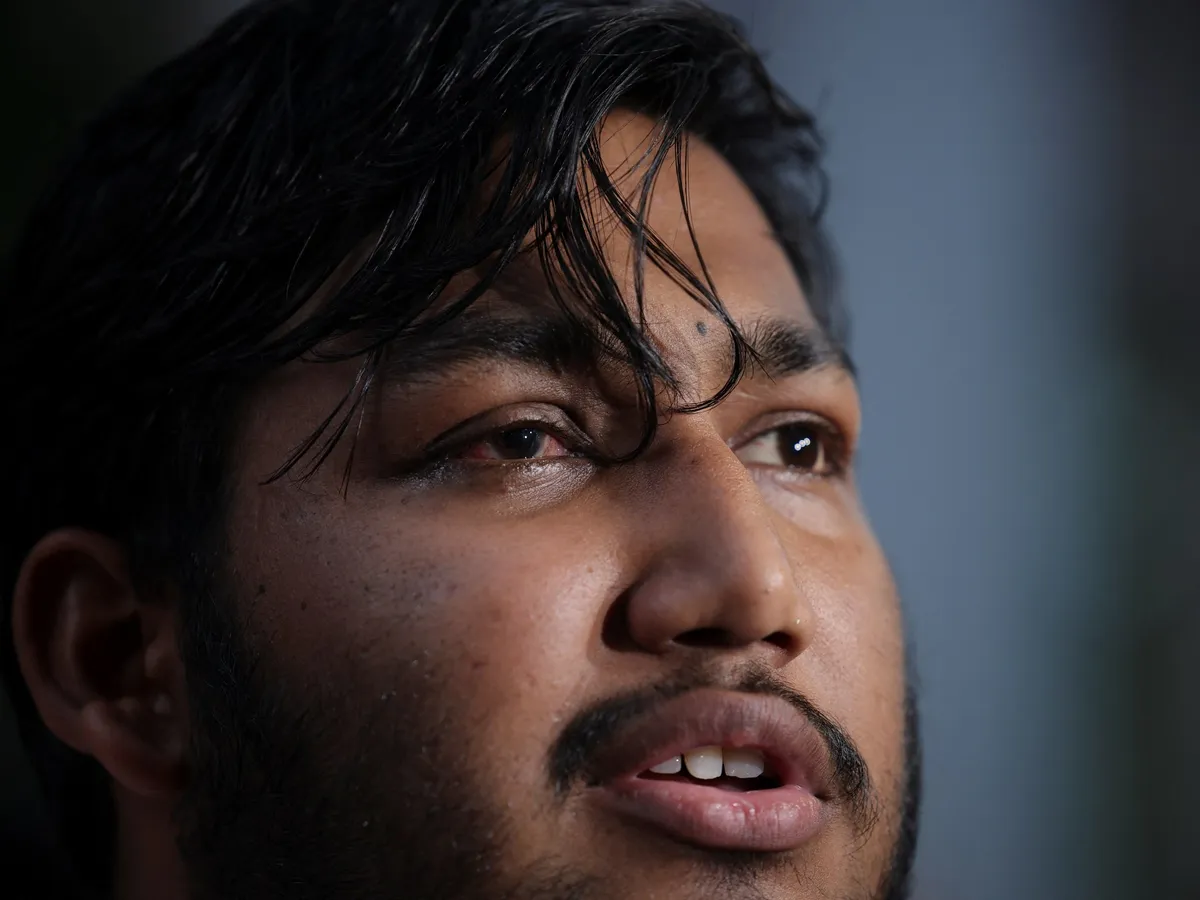
EXPLAINERSecurity forces used tear gas, pellet guns and electric shock devices against student protesters, Amnesty found in its investigation.Sahil Lochab, who suffered pellet gun injuries during the last month's protests by the supporters of the Cockroach Janta Party (CJP) over examination paper leaks, speaks to the media outside a police station in New Delhi, India, August 21, 2026 [Anushree Fadnavis/Reuters]Published On 24 Aug 2026New Delhi, India – An investigation by human rights group Amnesty International has confirmed that Indian government forces used lethal weapons, including pellet-firing shotguns, grenades, batons and electric shock devices against demonstrators in Gen Z protests that rocked the national capital last month.On July 20, thousands of protesters had all but shut down New Delhi, blocking off Parliament Street, demanding the resignation of then-Education Minister Dharmendra Pradhan following a string of examination scandals involving the leaking of national exam papers and other irregularities.More than 100 students were injured in the crackdown by police and paramilitary forces that day. Indian newspapers obtained hospital records that showed that doctors had treated pellet wounds in several cases.India’s opposition, led by Congress party leader Rahul Gandhi, has since called on Home Minister Amit Shah, seen as Prime Minister Narendra Modi’s confidant, to answer questions about the alleged police brutality and has joined protesters in calling for his resignation.But despite mounting evidence and growing political criticism, the Modi government repeatedly insisted that security forces had been measured in their response to the protests and denied using excessive force.Now, an Amnesty investigation has found the use of tactics that Indian law enforcement rulebooks themselves warn against using in all but exceptional circumstances.Cockroach Janta Party supporters in masks hold placards and chant slogans during protests over examination paper leaks, at Jantar Mantar in New Delhi, India, July 22, 2026 [Anushree Fadnavis/Reuters]What happened on July 20 in New Delhi?In July, the Cockroach Janta Party (CJP), a satirical, youth-led movement which gathered momentum in response to the national examinations scandal, called on its supporters to march on the Indian Parliament after a monthlong sit-in failed to oust the education minister.Two days before the march, the police forcibly removed renowned activist Sonam Wangchuk, who had been taking part in a hunger strike. That move galvanised public anger, bringing out more protesters in New Delhi.On the morning of the march day, the police used tear gas as protesters swelled, then attacked them with electric shock batons, as well as shooting at them with pellet guns, Amnesty International’s Evidence Lab has verified from video and photographic evidence alongside witness testimony.Amnesty also found that government forces had put up barricades and enforced a communications blackout.“The weapons were deployed in a manner that breached international law and standards and domestic policing guidelines,” Amnesty said in a statement on Monday.The rights group’s report also noted that the Delhi Police had publicly denied any disproportionate use of force, specifically pellet guns. The police also repeated this before India’s top court during a hearing about the alleged use of excessive force.Amnesty says the evidence it has gathered “directly contradicts [the police’s] account”.Four days after the July 20 march, as protests spread across the country, police in Bihar state’s Siwan town opened fire on protesters, injuring at least three youths.Indian opposition leader Rahul Gandhi gestures as he speaks with the media at a police station in New Delhi, August 21, 2026 [Anushree Fadnavis/Reuters]Did government forces fire pellets at protesters?Following the July 20 protest, several videos and photos emerged of protesters with injuries consistent with pellet wounds, which were reflected in their medical records as well.The Evidence Lab verified two videos showing a paramilitary Rapid Action Force officer firing a shotgun into the crowd at the intersection of Connaught Place and Parliament Street in New Delhi, where protesters had gathered.At least two protesters had wounds consistent with those caused by birdshot, a hunting round that fires a large number of small metal pellets, the group noted.“The doctors confirmed that they were pellet injuries. Thankfully, my bones have been saved, but my body has been scarred badly,” one protester told Amnesty.Amnesty said birdshot ammunition has not been developed for law enforcement purposes due to the widespread dispersion of the metal pellets, which “is inherently inaccurate and presents a high risk of serious injuries to the targeted person and even bystanders”.Amnesty also said the police did not issue a public warning before firing pellet guns, as recommended by the Indian government’s Bureau for Police Research and Development.Police and security forces have used metal pellets for more than a decade in Indian-administered Kashmir, leading to the first mass blinding during a 2016 civilian uprising.Posting on X, Delhi Police called the reports of pellet injuries during the latest protests “fake news”, “completely false and misleading” and warned that “appropriate legal action” would be taken against anyone “spreading rumours”.A subsequent internal inquiry by India’s paramilitary forces, however, reportedly found that personnel had fired at least seven rounds of ammunition containing metal pellets.“Instead of facilitating the right to protest, Indian authorities suppressed it first with a communication blackout, barricades and transport disruption. They then attempted to crush it with unnecessary or excessive use of force against peaceful protesters, including children,” said Aakar Patel, chair of the board, Amnesty International India.“This heavy-handed response was state-sanctioned violence masked as crowd control. The continued impunity after a month is a testament to that,” Patel said.Did police use tear gas grenades and batons?Government forces did use tear gas grenades to disperse the crowd at several places in New Delhi, as seen by Al Jazeera and verified by Amnesty, not just on July 20 to prevent CHP supporters’ march to Parliament.“Tear gas grenades releasing an excessive amount of explosive energy are extremely dangerous and should be prohibited for use in public assemblies,” Amnesty said, referring to videos of tear gas shells exploding near students.The group also noted that witnesses observed that “tear gas grenades were launched directly at protesters instead of at an angled trajectory above the head of protesters, at odds with UN Guidance on the use of Less-Lethal Weapons in Law Enforcement”.Amnesty has also verified claims that the police used lathis, the Indian version of batons, to beat protesters.The UN special rapporteur on torture considers lathis to be inherently cruel, inhuman or degrading as “they deliver a greater level [of] kinetic force than conventional batons, causing excessive pain and increasing the risk of serious injury” and has called for them to be prohibited, a position that Amnesty supports.The group also found men in civilian clothing beating protesters “while uniformed officers, who escorted them toward the crowd, stand beside them and make no attempt to intervene”, as visible in videos seen by Al Jazeera. Several officials were not wearing their name tags or badge numbers, as required.What has been the reaction to the use of excessive force?A day after the crackdown in New Delhi, CJP founder Abhijeet Dipke told the crowd, “Every police person who attacked you would be identified and dragged to the courts”.The group also launched a platform for protesters to upload videos and photos from the crackdown.The opposition, led by the Congress’s Gandhi, pushed the home minister for a discussion on the issue in Parliament, an issue that plagued the monsoon session with Shah missing.Gandhi argued that either Shah ordered the usage of lethal weapons, in which case “he is guilty”, or he was unaware of the situation, which makes him “incompetent” for the job.Sahil Lochab, a 19-year-old who lost vision in one eye due to pellet injuries, said the police had been refusing to register his complaint. In response, Gandhi staged a seven-hour sit-in outside the office of the Delhi Police chief, insisting that a case be registered over the use of pellet guns on protesters, alongside Lochab.After Gandhi’s pressure, the police relented. A student at the University of Delhi, Lochab received multiple pellet injuries on his chest, back, arms and face. Several pellets could not be taken out, he said in his complaint.“My medical documents show that there are over 200 pellets in my body. Doctors have told me that the possibility of my eyesight coming back is less than 1 percent,” Lochab wrote in his complaint.
SRCAl Jazeera
LANGEN
LEANCenter
WORDS1 356
ENT12
MON · 2026-08-24 · 10:53 GMTBRIEF NSR-2026-0824-105348
NSR-2026-0824-105348News Report·EN·Human Rights
India used pellets, grenades on Gen Z protests: What Amnesty report reveals
An Amnesty International investigation has found that Indian security forces used lethal weapons, including pellet guns, grenades, batons, and electric shock devices against student protesters in New Delhi on July 20. The protests, organized by the Cockroach Janta Party (CJP), demanded the resignation of the Education Minister due to examination paper leaks.
Yashraj SharmaAl JazeeraFiled 2026-08-24 · 10:53 GMTLean · CenterRead · 6 min
Al JazeeraFIG 01
Reading time
6min
Word count
1 356words
Sources cited
3cited
Entities identified
12entities
Quality score
100%
§ 01
Briefing Summary
AI-generatedNEWSAR · AI
An Amnesty International investigation has found that Indian security forces used lethal weapons, including pellet guns, grenades, batons, and electric shock devices against student protesters in New Delhi on July 20. The protests, organized by the Cockroach Janta Party (CJP), demanded the resignation of the Education Minister due to examination paper leaks. Amnesty's findings contradict the government's claims of a measured response, stating that the tactics breached international law and domestic guidelines. Evidence, including verified videos and witness testimony, shows security forces firing pellet guns into crowds, resulting in injuries consistent with birdshot. The report also notes a communications blackout and the use of tear gas and electric shock batons.
Confidence 0.90Sources 3Claims 5Entities 12
§ 02
Article analysis
Model · rule-basedFraming
Human Rights
Political Strategy
Tone
Mixed Tone
AI-assessed
CalmNeutralAlarmist
Factuality
0.70 / 1.00
Factual
LowHigh
Sources cited
3
Well sourced
FewMany
§ 03
Key claims
5 extracted01
Thousands of protesters demanded the resignation of the Education Minister due to examination paper leaks and irregularities.
factualarticle
Confidence
0.95
02
The Modi government repeatedly insisted that security forces had been measured in their response and denied using excessive force.
factualModi government
Confidence
0.90
03
Indian law enforcement rulebooks warn against using tactics like pellet guns and grenades in all but exceptional circumstances.
factualAmnesty International
Confidence
0.90
04
Amnesty International investigation confirmed Indian government forces used lethal weapons against Gen Z protesters.
factualAmnesty International
Confidence
0.90
05
More than 100 students were injured in the crackdown by police and paramilitary forces on July 20.
factualarticle
Confidence
0.85
§ 04
Full report
6 min read · 1 356 words§ 05
Entities
12 identifiedKey playerOppositionContextPositiveNeutralNegative
People6
Organizations2
§ 06
Keywords & salience
10 termspellet guns
1.00
student protests
0.90
human rights
0.80
police brutality
0.80
examination paper leaks
0.70
amnesty international
0.70
gen z protests
0.60
lethal weapons
0.50
modi government
0.40
security forces
0.40
§ 07
Topic connections
Interactive graph No topic relationship data available yet. This graph will appear once topic relationships have been computed.