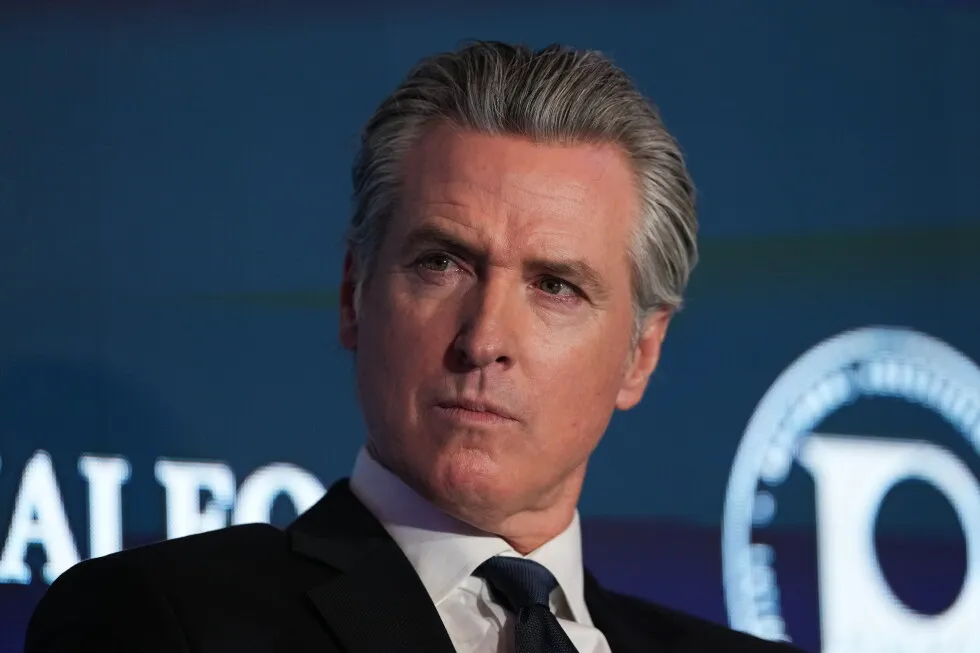
Newsom returns to a defining California fight: Who pays for wildfire damage? 1 of 4 | California Gov. Gavin Newsom attends the National Association of Latino Elected and Appointed Officials conference in Los Angeles, July 14, 2026. (AP Photo/Jae C. Hong, File) 2 of 4 | The Palisades Fire burns a residence in the Pacific Palisades neighborhood of Los Angeles, Jan. 7, 2025. (AP Photo/Ethan Swope, File) 3 of 4 | Fire crews watch the devastation from the Palisades Fire in the Pacific Palisades neighborhood of Los Angeles, Jan. 11, 2025. (AP Photo/John Locher, File) 4 of 4 | The Palisades Fire ravages a neighborhood amid high winds in the Pacific Palisades neighborhood of Los Angeles, Jan. 7, 2025. (AP Photo/Ethan Swope, File) By SOPHIE AUSTIN Updated 7:42 PM MESZ, August 24, 2026 Add AP News on Google Add AP News as your preferred source to see more of our stories on Google. Share Share Facebook Copy Link copied Print Email X LinkedIn Bluesky Flipboard Pinterest Reddit SACRAMENTO, Calif. (AP) — The bookends of California Gov. Gavin Newsom’s nearly eight years in office have been defined by a crucial question: Who should cover the cost of damage from wildfires caused by utility equipment? The most destructive wildfire in state history, a blaze that killed 85 people and destroyed more than 18,000 buildings in Northern California, started two days after Newsom won the governorship in 2018. Investigators determined it was caused by Pacific Gas & Electric equipment. Facing tens of billions of dollars in liability, the giant utility filed for bankruptcy just weeks after Newsom’s inauguration. Months later, Newsom signed a law creating a $21 billion fund, paid for by utility shareholders and ratepayers, to help utilities pay for wildfire damages if they take certain safety measures. Now, as the final legislative session of his governorship ends, Newsom is trying to broker a deal with lawmakers aimed at further shielding utilities from financial trouble if their equipment sparks a wildfire. His push comes as another major utility, California-edison" class="entity-link entity-organization" data-entity-id="178214" data-entity-type="organization">Southern California Edison, faces claims from the state’s second-most destructive blaze, a 2025 fire that killed 19 people outside of Los Angeles. Investigators ruled this month that it was sparked by one of the company’s transmission towers. Newsom’s plan could limit the amount electric and gas companies have to pay victims and attorneys. One of the goals is to stabilize the state’s electricity rates, which are among the highest in the nation and have continued to climb in recent years. Utilities have raised rates to pay for wildfire prevention and recovery as climate change has made the blazes more intense and frequent. Six of the state’s 10 most destructive wildfires have been caused by utility equipment. Newsom says the state needs to act quickly because he expects the wildfire fund to run out soon. His plan would require survivors to get paid by utilities sooner. Tax returns show California’s Newsom earning between $1.7 million and $2 million annually 1 MIN READ Authorities arrest arson suspect in connection with one of the devastating Spokane wildfires 3 MIN READ Fires near Spokane, Washington, have burned 600 structures and forced 60,000 evacuations 3 MIN READ “Status quo is not going to work,” Newsom recently told reporters. “It’s not going to work for victims, who consistently are last in line. And that’s at the core of this reform.” But some of those victims are pushing back. They’ve said Newsom’s plan prioritizes utilities over the needs of fire survivors. Meanwhile, insurance companies are concerned they would foot more of the bill for property damage. A coalition including the state’s major utilities — PG&E, California-edison" class="entity-link entity-organization" data-entity-id="178214" data-entity-type="organization">Southern California Edison, and San Diego Gas & Electric — has been urging lawmakers to pass the plan. The last-minute legislative battle could help shape Newsom’s legacy as he considers a run for president in 2028. Under California law, utilities have to pay damages for fires ignited by their equipment, even if a judge doesn’t find them negligent. Home insurers that pay for policyholders’ rebuilding expenses can try to get reimbursed by utilities. Newsom’s plan could change that by making insurance companies cover more of the cost of property damage. The proposal would also require utility CEOs to forfeit bonuses if their company sparks a wildfire resulting in more than $1 billion worth of damage. And utility shareholders could be fined up to $10 million for violating wildfire prevention requirements, according to the governor’s office, which hasn’t released the full details. Personal Insurance Federation of California, a group representing property insurers across the state, said insurance rates will increase if the plan is implemented. The onus should remain on utilities to pay, said Rex Frazier, the federation’s president. “Being responsible for your actions is something that parents tell children,” he said in a statement. “Hopefully the Legislature will tell this to the utilities.” Fire survivors are also frustrated with the plan, which could limit their payouts. Joy Chen, executive director of Every Fire Survivor’s Network, a group of survivors of the 2025 Los Angeles-area fires, blasted it at a virtual town hall this month. “This is overall a massive transfer of liability for the three for-profit utility monopolies that have continued to burn down communities across California,” Chen said. The Legislature has until Aug. 31 to pass a plan. If they don’t, Newsom could call them back for a special session. Democratic legislative leaders say the state needs to address the issue but haven’t specified what a deal could include. Newsom proposed another $18 billion last year to supplement the wildfire fund, which the Legislature approved. An economist says the state should reduce utility liability California’s longstanding requirement that utilities cover the cost of wildfire damages regardless of whether they were negligent is based on the fact that they are providing a public service, said Meredith Fowlie, an economist who co-directs an energy institute at the University of California, Berkeley. But as climate change has fueled more frequent and destructive fires, the state should rethink how to distribute the ballooning costs of recovering from those blazes, she said. “Utilities can start fires, but they don’t by themselves create catastrophe,” Fowlie said. Other factors make wildfires turn into catastrophes, such as failing to clear vegetation or upgrade homes to make them more fire-resistant, she said. The question of who should be held responsible — and by how much — is “a critical, core issue that we have not dealt with and is not going away,” Fowlie said. Newsom says he’s prepared to tackle the issue he’s kept revisiting since he took office. “I’m not going to walk away and hand a real mess to the next governor,” he said last week. SOPHIE AUSTIN Austin covers California state government and politics for the Associated Press. She reports on environmental, education and reparations policies. twitter mailto
SRCAssociated Press (AP)
LANGEN
LEANCenter
WORDS1 137
ENT10
MON · 2026-08-24 · 17:53 GMTBRIEF NSR-2026-0824-105446
NSR-2026-0824-105446News Report·EN·Economic Impact
Newsom returns to a defining California fight: Who pays for wildfire damage?
California Governor Gavin Newsom is pushing for legislation to further shield utility companies from financial liability for wildfire damage caused by their equipment. This effort comes as utilities like PG&E and Southern California Edison face billions in claims from devastating wildfires.
Associated Press (AP)Filed 2026-08-24 · 17:53 GMTLean · CenterRead · 5 min
Associated Press (AP)FIG 01
Reading time
5min
Word count
1 137words
Sources cited
1cited
Entities identified
10entities
Quality score
100%
§ 01
Briefing Summary
AI-generatedNEWSAR · AI
California Governor Gavin Newsom is pushing for legislation to further shield utility companies from financial liability for wildfire damage caused by their equipment. This effort comes as utilities like PG&E and Southern California Edison face billions in claims from devastating wildfires. Newsom's proposed plan aims to stabilize electricity rates by limiting utility payouts to victims and attorneys, and potentially shifting more of the property damage cost to insurance companies. While utilities support the plan, fire survivors and insurance groups are pushing back, arguing it prioritizes companies over victims. The legislative battle is ongoing as the governor's term nears its end, with potential implications for his future political aspirations.
Confidence 0.90Sources 1Claims 5Entities 10
§ 02
Article analysis
Model · rule-basedFraming
Economic Impact
Political Strategy
Tone
Measured
AI-assessed
CalmNeutralAlarmist
Factuality
0.80 / 1.00
Factual
LowHigh
Sources cited
1
Limited
FewMany
§ 03
Key claims
5 extracted01
Six of the state’s 10 most destructive wildfires have been caused by utility equipment.
statistic
Confidence
1.00
02
Newsom's plan aims to limit the amount electric and gas companies have to pay victims and attorneys, and stabilize electricity rates.
factual
Confidence
1.00
03
Southern California Edison faces claims from the state’s second-most destructive blaze in 2025, which killed 19 people.
factual
Confidence
1.00
04
California Gov. Gavin Newsom signed a law creating a $21 billion fund for utilities to pay for wildfire damages.
factual
Confidence
1.00
05
The most destructive wildfire in state history, which killed 85 people and destroyed over 18,000 buildings, was caused by PG&E equipment.
factualInvestigators
Confidence
1.00
§ 04
Full report
5 min read · 1 137 words§ 05
Entities
10 identifiedKey playerOppositionContextPositiveNeutralNegative
Organizations4
§ 06
Keywords & salience
9 termswildfire damage
1.00
utility liability
0.90
gavin newsom
0.80
wildfire prevention
0.70
financial responsibility
0.70
california
0.60
electric rates
0.50
legislative deal
0.40
bankruptcy
0.40
§ 07
Topic connections
Interactive graph Network visualization showing 51 related topics
View Full Graph Person Organization Location Event|Click node to navigate|Edge numbers = shared articles