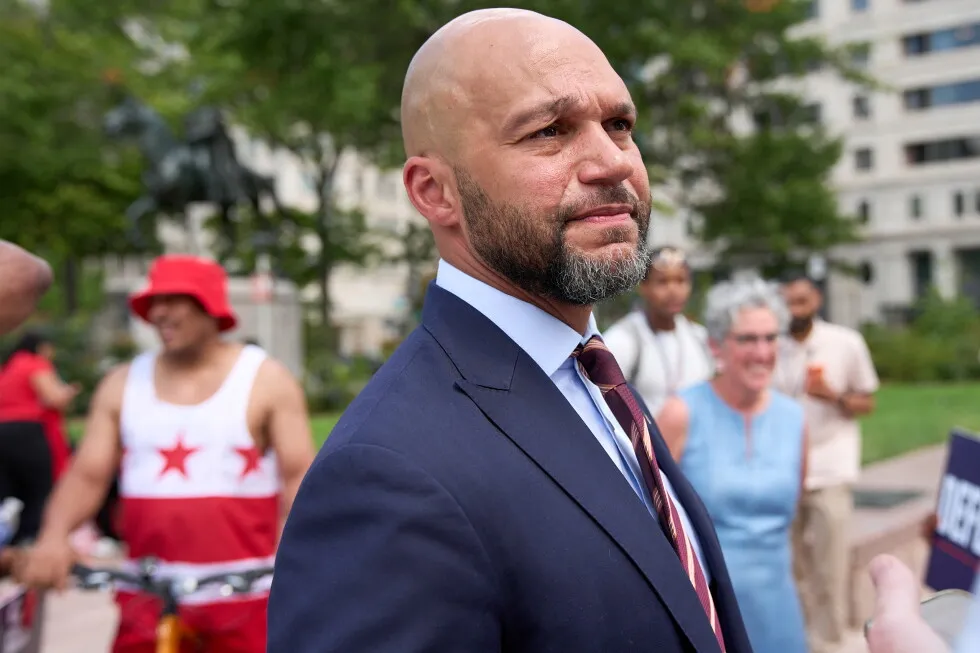
DC’s delegate candidate plans to target federal lawmakers challenging the city’s autonomy 1 of 2 | Congressional delegate candidate Robert White greets supporters after attending a news conference at Freedom Plaza in Washington, Monday, Aug. 24, 2026. (AP Photo/Jacquelyn Martin) 2 of 2 | Congressional delegate candidate Robert White, is hugged by District of Columbia Councilmember Elissa Silverman, left, after attending a news conference at Freedom Plaza in Washington, Monday, Aug. 24, 2026. (AP Photo/Jacquelyn Martin) By MATT BROWN and GARY FIELDS Updated 11:40 PM MESZ, August 24, 2026 Add AP News on Google Add AP News as your preferred source to see more of our stories on Google. Share Share Facebook Copy Link copied Print Email X LinkedIn Bluesky Flipboard Pinterest Reddit Washington (AP) — The District of Columbia’s presumptive incoming delegate to Congress unveiled a strategy Monday to counter Republican interventions in the city’s affairs by sending local residents to congressional districts in nearby states to stump for candidates who support greater autonomy for the nation’s capital. Robert White Jr., the Democratic nominee to be the district’s sole delegate to Congress, unveiled the “Defend DC” mobilization effort, which he said will recruit, train and transport city residents and supporters to canvass for candidates who support the district’s independence. White will also launch a political action committee to support candidates that back D.C. statehood and local control. “Congress has used its power over D.C. to attack us. So Washingtonians are banding together to use our collective power to change Congress,” White told a crowd of supporters in a downtown Washington plaza. The Constitution gives federal lawmakers authority over the District of Columbia, while the Home Rule Act of 1973 lets residents elect a mayor, a council and neighborhood commissioners. But Congress maintains significant control, including approving the budget and all laws passed by the D.C. Council. The D.C. delegate position is a nonvoting one, but it grants the nearly 700,000 people of the district, who have no other representation in Congress, a voice through speechmaking on the House floor and bill introduction. White’s plan comes as Washington during the second Trump administration has faced multiple new challenges to its autonomy, most visibly the ongoing deployment of the National Guard which has been extended into 2029. The plan will target U.S. House districts within driving distance of the nation’s capital in states like Pennsylvania, Virginia and New Jersey with members up for reelection who have backed President Donald Trump’s surge of federal agents into the district and who themselves have proposed efforts to overhaul the city’s governance. “If politicians somewhere else believe they can come into our city and take away our rights without consequences, then we will go into their communities, the communities that determine whether those politicians keep their jobs,” White said. Washington grapples with a National Guard deployment extended until 2029 4 MIN READ Guard deployment to Washington into 2029 will cost roughly $1.4B, estimate shows 4 MIN READ 14 Appeals court rules Trump can’t build White House ballroom without congressional approval 4 MIN READ 14 The program’s first target will be Rep. John McGuire, a Virginia Republican who introduced legislation last year that would codify into law Trump’s executive order, “ Making the District of Columbia Safe and Beautiful.” The order paved the way for the deployment of the National Guard and federal law enforcement agents onto the streets of Washington, D.C. Trump later also briefly federalized the city’s police force. This site is protected by reCAPTCHA and the Google and Terms of Service apply. D.C. Council Chair Phil Mendelson called White’s strategy necessary to protect D.C. residents’ constitutional rights. “Our current situation is one that was not imagined nor intended by the Founding Fathers,” Mendelson said. Taking the fight to the district’s congressional opponents has been central to White’s platform. He spoke of the strategy during debates. He also spoke of his plan the night of the June primary when he won the Democratic primary for the district’s delegate to Congress, ushering in generational change for a position long held by 18-term delegate Eleanor Holmes Norton. White’s win in the heavily Democratic city set him up to take the top spot in November’s general elections. Norton, 89 and a fixture of the Civil Rights movement, decided not to run again after facing growing concerns over her ability to forcefully push back against the Trump administration’s federal intervention into the city’s affairs. One of Norton’s key roles has been to push back against incursions by Republicans in Congress who have grown increasingly willing to step into local affairs, despite the city’s Home Rule. In recent years, Congress members have tried to overturn the district’s motorcycle helmet law and ban the district’s use of automated traffic cameras. White said he had spoken with House Minority Leader Hakeem Jeffries, D-N.Y., and Rep. Susan DelBene, the chair of House Democrats’ campaign arm, about the strategy. White modeled the strategy after one used by the district’s first delegate, Walter Fauntroy Jr., a civil rights legend who mobilized voters in several key races, most notably in 1972 in South Carolina. His efforts there were instrumental in defeating Rep. John McMillan, who chaired the House District Committee and routinely blocked the district’s efforts to govern itself. Michael Fauntroy, Fauntroy’s nephew, and the founding director of the Race, Politics, and Policy Center at George Mason University, said the elder Fauntroy drew on a relationship he had built during his civil rights work, especially in the South when he sought office and visited targeted districts. “His strategy was primarily to focus on those congressional districts in which the Black voters composed the margin of victory in a particular district,” said Michael Fauntroy, who authored “Home Rule or House Rule? Congress and the Erosion of Local Governance in the District of Columbia.” “At one point, there were roughly 100-some-odd districts around the country, primarily in the South in which the Black vote was the marginal vote,” he said. The situation is more complicated now. Gerrymandering has left few competitive districts, and Fauntroy said he doesn’t know what kind of network White has. “If you don’t have those connections, it’s going to be difficult to take the fight to somebody,” he said. MATT BROWN Brown covers national politics, federal policy and democracy issues for The Associated Press. twitter instagram mailto
SRCAssociated Press (AP)
LANGEN
LEANCenter
WORDS1 054
ENT11
MON · 2026-08-24 · 21:53 GMTBRIEF NSR-2026-0824-105520
NSR-2026-0824-105520News Report·EN·Political Strategy
DC’s delegate candidate plans to target federal lawmakers challenging the city’s autonomy
Robert White Jr., the Democratic nominee for D.C. delegate to Congress, has launched a strategy called "Defend DC" to counter Republican interference in the city's autonomy.
Associated Press (AP)Filed 2026-08-24 · 21:53 GMTLean · CenterRead · 5 min
Associated Press (AP)FIG 01
Reading time
5min
Word count
1 054words
Sources cited
2cited
Entities identified
11entities
Quality score
100%
§ 01
Briefing Summary
AI-generatedNEWSAR · AI
Robert White Jr., the Democratic nominee for D.C. delegate to Congress, has launched a strategy called "Defend DC" to counter Republican interference in the city's autonomy. The plan involves mobilizing D.C. residents and supporters to campaign in congressional districts in nearby states for candidates who support greater home rule for the nation's capital. White will also establish a political action committee to back candidates advocating for D.C. statehood and local control. This initiative comes amid increased federal intervention in D.C. affairs, particularly during the Trump administration, including the extended deployment of the National Guard. The strategy aims to hold accountable federal lawmakers who challenge D.C.'s self-governance by influencing their reelection prospects in their home districts.
Confidence 0.90Sources 2Claims 5Entities 11
§ 02
Article analysis
Model · rule-basedFraming
Political Strategy
Social Justice
Tone
Measured
AI-assessed
CalmNeutralAlarmist
Factuality
0.70 / 1.00
Factual
LowHigh
Sources cited
2
Limited
FewMany
§ 03
Key claims
5 extracted01
White will launch a political action committee to support candidates backing D.C. statehood and local control.
factualRobert White Jr.
Confidence
1.00
02
Congress has constitutional authority over the District of Columbia, including budget and law approval.
factual
Confidence
1.00
03
The D.C. delegate position is nonvoting but allows representation through speechmaking and bill introduction.
factual
Confidence
1.00
04
Robert White Jr. plans to mobilize D.C. residents to campaign in nearby states for candidates who support D.C. autonomy.
quoteRobert White Jr.
Confidence
1.00
05
Washington has faced new challenges to its autonomy during the second Trump administration, including National Guard deployments.
factual
Confidence
0.90
§ 04
Full report
5 min read · 1 054 words§ 05
Entities
11 identifiedKey playerOppositionContextPositiveNeutralNegative
Organizations3
Locations3
§ 06
Keywords & salience
10 termsdc autonomy
1.00
federal lawmakers
0.90
robert white jr.
0.80
d.c. statehood
0.70
home rule act
0.70
congressional delegate
0.60
local control
0.60
district of columbia
0.50
political action committee
0.50
republican interventions
0.40
§ 07
Topic connections
Interactive graph Network visualization showing 2 related topics
View Full Graph Person Organization Location Event|Click node to navigate|Edge numbers = shared articles