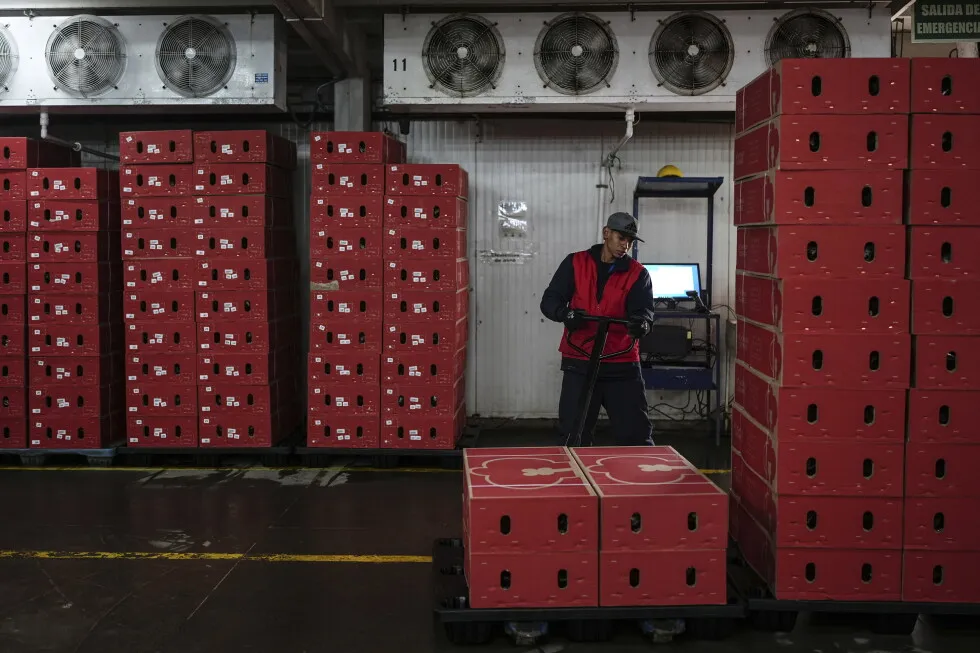
What are tariffs and how do they work? 0 seconds of 1 minute, 59 secondsVolume 0% Press shift question mark to access a list of keyboard shortcuts Keyboard ShortcutsEnabledDisabled Shortcuts Open/Close/ or ? Play/PauseSPACE Increase Volume↑ Decrease Volume↓ Seek Forward→ Seek Backward← Captions On/Offc Fullscreen/Exit Fullscreenf Mute/Unmutem Decrease Caption Size- Increase Caption Size+ or = Seek %0-9 Next Up Residents on both sides of Canada-border" class="entity-link entity-location" data-entity-id="192663" data-entity-type="location">US-Canada border decry new tariffs, breakdown in countries’ relationship 01:49 00:00 01:59 01:59 More Videos 01:49 Residents on both sides of Canada-border" class="entity-link entity-location" data-entity-id="192663" data-entity-type="location">US-Canada border decry new tariffs, breakdown in countries’ relationship 01:14 Trump praises deal to stave off Canada tariffs, says he’s going to meet with North Korea’s leader 01:09 AP Explains: Byron Donalds celebrates Republican nomination for Florida Governor 00:52 AP Top Stories August 19 01:19 Provincial leader says Trump is a ‘bad person’ as Canada weighs concessions for trade deal 01:03 AP top stories August 20 00:38 Migrant caravan sets out from southern Mexico amid asylum delays and unemployment 01:00 AP top stories August 19 Close 1 of 2 | President Donald Trump’s favorite economic tool is the tariff. In his first day in office, he said he planned to slap a 25% tariff on imports from Canada and Mexico -- and more are probably coming. 2 of 2 | A worker organizes boxes of flowers intended for export to the U.S. at a flower farm in Chia, on the outskirts of Bogota, Colombia, Monday, Jan. 27, 2025. (AP Photo/Ivan Valencia) By Paul Wiseman Updated 5:06 PM MESZ, February 1, 2025 Add AP News on Google Add AP News as your preferred source to see more of our stories on Google. Share Share Facebook Copy Link copied Print Email X LinkedIn Bluesky Flipboard Pinterest Reddit WASHINGTON (AP) — tariffs are in the news at the moment. Here’s what they are and what you need to know about them: tariffs are typically charged as a percentage of the price a buyer pays a foreign seller. In the United States, tariffs are collected by Customs and Border Protection agents at 328 ports of entry across the country. U.S. tariff rates vary: They are generally 2.5% on passenger cars, for instance, and 6% on golf shoes. tariffs can be lower for countries with which the United States has trade agreements. For example, most goods can move among the United States, Mexico and Canada tariff-free because of Trump’s Mexico-Canada-trade-agreement" class="entity-link entity-topic" data-entity-id="192664" data-entity-type="topic">US-Mexico-Canada trade agreement. Mainstream economists are generally skeptical of tariffs, considering them a mostly inefficient way for governments to raise money and promote prosperity. There’s much misinformation about who actually pays tariffs President Donald Trump, a proponent of tariffs, insists that they are paid for by foreign countries. In fact, it is importers — American companies — that pay tariffs, and the money goes to the U.S. Treasury. Those companies, in turn, typically pass their higher costs on to their customers in the form of higher prices. That’s why economists say consumers usually end up footing the bill for tariffs. Still, tariffs can hurt foreign countries by making their products pricier and harder to sell abroad. Foreign companies might have to cut prices — and sacrifice profits — to offset the tariffs and try to maintain their market share in the United States. Yang Zhou, an economist at Shanghai’s Fudan University, concluded in a study that Trump’s tariffs on Chinese goods inflicted more than three times as much damage to the Chinese economy as they did to the U.S. economy. Trump defends his sweeping tariffs and watches ‘America First’ drag races during Michigan stop 3 MIN READ 75 Trump says US and Canada have a trade deal, but key terms remain unclear 4 MIN READ 25 states sue over Trump’s new tariffs, calling them ‘pretext’ to replace his old ones 4 MIN READ What has Trump said about tariffs? Trump has said tariffs will create more factory jobs, shrink the federal deficit, lower food prices and allow the government to subsidize childcare. “tariffs are the greatest thing ever invented,’’ Trump said at a rally in Flint, Michigan, during his presidential campaign. As president, Trump imposed tariffs with a flourish — targeting imported solar panels, steel, aluminum and pretty much everything from China. Trump has promised even more and higher tariffs in his second term. The United States in recent years has gradually retreated from its post-World War II role of promoting global free trade and lower tariffs. That shift has been a response to the loss of U.S. manufacturing jobs, widely attributed to unfettered tree trade and an increasingly powerful China. tariffs are intended mainly to protect domestic industries By raising the price of imports, tariffs can protect home-grown manufacturers. They may also serve to punish foreign countries for committing unfair trade practices, like subsidizing their exporters or dumping products at unfairly low prices. Before the federal income tax was established in 1913, tariffs were a major revenue driver for the government. From 1790 to 1860, tariffs accounted for 90% of federal revenue, according to Douglas Irwin, a Dartmouth College economist who has studied the history of trade policy. tariffs fell out of favor as global trade grew after World War II. The government needed vastly bigger revenue streams to finance its operations. In the fiscal year that ended Sept. 30, the government collected around $80 billion in tariffs and fees. That’s a trifle next to the $2.5 trillion that comes from individual income taxes and the $1.7 trillion from Social Security and Medicare taxes. Still, Trump wants to enact a budget policy that resembles what was in place in the 19th century. tariffs can also be used to pressure other countries on issues that may or may not be related to trade. In 2019, for example, Trump used the threat of tariffs as leverage to persuade Mexico to crack down on waves of Central American migrants crossing Mexican territory on their way to the United States. “I can do it with a phone call,’’ he said at an August rally in North Carolina. If another country tries to start a war, he said he’d issue a threat: “We’re going to charge you 100% tariffs. And all of a sudden, the president or prime minister or dictator or whoever the hell is running the country says to me, ‘Sir, we won’t go to war.’ ” Economists generally consider tariffs self-defeating tariffs raise costs for companies and consumers that rely on imports. They’re also likely to provoke retaliation. The European Union, for example, punched back against Trump’s tariffs on steel and aluminum by taxing U.S. products, from bourbon to Harley-Davidson motorcycles. Likewise, China responded to Trump’s trade war by slapping tariffs on American goods, including soybeans and pork in a calculated drive to hurt his supporters in farm country. A study by economists at the Massachusetts Institute of Technology, the University of Zurich, Harvard and the World Bank concluded that Trump’s tariffs failed to restore jobs to the American heartland. The tariffs “neither raised nor lowered U.S. employment’’ where they were supposed to protect jobs, the study found. Despite Trump’s 2018 taxes on imported steel, for example, the number of jobs at U.S. steel plants barely budged: They remained right around 140,000. By comparison, Walmart alone employs 1.6 million people in the United States. Worse, the retaliatory taxes imposed by China and other nations on U.S. goods had “negative employment impacts,’’ especially for farmers, the study found. These retaliatory tariffs were only partly offset by billions in government aid that Trump doled out to farmers. The Trump tariffs also damaged companies that relied on targeted imports. If Trump’s trade war fizzled as policy, though, it succeeded as politics. The study found that support for Trump and Republican congressional candidates rose in areas most exposed to the import tariffs — the industrial Midwest and manufacturing-heavy Southern states like North Carolina and Tennessee.
SRCAssociated Press (AP)
LANGEN
LEANCenter
WORDS1 309
ENT12
TUE · 2026-08-25 · 02:53 GMTBRIEF NSR-2026-0825-105589
NSR-2026-0825-105589News Report·EN·Economic Impact
What are tariffs and how do they work?
Tariffs are taxes imposed on imported goods, typically calculated as a percentage of the purchase price. In the U.S., these taxes are collected by Customs and Border Protection.
Associated Press (AP)Filed 2026-08-25 · 02:53 GMTLean · CenterRead · 6 min
Associated Press (AP)FIG 01
Reading time
6min
Word count
1 309words
Sources cited
1cited
Entities identified
12entities
Quality score
100%
§ 01
Briefing Summary
AI-generatedNEWSAR · AI
Tariffs are taxes imposed on imported goods, typically calculated as a percentage of the purchase price. In the U.S., these taxes are collected by Customs and Border Protection. While former President Trump has claimed foreign countries pay tariffs, the article clarifies that American importers pay them, then often pass the increased costs to consumers. Economists generally view tariffs as an inefficient revenue-raising method and a potential cause of retaliatory measures from other countries. Tariffs can also be used as a tool for political leverage, as seen when Trump threatened them to influence Mexico's border policies. Studies suggest that Trump's tariffs have not significantly restored U.S. jobs and have negatively impacted American farmers due to retaliatory tariffs.
Confidence 0.90Sources 1Claims 5Entities 12
§ 02
Article analysis
Model · rule-basedFraming
Economic Impact
Political Strategy
Tone
Measured
AI-assessed
CalmNeutralAlarmist
Factuality
0.70 / 1.00
Factual
LowHigh
Sources cited
1
Limited
FewMany
§ 03
Key claims
5 extracted01
American companies — importers — pay tariffs, and the money goes to the U.S. Treasury.
factual
Confidence
1.00
02
Most goods can move among the United States, Mexico and Canada tariff-free because of Trump’s US-Mexico-Canada trade agreement.
factual
Confidence
1.00
03
In the United States, tariffs are collected by Customs and Border Protection agents at 328 ports of entry across the country.
factual
Confidence
1.00
04
Tariffs are typically charged as a percentage of the price a buyer pays a foreign seller.
factual
Confidence
1.00
05
Mainstream economists are generally skeptical of tariffs, considering them a mostly inefficient way for governments to raise money and promote prosperity.
quotemainstream economists
Confidence
0.90
§ 04
Full report
6 min read · 1 309 words§ 05
Entities
12 identifiedKey playerOppositionContextPositiveNeutralNegative
People3
Organizations1
Locations6
§ 06
Keywords & salience
8 termstariffs
1.00
trade agreements
0.80
us-canada border
0.70
donald trump
0.60
imports
0.50
economic tool
0.50
us-mexico-canada trade agreement
0.40
customs and border protection
0.40
§ 07
Topic connections
Interactive graph Network visualization showing 51 related topics
View Full Graph Person Organization Location Event|Click node to navigate|Edge numbers = shared articles