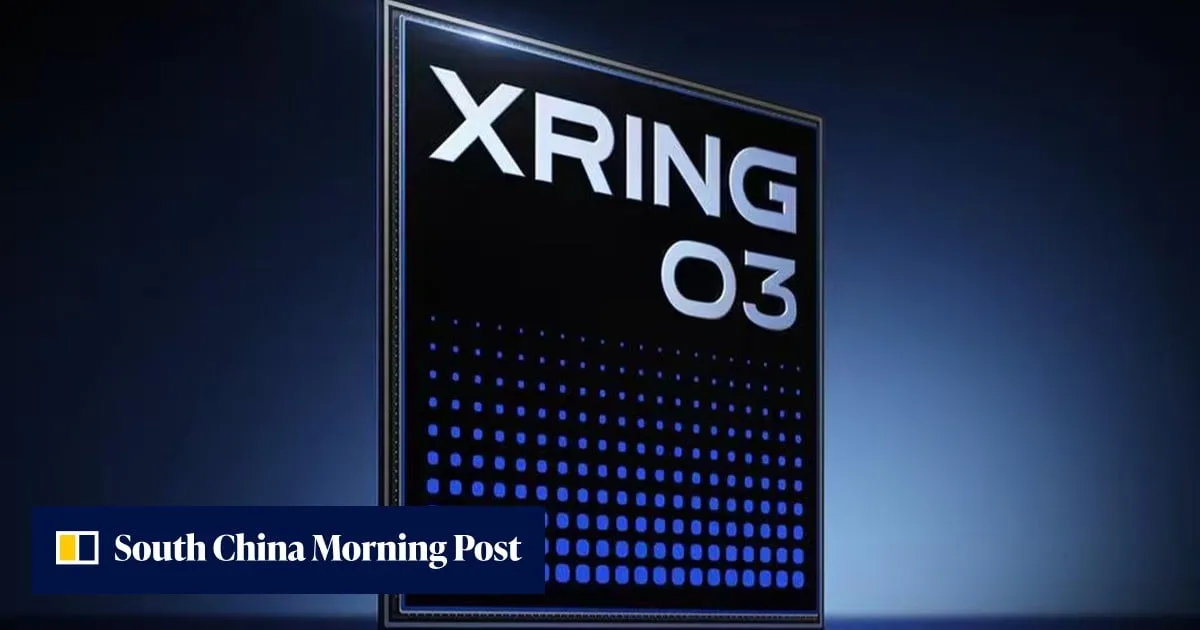
Xiaomi’s long-term push into proprietary silicon is laying the groundwork for complex Artificial Intelligence workloads on smartphones and cars, analysts say, as the Chinese tech giant doubles down on self-developed chips despite an earnings slump and soaring component costs.On Monday it unveiled its flagship Xring O3 3-nanometre AI processor for smartphones, which is scheduled to debut in September aboard its Xiaomi-18-fold" class="entity-link entity-topic" data-entity-id="192802" data-entity-type="topic">Xiaomi 18 Fold smartphone.The company has also introduced the Xring O100 – a 6nm AI accelerator designed to boost Xiaomi’s MiMo large language model when paired with the O3 – alongside a 3nm Xring D100 chip for autonomous driving. Xiaomi said both the O100 and D100 will be deployed commercially next year.
SRCSouth China Morning Post
LANGEN
LEANCenter-Right
WORDS112
ENT8
TUE · 2026-08-25 · 07:31 GMTBRIEF NSR-2026-0825-105639
NSR-2026-0825-105639News Report·EN·Technology
Why is Xiaomi doubling down on in-house chips despite profit slump?
Xiaomi is continuing its strategic investment in self-developed chips, including its new Xring O3 3-nanometre AI processor for smartphones, set to debut in September. This push, despite an earnings slump and rising component costs, is aimed at enabling complex artificial intelligence workloads for smartphones and cars.
Iris DengSouth China Morning PostFiled 2026-08-25 · 07:31 GMTLean · Center-RightRead · 1 min
South China Morning PostFIG 01
Reading time
1min
Word count
112words
Sources cited
1cited
Entities identified
8entities
Quality score
100%
§ 01
Briefing Summary
AI-generatedNEWSAR · AI
Xiaomi is continuing its strategic investment in self-developed chips, including its new Xring O3 3-nanometre AI processor for smartphones, set to debut in September. This push, despite an earnings slump and rising component costs, is aimed at enabling complex artificial intelligence workloads for smartphones and cars. The company also introduced the Xring O100, a 6nm AI accelerator for its MiMo large language model, and the 3nm Xring D100 chip for autonomous driving. Both the O100 and D100 are slated for commercial deployment next year. Analysts suggest this long-term strategy is preparing Xiaomi for future AI demands.
Confidence 0.85Sources 1Claims 5Entities 8
§ 02
Article analysis
Model · rule-basedFraming
Technology
Economic Impact
Tone
Measured
AI-assessed
CalmNeutralAlarmist
Factuality
0.70 / 1.00
Factual
LowHigh
Sources cited
1
Limited
FewMany
§ 03
Key claims
5 extracted01
Xiaomi also introduced a 3nm Xring D100 chip for autonomous driving.
factual
Confidence
1.00
02
Xiaomi introduced the Xring O100 – a 6nm AI accelerator designed to boost Xiaomi’s MiMo large language model.
factual
Confidence
1.00
03
Xiaomi unveiled its flagship Xring O3 3-nanometre AI processor for smartphones.
factual
Confidence
1.00
04
Xiaomi is doubling down on self-developed chips despite an earnings slump and soaring component costs.
factual
Confidence
1.00
05
The Xring O3 processor is scheduled to debut in September aboard the Xiaomi 18 Fold smartphone.
prediction
Confidence
0.90
§ 04
Full report
1 min read · 112 words§ 05
Entities
8 identifiedKey playerOppositionContextPositiveNeutralNegative
Organizations1
Locations1
§ 06
Keywords & salience
8 termsin-house chips
1.00
artificial intelligence
0.90
proprietary silicon
0.80
xiaomi
0.70
ai processor
0.70
autonomous driving
0.60
large language model
0.50
component costs
0.40
§ 07
Topic connections
Interactive graph Network visualization showing 16 related topics
View Full Graph Person Organization Location Event|Click node to navigate|Edge numbers = shared articles