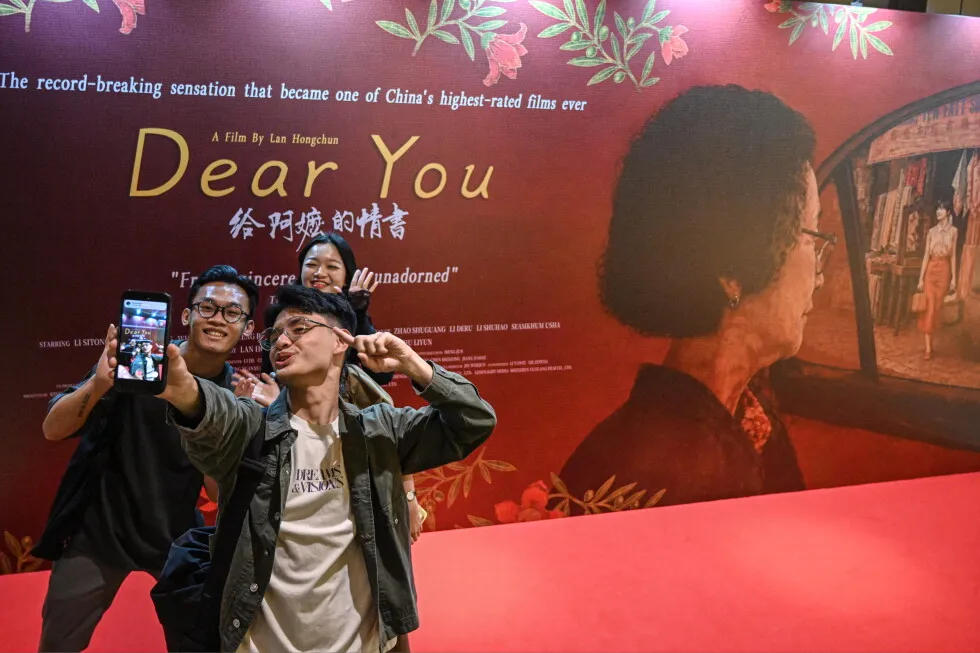
How a Chinese film shot in dialect is finding a global audience 1 of 5 | In this photo released by Xinhua News Agency, viewers take selfie in front of an for the Chinese film “Dear You” during its premiere in Jakarta, Indonesia, on Aug. 5, 2026. (Agung Kuncahya B./Xinhua via AP) 2 of 5 | A man walks past a poster for the movie “Dear You” at a shopping mall in Rayong, Thailand, on Aug. 10, 2026. (AP Photo/Sakchai Lalit) 3 of 5 | In this photo released by Xinhua News Agency, a woman takes photos during the special screening of Chinese film “Dear You” in Kuala Lumpur, Malaysia, on June 15, 2026. (Chen Zeguo/Xinhua via AP) 4 of 5 | In this photo released by Xinhua News Agency, audience react to the Chinese film “Dear You” during its premiere in Jakarta, Indonesia, on Aug. 5, 2026. (Agung Kuncahya B./Xinhua via AP) 5 of 5 | In this photo released by Xinhua News Agency, a poster is displayed outside a cinema before the premiere of Chinese film “Dear You” in London, on June 20, 2026. (Zhao Jiasong/Xinhua via AP) 1 of 5 | In this photo released by Xinhua News Agency, viewers take selfie in front of an for the Chinese film “Dear You” during its premiere in Jakarta, Indonesia, on Aug. 5, 2026. (Agung Kuncahya B./Xinhua via AP) 1 of 5 In this photo released by Xinhua News Agency, viewers take selfie in front of an for the Chinese film “Dear You” during its premiere in Jakarta, Indonesia, on Aug. 5, 2026. (Agung Kuncahya B./Xinhua via AP) Add AP News on Google Add AP News as your preferred source to see more of our stories on Google. Share 2 of 5 | A man walks past a poster for the movie “Dear You” at a shopping mall in Rayong, Thailand, on Aug. 10, 2026. (AP Photo/Sakchai Lalit) 2 of 5 A man walks past a poster for the movie “Dear You” at a shopping mall in Rayong, Thailand, on Aug. 10, 2026. (AP Photo/Sakchai Lalit) Add AP News on Google Add AP News as your preferred source to see more of our stories on Google. Share 3 of 5 | In this photo released by Xinhua News Agency, a woman takes photos during the special screening of Chinese film “Dear You” in Kuala Lumpur, Malaysia, on June 15, 2026. (Chen Zeguo/Xinhua via AP) 3 of 5 In this photo released by Xinhua News Agency, a woman takes photos during the special screening of Chinese film “Dear You” in Kuala Lumpur, Malaysia, on June 15, 2026. (Chen Zeguo/Xinhua via AP) Add AP News on Google Add AP News as your preferred source to see more of our stories on Google. Share 4 of 5 | In this photo released by Xinhua News Agency, audience react to the Chinese film “Dear You” during its premiere in Jakarta, Indonesia, on Aug. 5, 2026. (Agung Kuncahya B./Xinhua via AP) 4 of 5 In this photo released by Xinhua News Agency, audience react to the Chinese film “Dear You” during its premiere in Jakarta, Indonesia, on Aug. 5, 2026. (Agung Kuncahya B./Xinhua via AP) Add AP News on Google Add AP News as your preferred source to see more of our stories on Google. Share 5 of 5 | In this photo released by Xinhua News Agency, a poster is displayed outside a cinema before the premiere of Chinese film “Dear You” in London, on June 20, 2026. (Zhao Jiasong/Xinhua via AP) 5 of 5 In this photo released by Xinhua News Agency, a poster is displayed outside a cinema before the premiere of Chinese film “Dear You” in London, on June 20, 2026. (Zhao Jiasong/Xinhua via AP) Add AP News on Google Add AP News as your preferred source to see more of our stories on Google. Share Updated [hour]:[minute] [AMPM] [timezone], [monthFull] [day], [year] BANGKOK (AP) — The buzziest film in China this year was shot almost entirely in a southern Chinese dialect that most Chinese viewers need subtitles to understand.Yet “Dear You” has become China’s second-highest-grossing film of the year. Now it is heading overseas, part of a broader wave of Chinese cultural exports.“Dear You” was shot mostly in Teochew, a dialect spoken in Guangdong’s Shantou region. Set among the Teochew immigrant community in Bangkok, it tells the story of people who left China in search of work to support their families. Made on a low budget, it features a cast of mostly unknown actors.The film provides a glimpse into the centuries-long history of Chinese migration to Southeast Asia. It has succeeded in making this little-discussed history visible to a wider audience, threading the fine needle of passing official censorship requirements, experts say, while telling a compelling story. As of August, the movie had grossed about 269 million yuan ($40 million) at the Chinese box office. It was released in Thailand in early August after being shown in Singapore, Malaysia and Australia. It will be released in the U.S. next month. China is increasing its soft power with cultural exportsThe film’s popularity comes as Chinese culture and consumer brands have been gaining global cachet — from collectible Labubu dolls to “Chinamaxxing,” a social media trend of embracing aspects of the Chinese lifestyle. The Chinese government began promoting the film as it became a hit and prepared for its international release. 3 MIN READ ★★★★ 1 MIN READ 3 MIN READ The Chinese consul in Sydney said at a June screening of the film that it “reflects the Chinese nation’s virtues of diligence, kindness, courage and unity.” The movie aligns with Beijing’s broader goal of “telling China’s stories well,” highlighting themes of friendship, tradition and family, including motherhood and kinship, said Belinda He, an assistant professor of East Asian cinema and media studies at the University of Illinois Urbana-Champaign.China’s ambassador to Thailand presented the film at a special screening in July and again at a red carpet event this month.“We’re grateful to Guangdong for making such a wonderful film,” Chinese ambassador Zhang Jiangwei said at the red carpet event, which was attended by officials from Guangdong’s Information Office. “Stories about ordinary people and simple, genuine emotions can be even more moving. This film is an excellent vehicle for telling China’s story well.” Chinese migration to Southeast Asia has been ongoing for centuriesThe film first resonated in Malaysia and Singapore because it showcases a history that’s rarely featured in mainstream films. Chinese migration to Southeast Asia dates back centuries, with many migrants coming from the Guangdong and Fujian provinces in southern China. Many worked as laborers in building projects in an era of Western colonial rule across much of Asia.The film starts with a young man trying to find his grandfather, Deng Musheng, in hopes of getting a loan to repay his debts. In the family lore, there was supposedly a wealthy grandfather in Thailand, who left his young wife and children behind in China and never came back.Using an address on an old remittance letter his grandfather had sent, he meets people who became part of his grandfather’s life in Bangkok, uncovering the mystery of why his grandfather never returned. The film’s director, Lan Hongchun, wrote in a column for the People’s Daily, a state media outlet, that he grew up hearing stories from his grandmother about people she knew migrating to Bangkok, and wanted to tell these stories in film. The film also resonates with Thai Chinese viewersThe plot revolves around “qiaopi,” remittance letters used by Chinese immigrants to send money and news back home. Many workers who could not write Chinese relied on scribes to compose the letters.Scenes set in the centralized offices where the scribes worked, called “poy kuan,” were directly out of the childhood of 74-year-old Sathien Tuntipaiboontana. “I connected emotionally with that part of the film quite strongly,” he said after watching the first screening of the film in a Bangkok theater with his older sisters and sisters-in-law. Among them was his eldest sister, who is 89 and needed help climbing the stairs to the cinema.Their father had immigrated to Bangkok from China in search of work, leaving behind a wife and children. He ended up remarrying and never returned to China. But Sathien’s family continued to send remittances to the family left behind in China. Thitikorn Phanprayoon, a third-generation Thai Chinese, said he decided to see the film after hearing Teochew, the Chinese dialect he speaks at home, in the trailer. It surprised him since most Chinese films are in Mandarin. He plans to return with his parents.“I felt like I was sitting at home,” he said. “It felt like my family was performing in the movie in front of me.”___AP writer Fu Ting contributed to this story from Washington, D.C. Wu covers Chinese culture, society, and politics for The Associated Press, as well as the country’s growing overseas influence from Bangkok. She was previously based in Taiwan and China.
SRCAssociated Press (AP)
LANGEN
LEANCenter
WORDS1 495
ENT11
WED · 2026-08-26 · 01:23 GMTBRIEF NSR-2026-0826-105943
NSR-2026-0826-105943News Report·EN·Human Interest
How a Chinese film shot in dialect is finding a global audience
The Chinese film "Dear You," primarily shot in the Teochew dialect, has achieved significant success, becoming China's second-highest-grossing film of the year despite requiring subtitles for most viewers. The low-budget film, featuring unknown actors, tells the story of the Teochew immigrant community in Bangkok and their history of migration to Southeast Asia.
By
HUIZHONG WU and JINTAMAS SAKSORNCHAIAssociated Press (AP)Filed 2026-08-26 · 01:23 GMTLean · CenterRead · 6 min
Associated Press (AP)FIG 01
Reading time
6min
Word count
1 495words
Sources cited
0cited
Entities identified
11entities
Quality score
100%
§ 01
Briefing Summary
AI-generatedNEWSAR · AI
The Chinese film "Dear You," primarily shot in the Teochew dialect, has achieved significant success, becoming China's second-highest-grossing film of the year despite requiring subtitles for most viewers. The low-budget film, featuring unknown actors, tells the story of the Teochew immigrant community in Bangkok and their history of migration to Southeast Asia. "Dear You" has grossed approximately $40 million in China and is now being released internationally in countries like Thailand, Singapore, Malaysia, Australia, and soon the U.S. This success aligns with China's broader strategy to increase its soft power through cultural exports, with the government actively promoting the film. The movie resonates with audiences by highlighting themes of diligence, kindness, and family, and by bringing a lesser-discussed aspect of Chinese history to a wider audience.
Confidence 0.90Claims 5Entities 11
§ 02
Article analysis
Model · rule-basedFraming
Human Interest
Tone
Measured
AI-assessed
CalmNeutralAlarmist
Factuality
0.80 / 1.00
Factual
LowHigh
Sources cited
0
No named sources
FewMany
§ 03
Key claims
5 extracted01
A special screening of the film was held in Kuala Lumpur, Malaysia on June 15, 2026.
factual
Confidence
1.00
02
A poster for the movie “Dear You” was seen in Rayong, Thailand on Aug. 10, 2026.
factual
Confidence
1.00
03
The film premiered in Jakarta, Indonesia on Aug. 5, 2026.
factual
Confidence
1.00
04
The film is shot in dialect.
factual
Confidence
1.00
05
The Chinese film “Dear You” is finding a global audience.
factual
Confidence
0.90
§ 04
Full report
6 min read · 1 495 words§ 05
Entities
11 identifiedKey playerOppositionContextPositiveNeutralNegative
Locations8
§ 06
Keywords & salience
8 termschinese film
1.00
global audience
0.90
dialect
0.80
dear you
0.70
film industry
0.60
international distribution
0.50
cultural exchange
0.50
cinema
0.40
§ 07
Topic connections
Interactive graph Network visualization showing 9 related topics
View Full Graph Person Organization Location Event|Click node to navigate|Edge numbers = shared articles