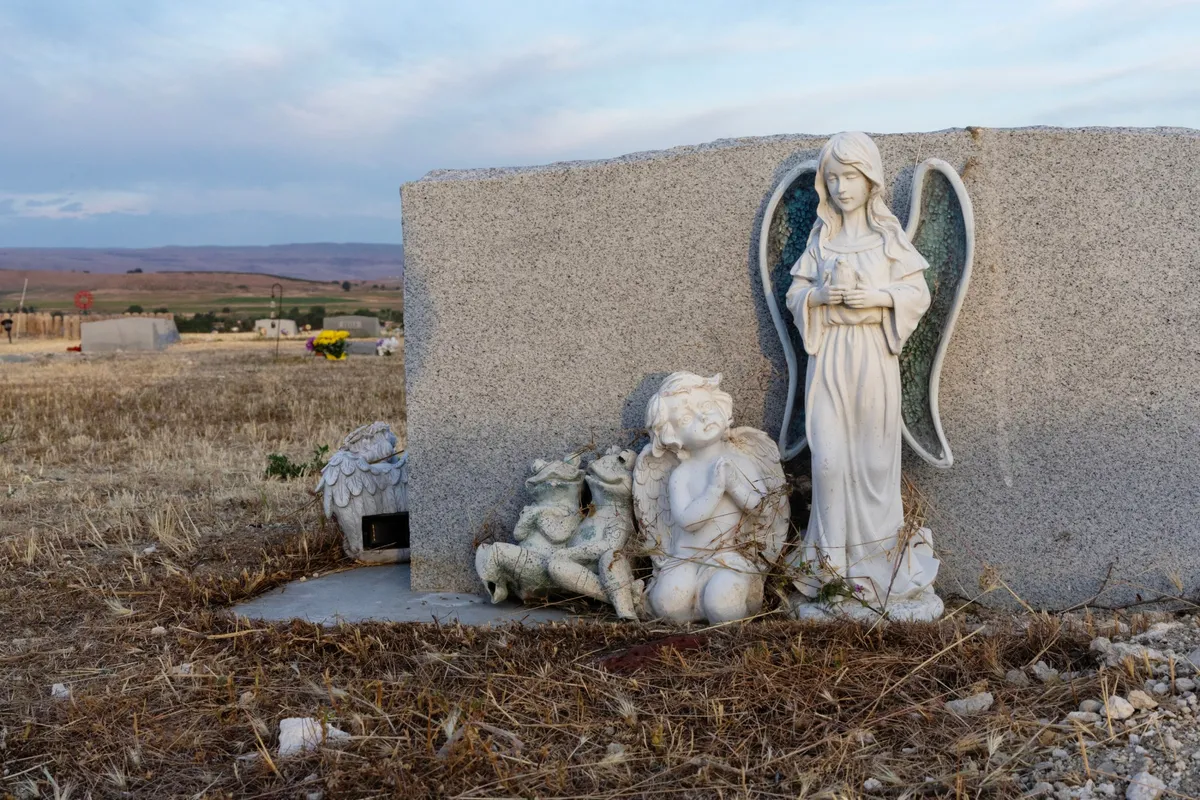
Members of the faith-healing sect Followers of Christ bury loved ones, many of them children and infants, in Peaceful Valley Cemetery in Caldwell, Idaho Sarah A. Miller for ProPublica In Idaho, parents who say their faith prohibits lifesaving medical care for their children can’t be charged with child neglect or manslaughter. Supporters of this protection over the years have included lawmakers who voiced support for “traditional” Idaho values. But from at least the 1880s through the early 1970s, it was illegal for parents in Idaho to choose prayer over medical care when a child’s life was at stake, newspaper archives and historical documents show. “Every parent of any child who willfully omits, without lawful excuse, to furnish necessary food, clothing, shelter, or medical attendance for such child, is guilty of a misdemeanor,” reads the 1887 edition of Idaho territory statutes , published before statehood. The statutes included no mention of spiritual belief as a “lawful excuse.” Three years later, the state constitution explicitly put limits on Idaho’s freedom of religion. It would not excuse “acts of licentiousness,” polygamy or other practices “inconsistent with morality or the peace or safety of the state.” It wasn’t long before the law came down on members of the Followers of Christ, a faith-healing sect that arrived in Idaho in 1899 and remains active in the state. From 2015 to 2025, the sect’s congregations in Idaho experienced 15 preventable deaths of children , according to ProPublica’s reporting. Children in a Faith-Healing Sect Keep Dying. The State Lets It Happen. Pearl Annis was a 13-year-old girl whose parents had moved from Oklahoma to Idaho’s Magic Valley in the spring of 1915 with at least one other Followers family. The Annises and their 13 children shared “a two-room shack,” a local newspaper reported. An officer and a doctor visited the home after neighbors voiced concern. They found Pearl in bed, fully dressed and on the cusp of death. Her father, Lurid P. “Lewis” Annis, was arrested on a misdemeanor charge of refusing to provide medical attention. Pearl was taken to the hospital, according to the news story, and died there with what today would be described as septic shock from a bowel blockage. The newspaper, which didn’t appear to follow up on Annis’ criminal charge, called the Followers church “a religious cult” and Pearl’s death a consequence of “religious mania.” News archives and historic records don’t say how many times Idaho acted on similar cases in the decades after. But one legal battle over lifesaving care drew attention in the 1960s, as sickness made its way through a Followers family in a Boise suburb. The mother died in December 1965. Her 4-year-old daughter died the following June. Days after the girl’s death, a judge ordered the state to take custody of her 10-year-old brother under Idaho’s child protection law. The boy was admitted to a local hospital with pneumonia, a complication of the measles. He spent days in critical condition but survived. The judge told the father that to regain custody, he would have to be willing to give the boy medical care as the law required. A doctor testified that without the hospitalization, the child “almost certainly would have died,” a newspaper report said. The father’s lawyer told the judge that his sect was rooted in “faith that God will heal the sick.” The law in the 1960s was clear, though: a parent had a duty to protect their child’s health, no exceptions. The judge told Samuel’s father: “The law governs conduct. Religion governs opinion.” But the legal landscape was about to shift. It came with little public attention. During a full-on rewrite of Idaho’s criminal code in 1971, the Legislature added a section that said the state could not bring endangerment charges against someone “who chooses for his child treatment by prayer or spiritual means alone.” Legislative records don’t make clear how the wording originated. The passage of another law one year later, affirming the “spiritual means” language and applying it to other crimes, has been credited to the Christian Science church, another Christian denomination with Idaho members. (The Christian Science website says the church’s practice of “healing in the way Christ Jesus taught” is not “faith healing” and that members are free to choose any form of healthcare . The church also supported Oregon’s full removal of its faith-healing exemption in 2011.) Faith-healing exemptions soon became widespread nationally. The trigger was the federal Child Abuse Prevention and Treatment Act of 1974 , which set out to standardize the nation’s child welfare system by giving states grants to more effectively investigate reports of child abuse. The Department of Health, Education and Welfare interpreted the law as requiring states to have a faith-healing exemption to qualify for the grants — an interpretation that records from the time don’t explain. Most states went along, and Idaho further broadened its exemption in 1976 to not only keep faith healers from going to jail if their children died, but also to keep their children from being placed in foster care solely for lack of medical care. At the national level, the mandate lasted less than a decade. The Reagan administration adopted new regulations in 1983 that took a neutral stance on the subject, and several states in subsequent years rolled back their exemptions. Colorado, for example, reverted to prosecuting faith healers as it would any other parent in 2001 following deaths in the Followers-adjacent sect Church of the First Born, including the death of a 13-year-old girl from untreated diabetes. But Idaho clung to its special treatment for faith healers. It has remained that way ever since. The post Idaho Law Protects Faith Healers. It Wasn’t Always That Way. appeared first on ProPublica .
SRCProPublica
LANGEN
LEANCenter-Left
WORDS955
ENT12
WED · 2026-08-26 · 09:00 GMTBRIEF NSR-2026-0826-106051
NSR-2026-0826-106051News Report·EN·Public Health
Idaho Law Protects Faith Healers. It Wasn’t Always That Way.
Idaho law now protects parents who refuse medical care for their children based on religious beliefs, a protection that was not always in place. Historically, from the late 1800s to the early 1970s, Idaho law prohibited parents from neglecting their children's medical needs, regardless of religious objections.
Audrey DuttonProPublicaFiled 2026-08-26 · 09:00 GMTLean · Center-LeftRead · 4 min
ProPublicaFIG 01
Reading time
4min
Word count
955words
Sources cited
3cited
Entities identified
12entities
Quality score
100%
§ 01
Briefing Summary
AI-generatedNEWSAR · AI
Idaho law now protects parents who refuse medical care for their children based on religious beliefs, a protection that was not always in place. Historically, from the late 1800s to the early 1970s, Idaho law prohibited parents from neglecting their children's medical needs, regardless of religious objections. This changed in 1971 when the state legislature added a provision allowing endangerment charges to be dropped if parents opted for prayer or spiritual means alone for their children's treatment. This shift was influenced by a federal act in 1974 that incentivized states to adopt faith-healing exemptions to receive child welfare grants. While many states later rolled back these exemptions, Idaho has maintained its protection for faith healers, leading to preventable child deaths within sects like the Followers of Christ.
Confidence 0.90Sources 3Claims 5Entities 12
§ 02
Article analysis
Model · rule-basedFraming
Public Health
Legal & Judicial
Tone
Mixed Tone
AI-assessed
CalmNeutralAlarmist
Factuality
0.80 / 1.00
Factual
LowHigh
Sources cited
3
Well sourced
FewMany
§ 03
Key claims
5 extracted01
The state constitution of Idaho, from 1890, would not excuse religious practices 'inconsistent with morality or the peace or safety of the state.'
factual
Confidence
1.00
02
From 1887 through the early 1970s, it was illegal in Idaho for parents to choose prayer over medical care for a child's life.
factual
Confidence
1.00
03
Idaho law protects parents who prioritize faith healing over medical care for children from child neglect or manslaughter charges.
factual
Confidence
1.00
04
In 1915, a 13-year-old girl named Pearl Annis died of septic shock from a bowel blockage after her parents chose faith healing.
factual
Confidence
0.90
05
From 2015 to 2025, Followers of Christ congregations in Idaho experienced 15 preventable child deaths.
statisticProPublica's reporting
Confidence
0.90
§ 04
Full report
4 min read · 955 words§ 05
Entities
12 identifiedKey playerOppositionContextPositiveNeutralNegative
People3
Locations4
§ 06
Keywords & salience
8 termsfaith healing
1.00
child neglect
0.90
religious freedom
0.80
medical care
0.70
followers of christ
0.60
idaho
0.60
child deaths
0.50
legal protection
0.40
§ 07
Topic connections
Interactive graph Network visualization showing 14 related topics
View Full Graph Person Organization Location Event|Click node to navigate|Edge numbers = shared articles