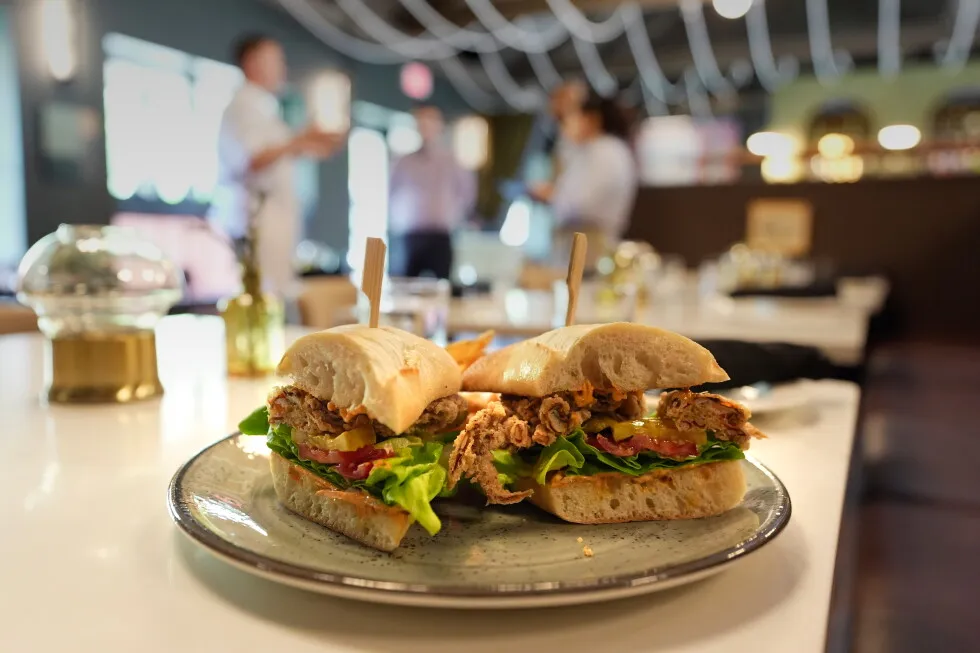
Invasive European green crabs are destroying valuable New England fisheries, but a coalition of oyster farmers, scientists, volunteers and chefs are developing a dining market to curb the aggressive predators. (AP Video and Production: Rodrique Ngowi.) Updated [hour]:[minute] [AMPM] [timezone], [monthFull] [day], [year] YORK, Maine (AP) — As a morning fog lifted over Maine’s York River, Mike Masi and his two interns stood on a dock sorting through a mound of one of the region’s most despised crabs and hoped to find a few that would end up on a gastronome’s plate somewhere in New England.The trick is to identify invasive European green crabs that are about to shed their hard shell, or molt, revealing a softer exterior that has the feel of a leather couch, and are popular at restaurants. Not only do these green crabs fetch more money — Masi can get $3 a crab at market compared to as little as 8 cents for a hard shell — but catching them provides a service of sorts to the ocean’s ecosystem.“Just about everyone hates them and we’re trying to turn them into a premium seafood product,” said Masi, whose company, shell+claw, is the only one that commercially cultivates these crabs. Harvester Mike Masi dumps a trap full of green crabs into a crate while working on the York River, Thursday, June 11, 2026, in York, Maine. (AP Photo/Robert F. Bukaty) Harvester Mike Masi dumps a trap full of green crabs into a crate while working on the York River, Thursday, June 11, 2026, in York, Maine. (AP Photo/Robert F. Bukaty) Add AP News on Google Add AP News as your preferred source to see more of our stories on Google. Share Interns Grace Welles, left, and Jackson Martine, center, sort green crabs with Mike Masi while working the York River, Thursday, June 11, 2026, in York, Maine. (AP Photo/Robert F. Bukaty) Interns Grace Welles, left, and Jackson Martine, center, sort green crabs with Mike Masi while working the York River, Thursday, June 11, 2026, in York, Maine. (AP Photo/Robert F. Bukaty) Add AP News on Google Add AP News as your preferred source to see more of our stories on Google. Share Masi, a 45-year-old former marine science teacher, is part of a growing movement across New England aiming to lessen the crabs’ destructive impact by developing new markets. Others are putting green crabs in pet treats, fish sauce and even a line of green crab whiskey in New Hampshire. The green crabs, Carcinus maenas, made their way from Europe to the East Coast in the ballast waters of ships hundreds of years ago. Numbering in the tens of millions, they outcompete Atlantic rock crab and juvenile lobster, destroy eelgrass beds and undermine salt marsh banks. They also are costing the region’s shellfish industry tens of millions of dollars each year, as they eat mussels, oysters and soft-shell clams. Chad Coffin, a clam fisherman from Maine, blamed a dramatic decline in his catch on the emergence of green crabs. Soft-shell clam landings have gone from 7.8 million meat pounds in 1978 to 1.3 million pounds in 2025, according to the state. Chad Coffin wipes sweat from his face while harvesting clams in the mud at low tide on the Harraseeket River, Tuesday, June 16, 2026, in Freeport, Maine. (AP Photo/Robert F. Bukaty) Chad Coffin wipes sweat from his face while harvesting clams in the mud at low tide on the Harraseeket River, Tuesday, June 16, 2026, in Freeport, Maine. (AP Photo/Robert F. Bukaty) Add AP News on Google Add AP News as your preferred source to see more of our stories on Google. Share Chad Coffin harvests clams on the Harraseeket River, Tuesday, June 16, 2026, in Freeport, Maine. (AP Photo/Robert F. Bukaty) Chad Coffin harvests clams on the Harraseeket River, Tuesday, June 16, 2026, in Freeport, Maine. (AP Photo/Robert F. Bukaty) Add AP News on Google Add AP News as your preferred source to see more of our stories on Google. Share Clam digger Chad Coffin heads out onto a mudflat at low tide on the Harraseeket River, Tuesday, June 16, 2026, in Freeport, Maine. (AP Photo/Robert F. Bukaty) Clam digger Chad Coffin heads out onto a mudflat at low tide on the Harraseeket River, Tuesday, June 16, 2026, in Freeport, Maine. (AP Photo/Robert F. Bukaty) Add AP News on Google Add AP News as your preferred source to see more of our stories on Google. Share Climate change is helping the crabs Green crabs, known for their brown or green shells and five spines on either side of their eyes, have taken advantage of warming ocean waters, a result of climate change that’s driven mostly by the release of greenhouse gases when coal, oil and gas are burned. The crabs are able to survive New England winters while also thriving in a range of diverse habitats. They eat almost anything and produce plenty of young; a female will release up to 185,000 eggs once or twice a year. A mass of thousands of eggs clings to the abdomen of a female green crab caught on the Harraseeket River, Friday, June 19, 2026, in Freeport, Maine. (AP Photo/Robert F. Bukaty) A mass of thousands of eggs clings to the abdomen of a female green crab caught on the Harraseeket River, Friday, June 19, 2026, in Freeport, Maine. (AP Photo/Robert F. Bukaty) Add AP News on Google Add AP News as your preferred source to see more of our stories on Google. Share These traits have made them among the world’s most successful invasive species, expanding along the West Coast and into Alaska and reaching South Africa, Japan, Argentina and Australia.“They’re really pretty resilient little guys,” said Carolyn Tepolt, an evolutionary biologist at Woods Hole Oceanographic Institution who has studied green crabs for two decades and uses them to understand why some species thrive in different environments.Large-scale crab fishery remains elusive Green crabs are segregated into “crab condos” before harvesting Thursday, June 11, 2026, in York, Maine. (AP Photo/Robert F. Bukaty) Green crabs are segregated into “crab condos” before harvesting Thursday, June 11, 2026, in York, Maine. (AP Photo/Robert F. Bukaty) Add AP News on Google Add AP News as your preferred source to see more of our stories on Google. Share For the past decade, the region’s campaign to combat the crab invasion has been a grassroots affair that has had minimal impact on their numbers.While a growing list of restaurants and seafood businesses are offering green crab, there are very few New England fishermen catching the crabs and almost no infrastructure to process the catch and get them to market. There isn’t even enough data to show how many crabs a fishery in New England could support, though experts say capacity is far higher than currently being caught.Marissa McMahan, vice president of fisheries at Manomet Conservation Sciences, says that people in Washington County, Maine, on the Canadian border, tell her they can catch “as many green crabs as you could ever possibly want.” “But they can’t get them on a truck and get them to where they need to actually be, and often that’s Boston or New Bedford or New York City,” she said. “That is a huge impediment.”Small steps have been taken. Rhode Island passed a law that offers a green crab fishing license for just $10, Connecticut now allows crabs to be sold to restaurants without extra permitting, and Maine made it easier to get the crabs to market. University of Miami intern Grace Welles sorts pre-molt green crabs Thursday, June 11, 2026, in York, Maine. (AP Photo/Robert F. Bukaty) University of Miami intern Grace Welles sorts pre-molt green crabs Thursday, June 11, 2026, in York, Maine. (AP Photo/Robert F. Bukaty) Add AP News on Google Add AP News as your preferred source to see more of our stories on Google. Share The soft shell of a molting green crab is detached, revealing the crab’s meat, Thursday, June 11, 2026, in York, Maine. (AP Photo/Robert F. Bukaty) The soft shell of a molting green crab is detached, revealing the crab’s meat, Thursday, June 11, 2026, in York, Maine. (AP Photo/Robert F. Bukaty) Add AP News on Google Add AP News as your preferred source to see more of our stories on Google. Share The problem, many advocates say, is the absence of significant government support in New England. Only Massachusetts offers incentives to catch them: Fishermen receive 40 cents per pound on top of what they get selling them, up to $100,000 per year. Meanwhile, Washington state declared an emergency in 2022 and expects to spend more than $38 million in state and federal funds through fiscal year 2027 eradicating the crabs. So far this year, nearly 2 million crabs have been caught and mostly converted into 135,000 pounds of waste that goes to an organic fertilizer company. The Shoalwater Bay Indian Tribe and Lummi Nation also catch crabs and use them as compost.“We’ve got treaty-protected fisheries at risk and critical habitats that are used by all sorts of native species, so we’re really worried that we’ll start to see those types of effects that they saw on the East Coast if we let the population get established,” said Raquel Crosier, the deputy director of the state’s Fish Program. Some diners are loving green crab A breaded green crab is pulled from a fryer at Signal restaurant Tuesday, June 16, 2026, in Kennebunk, Maine. (AP Photo/Robert F. Bukaty) A breaded green crab is pulled from a fryer at Signal restaurant Tuesday, June 16, 2026, in Kennebunk, Maine. (AP Photo/Robert F. Bukaty) Add AP News on Google Add AP News as your preferred source to see more of our stories on Google. Share The good news in New England is that there is a growing appetite for green crab.Since 2021, advocates have seen a more than 10-fold increase in restaurants offering crab. Some are putting fried green crab in sandwiches, on top of pasta dishes and in their sauces. Many take part in green crab weeks that happen during the roughly two-month softshell season.PAGU, a Spanish Japanese tapas restaurant in Cambridge, Massachusetts, puts the crustaceans into the broth of its green crab laksa, a Malaysian-inspired noodle soup, and, when available, puts a tempura-fried soft-shell green crab inside a steamed bun called bao. “These crabs are way more potent in terms of flavor,” said PAGU’s chef and owner Tracy Chang. Executive chef Benjamin Hasty drops a breaded green crab into a fryer at Signal restaurant Tuesday, June 16, 2026, in Kennebunk, Maine. (AP Photo/Robert F. Bukaty) Executive chef Benjamin Hasty drops a breaded green crab into a fryer at Signal restaurant Tuesday, June 16, 2026, in Kennebunk, Maine. (AP Photo/Robert F. Bukaty) Add AP News on Google Add AP News as your preferred source to see more of our stories on Google. Share A breaded green crab sandwich is served at Signal restaurant Tuesday, June 16, 2026, in Kennebunk, Maine. (AP Photo/Robert F. Bukaty) A breaded green crab sandwich is served at Signal restaurant Tuesday, June 16, 2026, in Kennebunk, Maine. (AP Photo/Robert F. Bukaty) Add AP News on Google Add AP News as your preferred source to see more of our stories on Google. Share Comparing them to king, stone or Jonah crabs, she added: “Those all have just kind of like a sweet light crab flavor and this has like a really rich deep like luscious crab flavor.”Sitting in the crowded restaurant, Dr. William Li, a physician and author, took his first bite from his bao. Tangy, sweet and crunchy with its claws sticking out, the dish caught Li’s attention because he loves crab.“This is kind of like a bite-sized treat to elevate your health,” Li said. “This green crab bao was spectacular, filled with flavor, easy to eat, and very tasty.” Grace Welles, left, places a mesh basket containing small green crabs into submerged grow cages while working with Jackson Martine on the York River, Thursday, June 11, 2026, in York, Maine. (AP Photo/Robert F. Bukaty) Grace Welles, left, places a mesh basket containing small green crabs into submerged grow cages while working with Jackson Martine on the York River, Thursday, June 11, 2026, in York, Maine. (AP Photo/Robert F. Bukaty) Add AP News on Google Add AP News as your preferred source to see more of our stories on Google. Share Back out on the water with Masi, however, it feels like industrial-scale green crabbing is a long way off.Masi’s system is labor intensive: His crew picks through thousands of green crabs by hand to spot those about to molt. Caught in the wild, the crabs are stored out on the water. Once they show signs of molting or busting, the crabs are relocated into a network of tubes in lobster crates.Masi’s business has grown since he began five years ago, but he says it still feels like a hobby that brings in up to $20,000 annually. He remains bullish on a green crab fishery, talking of one day getting a bigger boat and improving efficiency. His inspiration is a centuries-old fishery in Venice, where green crabs, which are native there, are caught by families and fried to make a dish called moeche, among other delicacies.“I am cautiously optimistic about the potential for green crabs,” Masi said. “We are one breakthrough from making this a profitable business.”___The Associated Press’ climate and environmental coverage receives financial support from multiple private foundations. AP is solely responsible for all content. Find AP’s standards for working with philanthropies, a list of supporters and funded coverage areas at AP.org. Casey writes about the environment, housing and inequality for The Associated Press. He lives in Boston.
SRCAssociated Press (AP)
LANGEN
LEANCenter
WORDS2 278
ENT12
WED · 2026-08-26 · 13:23 GMTBRIEF NSR-2026-0826-106137
NSR-2026-0826-106137News Report·EN·Environmental
Invasive green crabs are bad for the environment so New Englanders are starting to eat more of them
Invasive European green crabs are causing significant damage to New England's fisheries and ecosystems. To combat this, a growing movement is developing new markets for these crabs, including culinary uses, pet treats, and even whiskey.
By
MICHAEL CASEYAssociated Press (AP)Filed 2026-08-26 · 13:23 GMTLean · CenterRead · 10 min
Associated Press (AP)FIG 01
Reading time
10min
Word count
2 278words
Sources cited
3cited
Entities identified
12entities
Quality score
100%
§ 01
Briefing Summary
AI-generatedNEWSAR · AI
Invasive European green crabs are causing significant damage to New England's fisheries and ecosystems. To combat this, a growing movement is developing new markets for these crabs, including culinary uses, pet treats, and even whiskey. Fishermen like Mike Masi are focusing on catching "soft-shell" green crabs, which are more valuable and help reduce the invasive population. These crabs, introduced from Europe centuries ago, outcompete native species, destroy habitats, and cost the shellfish industry millions annually. While some states are making it easier to sell green crabs, the development of a large-scale fishery faces challenges due to a lack of infrastructure and government support. Despite these hurdles, there's increasing consumer interest, with restaurants offering green crab dishes, and advocates are cautiously optimistic about the potential for a profitable fishery.
Confidence 0.90Sources 3Claims 5Entities 12
§ 02
Article analysis
Model · rule-basedFraming
Environmental
Economic Impact
Tone
Measured
AI-assessed
CalmNeutralAlarmist
Factuality
0.80 / 1.00
Factual
LowHigh
Sources cited
3
Well sourced
FewMany
§ 03
Key claims
5 extracted01
Green crabs outcompete native species, destroy eelgrass beds, and undermine salt marsh banks.
factual
Confidence
0.90
02
Mike Masi can get $3 per soft-shell green crab at market, compared to as little as 8 cents for a hard-shell crab.
statisticMike Masi
Confidence
0.90
03
A coalition of oyster farmers, scientists, volunteers, and chefs are developing a dining market for green crabs to curb their population.
factual
Confidence
0.90
04
Invasive European green crabs are destroying valuable New England fisheries and costing the region's shellfish industry tens of millions of dollars annually.
factual
Confidence
0.90
05
Soft-shell clam landings have declined dramatically due to the emergence of green crabs.
statisticChad Coffin
Confidence
0.80
§ 04
Full report
10 min read · 2 278 words§ 05
Entities
12 identifiedKey playerOppositionContextPositiveNeutralNegative
People4
Organizations2
Locations4
§ 06
Keywords & salience
10 termsinvasive green crabs
1.00
new england fisheries
0.90
oyster farmers
0.70
culinary market
0.70
shelling crabs
0.60
premium seafood
0.50
ecosystem
0.50
pet treats
0.40
fish sauce
0.40
destructive impact
0.40
§ 07
Topic connections
Interactive graph No topic relationship data available yet. This graph will appear once topic relationships have been computed.