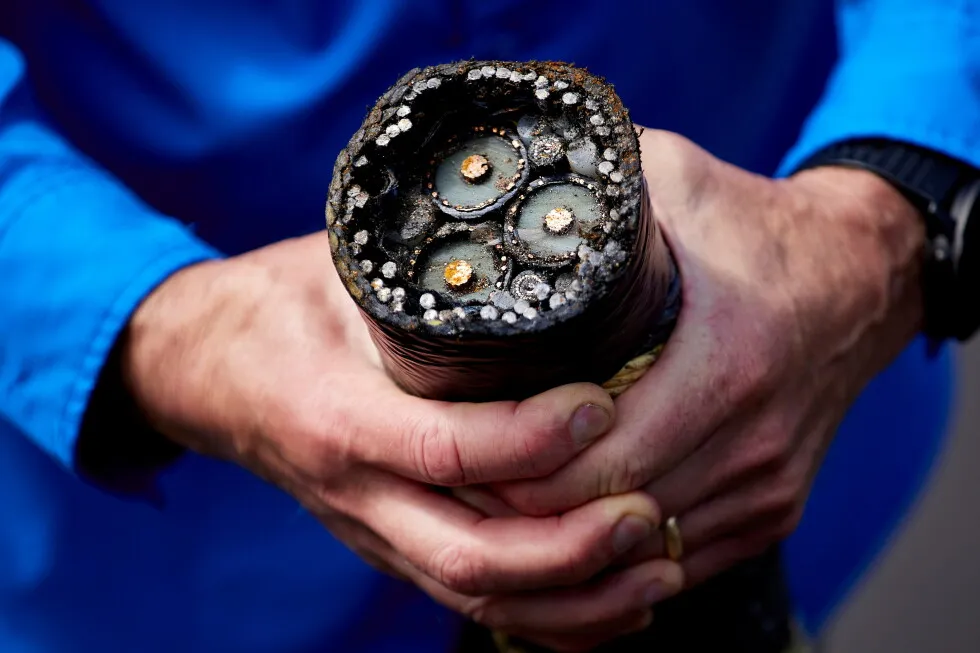
wave energy testing site opens off Oregon, a green energy milestone in the Trump administration 1 of 2 | Burke Hales, chief scientist for the PacWave wave energy test site overseen by Oregon-state-university" class="entity-link entity-organization" data-entity-id="92303" data-entity-type="organization">Oregon State University, shows the electric cables that are buried under the seabed near Newport, Ore., Aug. 23, 2024. (AP Photo/Craig Mitchelldyer, File) 2 of 2 | The area around the city of Newport, Ore. is visible from the Pacific Ocean near the PacWave South wave energy test site Aug. 23, 2024. (AP Photo/Craig Mitchelldyer, File) 1 of 2 | Burke Hales, chief scientist for the PacWave wave energy test site overseen by Oregon-state-university" class="entity-link entity-organization" data-entity-id="92303" data-entity-type="organization">Oregon State University, shows the electric cables that are buried under the seabed near Newport, Ore., Aug. 23, 2024. (AP Photo/Craig Mitchelldyer, File) 1 of 2 Burke Hales, chief scientist for the PacWave wave energy test site overseen by Oregon-state-university" class="entity-link entity-organization" data-entity-id="92303" data-entity-type="organization">Oregon State University, shows the electric cables that are buried under the seabed near Newport, Ore., Aug. 23, 2024. (AP Photo/Craig Mitchelldyer, File) Add AP News on Google Add AP News as your preferred source to see more of our stories on Google. Share 2 of 2 | The area around the city of Newport, Ore. is visible from the Pacific Ocean near the PacWave South wave energy test site Aug. 23, 2024. (AP Photo/Craig Mitchelldyer, File) 2 of 2 The area around the city of Newport, Ore. is visible from the Pacific Ocean near the PacWave South wave energy test site Aug. 23, 2024. (AP Photo/Craig Mitchelldyer, File) Add AP News on Google Add AP News as your preferred source to see more of our stories on Google. Share Updated [hour]:[minute] [AMPM] [timezone], [monthFull] [day], [year] The first large site in the continental U.S. for testing technologies that generate electricity from ocean waves is now open after securing a key green-energy approval from the Trump administration.The federal approval is notable because President Donald Trump has created massive hurdles for clean energy, particularly offshore wind. His government has implemented policies that slow energy permitting and development, canceled billions in grants for hundreds of clean energy projects and spent nearly $4 billion to buy back leases to stop offshore wind projects. But Trump officials see promise in harnessing the power of the ocean’s waves.Companies can now bring wave energy technologies off the coast of Oregon to PacWave South to test their ability to generate power in the open ocean and deliver it to the local grid. The goal is to advance an industry that’s still in its infancy but has enormous potential for cleanly generating large amounts of electricity.Oregon-state-university" class="entity-link entity-organization" data-entity-id="92303" data-entity-type="organization">Oregon State University developed the test facility. After Trump returned to office in 2025, PacWave had to pass a “go/no-go” review at the Energy Department that required approval by the energy secretary to open, PacWave Director Dan Hellin said. Hellin said the approval came through last summer and they connected to the grid this summer.But the facility has yet to generate any electricity because no wave energy devices have arrived, with developers facing delays in federal funding. Marine energy refers to power generated from tides, currents or waves The area around the city of Newport, Ore. is visible from the Pacific Ocean near the PacWave South wave energy test site Aug. 23, 2024. (AP Photo/Craig Mitchelldyer, File) The area around the city of Newport, Ore. is visible from the Pacific Ocean near the PacWave South wave energy test site Aug. 23, 2024. (AP Photo/Craig Mitchelldyer, File) Add AP News on Google Add AP News as your preferred source to see more of our stories on Google. Share The Department of Energy has invested nearly $150 million since 2016 in the facility’s siting and construction costs. The university is marking the facility’s opening Thursday in an invitation-only event.Bringing PacWave South online will help streamline the testing and permitting process that has held back marine energy for decades, an Energy Department spokesperson said in a statement.Burning coal, oil and natural gas for electricity emits carbon dioxide, trapping heat in the atmosphere and warming the planet. By contrast, marine energy is carbon-free. 4 MIN READ 3 MIN READ 2 MIN READ It has the potential to power about 57% of U.S. electrical needs, according to federal estimates. The Energy Department says that even if only a small portion of this is captured, marine energy technologies would make significant contributions to America’s energy system. The department also says the wave energy devices that will be tested at the PacWave site can enhance national security, in contrast to its characterization of wind energy. The administration has worked to stop offshore wind development on the grounds that it’s a national security risk since late last year.The Energy Department said that technologies that convert wave energy to electricity are “uniquely suited to provide power sources for national security applications.” Those could include remote sensors, autonomous underwater vehicles and other equipment that requires persistent, low-visibility power in remote and sensitive offshore and coastal environments, as well as power resiliency for forward military bases. The PacWave South site in Oregon isn’t the first grid-connected wave energy test site in the nation — the U.S. Navy has one in Hawaii — but it’s the first to be connected to the continental U.S. grid. It’s also “pre-permitted,” which means developers can bring several types of wave energy converters there without having to acquire permits on their own for testing, saving them time and money. Those include point absorbers, oscillating water columns and attenuators.
SRCAssociated Press (AP)
LANGEN
LEANCenter
WORDS913
ENT12
WED · 2026-08-26 · 13:23 GMTBRIEF NSR-2026-0826-106138
NSR-2026-0826-106138News Report·EN·Technology
Wave energy testing site opens off Oregon, a green energy milestone in the Trump administration
The PacWave South test site, the first large facility in the continental U.S. for testing wave energy technologies, has opened off the coast of Oregon.
By
JENNIFER McDERMOTTAssociated Press (AP)Filed 2026-08-26 · 13:23 GMTLean · CenterRead · 4 min
Associated Press (AP)FIG 01
Reading time
4min
Word count
913words
Sources cited
2cited
Entities identified
12entities
Quality score
100%
§ 01
Briefing Summary
AI-generatedNEWSAR · AI
The PacWave South test site, the first large facility in the continental U.S. for testing wave energy technologies, has opened off the coast of Oregon. Developed by Oregon State University, the site received a key approval from the Trump administration, which has otherwise created obstacles for clean energy projects. Companies can now test devices to generate electricity from ocean waves and deliver it to the local grid, aiming to advance the nascent wave energy industry. The Department of Energy has invested nearly $150 million in the facility, which is designed to streamline testing and permitting processes. While the site is operational and connected to the grid, it has not yet generated electricity as wave energy devices are still awaiting federal funding. The Energy Department also noted that wave energy technologies could enhance national security applications.
Confidence 0.90Sources 2Claims 5Entities 12
§ 02
Article analysis
Model · rule-basedFraming
Technology
Political Strategy
Tone
Measured
AI-assessed
CalmNeutralAlarmist
Factuality
0.70 / 1.00
Factual
LowHigh
Sources cited
2
Limited
FewMany
§ 03
Key claims
5 extracted01
Companies can now test wave energy technologies at PacWave South to generate power and deliver it to the local grid.
factual
Confidence
1.00
02
PacWave had to pass a 'go/no-go' review at the Energy Department requiring approval by the energy secretary after Trump returned to office in 2025.
quoteDan Hellin
Confidence
1.00
03
Oregon State University developed the PacWave wave energy test facility.
factual
Confidence
1.00
04
The federal approval for the site was secured from the Trump administration.
factual
Confidence
1.00
05
The first large site in the continental U.S. for testing wave energy technologies is now open off Oregon.
factual
Confidence
1.00
§ 04
Full report
4 min read · 913 words§ 05
Entities
12 identifiedKey playerOppositionContextPositiveNeutralNegative
Organizations4
Locations3
§ 06
Keywords & salience
10 termswave energy
1.00
green energy
0.90
pacwave south
0.80
oregon state university
0.70
trump administration
0.60
renewable energy
0.60
energy testing site
0.50
ocean waves
0.50
clean energy approval
0.40
offshore wind
0.40
§ 07
Topic connections
Interactive graph Network visualization showing 51 related topics
View Full Graph Person Organization Location Event|Click node to navigate|Edge numbers = shared articles