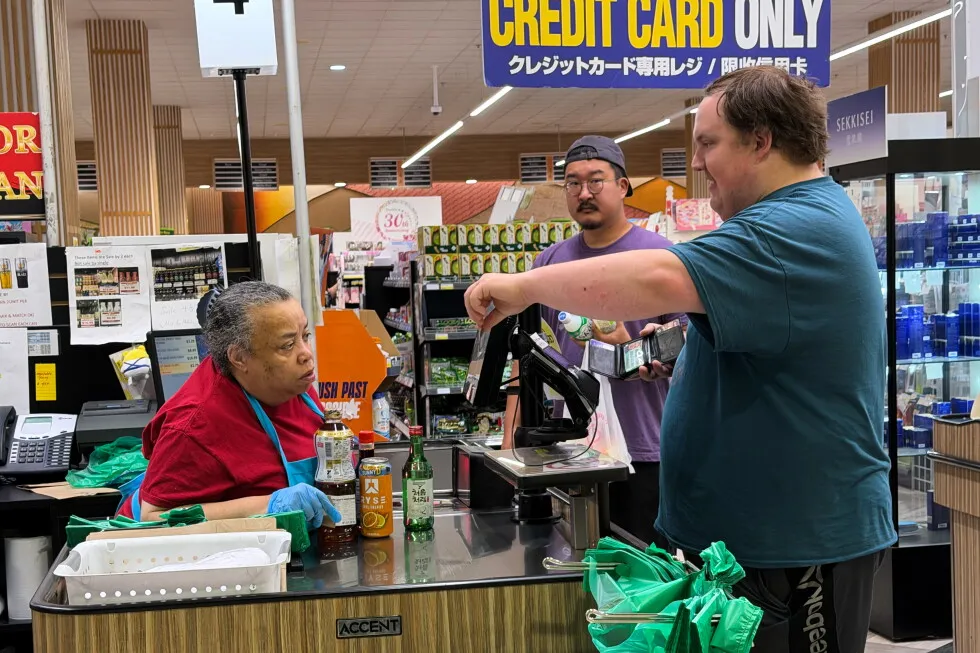
US economy expanded at sluggish 1.5% pace in second quarter, on par with earlier estimate 1 of 2 | An employee checks a customer’s identification card before checking out alcohol at a cash register in a grocery store in Arlington Heights, Ill., Monday, July 6, 2026. (AP Photo/Nam Y. Huh) 2 of 2 | Customer shop at a grocery store in Arlington Heights, Ill., Monday, July 6, 2026. (AP Photo/Nam Y. Huh) 1 of 2 | An employee checks a customer’s identification card before checking out alcohol at a cash register in a grocery store in Arlington Heights, Ill., Monday, July 6, 2026. (AP Photo/Nam Y. Huh) 1 of 2 An employee checks a customer’s identification card before checking out alcohol at a cash register in a grocery store in Arlington Heights, Ill., Monday, July 6, 2026. (AP Photo/Nam Y. Huh) Add AP News on Google Add AP News as your preferred source to see more of our stories on Google. Share 2 of 2 | Customer shop at a grocery store in Arlington Heights, Ill., Monday, July 6, 2026. (AP Photo/Nam Y. Huh) 2 of 2 Customer shop at a grocery store in Arlington Heights, Ill., Monday, July 6, 2026. (AP Photo/Nam Y. Huh) Add AP News on Google Add AP News as your preferred source to see more of our stories on Google. Share Updated [hour]:[minute] [AMPM] [timezone], [monthFull] [day], [year] WASHINGTON (AP) — The U.S. economy grew at a sluggish 1.5% pace from April through June. But consumer spending stayed strong. Growth in gross domestic product — the nation’s output of a goods and services — decelerated from a 2.1% pace from January through March, the Commerce Department reported Wednesday. The second-quarter growth number was unchanged from the department’s first estimate. Still, consumer spending — which accounts for about 70% of U.S. economic activity — increased at a healthy 3.4% annual clip, up from 0.5% in the January-March period.The reason for the lackluster growth was imports. They are subtracted from growth because GDP is only supposed to count domestic production. Imports rose at a 12.5% annual pace from April through June, partly due to a surge in shipments of computer chips and other products that support Artificial Intelligence investment, and sliced 1.64 percentage points off second-quarter growth. AP AUDIO: US economy expanded at sluggish 1.5% pace in second quarter, on par with earlier estimate AP correspondent Donna Warder reports on the U.S. economy remaining sluggish. Beyond the headline figures, the U.S. economy has proven surprisingly resilient in the face of fighting with Iran and the spike in energy prices it caused. Business investment, excluding housing, rose at a 8.5% pace in the second quarter, reflecting the AI investment boom. And a measure of the economy’s underlying strength — which strips out volatile government spending and trade numbers — grew at a strong 4.2% rate, up from 1.7% in the first quarter. Investment in housing rose, ticking up for the first time since the end of 2024. The housing market has been depressed by high mortgage rates,. 6 MIN READ 4 MIN READ 3 MIN READ Wednesday’s report was the second of three Commerce Department looks at second-quarter GDP growth. The third and final report is due Sept. 30. Also on Wednesday, the U.S. reported that an inflation measure closely watched by the Federal Reserve was unchanged last month in the latest sign that many Americans are still struggling with higher costs. The Commerce Department’s report showed that prices rose 3.7% in July compared with a year earlier, but the pace was the same as June. Inflation has worsened since the U.S. and Israel attacked Iran in late February, when it stood at 2.9%. It’s noticeably above the Fed’s target of 2%. Stubbornly high prices are shaping up to be a key issue in the midterm elections, now just 10 weeks away, particularly as the Iran war keeps gas prices high, President Donald Trump is threatening new tariffs on Canada and China, and spending on AI infrastructure has pushed up the cost of computers, gaming consoles, and semiconductors.
SRCAssociated Press (AP)
LANGEN
LEANCenter
WORDS680
ENT7
WED · 2026-08-26 · 12:53 GMTBRIEF NSR-2026-0826-106142
NSR-2026-0826-106142News Report·EN·Economic Impact
US economy expands at sluggish 1.5% pace in second quarter, but consumer spending stayed strong
The U.S. economy grew at a sluggish 1.5% annual pace in the second quarter, a deceleration from the previous quarter's 2.1% growth.
By
PAUL WISEMANAssociated Press (AP)Filed 2026-08-26 · 12:53 GMTLean · CenterRead · 3 min
Associated Press (AP)FIG 01
Reading time
3min
Word count
680words
Sources cited
1cited
Entities identified
7entities
Quality score
100%
§ 01
Briefing Summary
AI-generatedNEWSAR · AI
The U.S. economy grew at a sluggish 1.5% annual pace in the second quarter, a deceleration from the previous quarter's 2.1% growth. Despite this slowdown, consumer spending remained strong, increasing at a healthy 3.4% annual clip. The primary reason for the weaker overall growth was a significant rise in imports, which are subtracted from GDP calculations. This surge in imports, partly driven by AI-related investments, reduced second-quarter growth by 1.64 percentage points. However, business investment showed strength, and underlying economic measures indicated resilience, even amidst geopolitical tensions and rising energy prices. This report is the second of three Commerce Department estimates for second-quarter GDP.
Confidence 0.90Sources 1Claims 5Entities 7
§ 02
Article analysis
Model · rule-basedFraming
Economic Impact
Technology
Tone
Measured
AI-assessed
CalmNeutralAlarmist
Factuality
0.90 / 1.00
Factual
LowHigh
Sources cited
1
Limited
FewMany
§ 03
Key claims
5 extracted01
A measure of the economy’s underlying strength grew at a strong 4.2% rate in the second quarter.
statisticCommerce Department
Confidence
1.00
02
Business investment, excluding housing, rose at an 8.5% pace in the second quarter.
statisticCommerce Department
Confidence
1.00
03
Imports rose at a 12.5% annual pace from April through June, slicing 1.64 percentage points off second-quarter growth.
statisticCommerce Department
Confidence
1.00
04
Consumer spending increased at a healthy 3.4% annual clip in the second quarter.
statisticCommerce Department
Confidence
1.00
05
The U.S. economy grew at a sluggish 1.5% pace from April through June.
statisticCommerce Department
Confidence
1.00
§ 04
Full report
3 min read · 680 words§ 05
Entities
7 identifiedKey playerOppositionContextPositiveNeutralNegative
Locations3
§ 06
Keywords & salience
8 termseconomic growth
1.00
us economy
1.00
consumer spending
0.90
gross domestic product
0.80
imports
0.70
artificial intelligence
0.60
sluggish pace
0.50
commerce department
0.40
§ 07
Topic connections
Interactive graph Network visualization showing 51 related topics
View Full Graph Person Organization Location Event|Click node to navigate|Edge numbers = shared articles