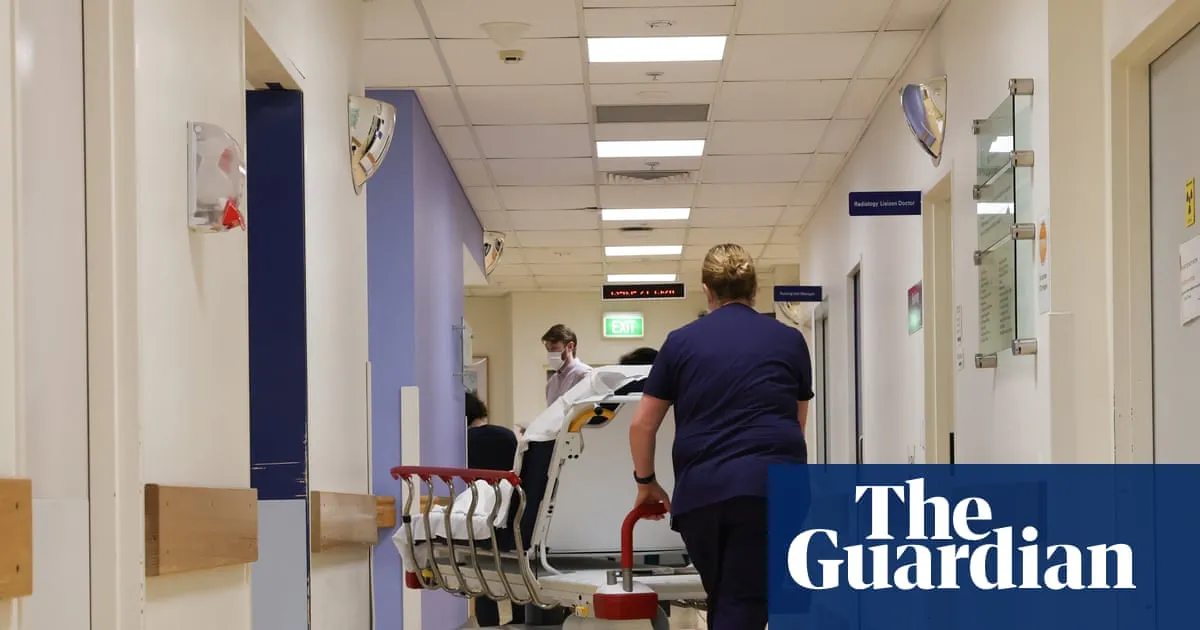
The government rejects concerns that removing the higher private health insurance rebate for people aged 65 and over could put pressure on public hospitals. Photograph: Carly Earl/The Guardian View image in fullscreen The government rejects concerns that removing the higher private health insurance rebate for people aged 65 and over could put pressure on public hospitals. Photograph: Carly Earl/The Guardian Ending private health rebate for Australians 65 and over is ‘good policy change’, report co-author finds Research finds just 0.1-0.4% of the total insured population will ditch insurance, while the government will save as much as $940m a year Get our breaking news email, free app or daily news podcast Removing the higher private health insurance rebate for people aged 65 and over is good policy that is unlikely to place additional pressure on public hospitals, according to health economists. The proposed changes, set to take effect in April 2027, will mean the private health insurance rebate will depend only on how much money a person earns – matching the rules for people aged under 65. Currently, those 65 or over receive a larger rebate on their premium than someone under 65 on the same income, with the rebate rising again for those aged 70 and over. To assess the impact of the change, health economists with the University of Melbourne analysed a decade of tax data for about 130,000 Australians. They examined how the incentive of the private health insurance rebate, and the penalty at tax time for high-income earners without insurance (the Medicare Levy Surcharge), impacts uptake. A co-author of the paper, Associate Prof Kevin Staub, said both have little impact on private health insurance participation. private health insurance uptake is driven by health needs and habit, he said, with many maintaining insurance because they have always had it. Giving those 65 and over a higher rebate means “the government is spending a lot of money to keep people in health insurance who wouldn’t actually drop it without the incentive”, he said. The research estimates 14,821 to 42,498 older Australians will drop their cover as a result of the policy, or 0.1% to 0.4% of the total insured population. This is roughly in line with the government modelling which estimates 44,000 people will drop their cover following the change. Staub and his colleague, Prof Yuting Zhang, found by stopping the extra rebate for older Australians, the government would save about $730m to $940m a year by 2028-29. “I think that, overall, this is a good policy change,” Staub said. The health minister, Mark Butler, told ABC Radio Perth on Tuesday the savings would be directed towards aged care. He rejected comments from the Australian Private Hospitals Association and the Australian Medical Association (AMA) that the changes would lead to a further strained public hospital system. “We don’t think there will be a material impact on public hospital activity,” he said. The health economist and senior postdoctoral research fellow with the Australia Institute, Luke Slawomirski, described the University of Melbourne paper as “empirical analysis from highly skilled, independent researchers”. Slawomirski co-authored a submission from the Australia Institute to a Senate inquiry into the proposed changes, which is due to report its findings in October. The submission said there is little evidence that subsidising private health insurance materially relieves pressure on public hospitals, since both draw on the same clinical workforce, not every private procedure would otherwise occur in a public hospital, and private insurance generally does not cover emergency-department attendance. Removing the extra age-based rebate is a fair and modest change, the Australia Institute found. “private health insurance is already designed so younger and healthier members subsidise older and sicker members,” Slawomirski said. “The private health lobby is warning of a flood into public hospitals, but the evidence suggests that the effect will be small. The Commonwealth spends around $8bn a year directly subsidising private health insurance. “For that kind of money, taxpayers should expect clear evidence that the policy improves health or meaningfully helps public hospitals.” Government modelling shows people on the lowest incomes are most likely to drop their cover as a result of the policy change. The AMA urged the government to protect older Australians on the lowest incomes by exempting them from the proposed changes. Those on low income, for example receiving a pension, now receive the maximum rebate discount plus the bonus discount if they are aged 65 or older. The shadow health minister, Senator Anne Ruston, described the reforms as “callous” for those Australians especially. “We will be fighting to block these callous cuts in the Senate,” she said on Thursday. “This is the same government that put an untested algorithm in charge of aged care assessments without consulting a single provider or older Australian and now it has designed a health tax for more than a million pensioners without even counting them first.” Explore more on these topics private health insurance Health Medicare Australia Mark Butler Australian politics news Share Reuse this content
SRCThe Guardian - World News
LANGEN
LEANCenter-Left
WORDS831
ENT8
WED · 2026-08-26 · 15:00 GMTBRIEF NSR-2026-0826-106160
NSR-2026-0826-106160News Report·EN·Economic Impact
Ending private health rebate for Australians 65 and over is ‘good policy change’, report co-author finds
A report co-authored by University of Melbourne health economists suggests that removing the higher private health insurance rebate for Australians aged 65 and over, effective April 2027, is a "good policy change." The research indicates this change, which will align rebates solely with income, is unlikely to significantly increase pressure on public hospitals, with only a small percentage of insured individuals expected to drop their coverage. This policy is projected to save the government between $730 million and $940 million annually, with savings intended for aged care.
Melissa Davey Medical editorThe Guardian - World NewsFiled 2026-08-26 · 15:00 GMTLean · Center-LeftRead · 4 min
The Guardian - World NewsFIG 01
Reading time
4min
Word count
831words
Sources cited
3cited
Entities identified
8entities
Quality score
100%
§ 01
Briefing Summary
AI-generatedNEWSAR · AI
A report co-authored by University of Melbourne health economists suggests that removing the higher private health insurance rebate for Australians aged 65 and over, effective April 2027, is a "good policy change." The research indicates this change, which will align rebates solely with income, is unlikely to significantly increase pressure on public hospitals, with only a small percentage of insured individuals expected to drop their coverage. This policy is projected to save the government between $730 million and $940 million annually, with savings intended for aged care. While the government rejects concerns about public hospital strain, the AMA has urged protection for low-income older Australians, and the opposition has criticized the reforms as "callous."
Confidence 0.90Sources 3Claims 5Entities 8
§ 02
Article analysis
Model · rule-basedFraming
Economic Impact
Public Health
Tone
Measured
AI-assessed
CalmNeutralAlarmist
Factuality
0.80 / 1.00
Factual
LowHigh
Sources cited
3
Well sourced
FewMany
§ 03
Key claims
5 extracted01
The government will save about $730m to $940m a year by 2028-29 by stopping the extra rebate for older Australians.
statisticAssociate Prof Kevin Staub and Prof Yuting Zhang
Confidence
0.95
02
The government rejects concerns that removing the higher private health insurance rebate could put pressure on public hospitals.
quoteMark Butler
Confidence
0.90
03
14,821 to 42,498 older Australians will drop their cover as a result of the policy, or 0.1% to 0.4% of the total insured population.
statisticResearch
Confidence
0.90
04
Removing the higher private health insurance rebate for people aged 65 and over is good policy.
quoteAssociate Prof Kevin Staub
Confidence
0.90
05
The change is unlikely to place additional pressure on public hospitals.
quoteAssociate Prof Kevin Staub
Confidence
0.85
§ 04
Full report
4 min read · 831 words§ 05
Entities
8 identifiedKey playerOppositionContextPositiveNeutralNegative
Locations1
§ 06
Keywords & salience
8 termsprivate health insurance rebate
1.00
older australians
0.90
policy change
0.80
health economists
0.70
government savings
0.70
public hospitals
0.60
private health insurance participation
0.50
medicare levy surcharge
0.40
§ 07
Topic connections
Interactive graph Network visualization showing 51 related topics
View Full Graph Person Organization Location Event|Click node to navigate|Edge numbers = shared articles