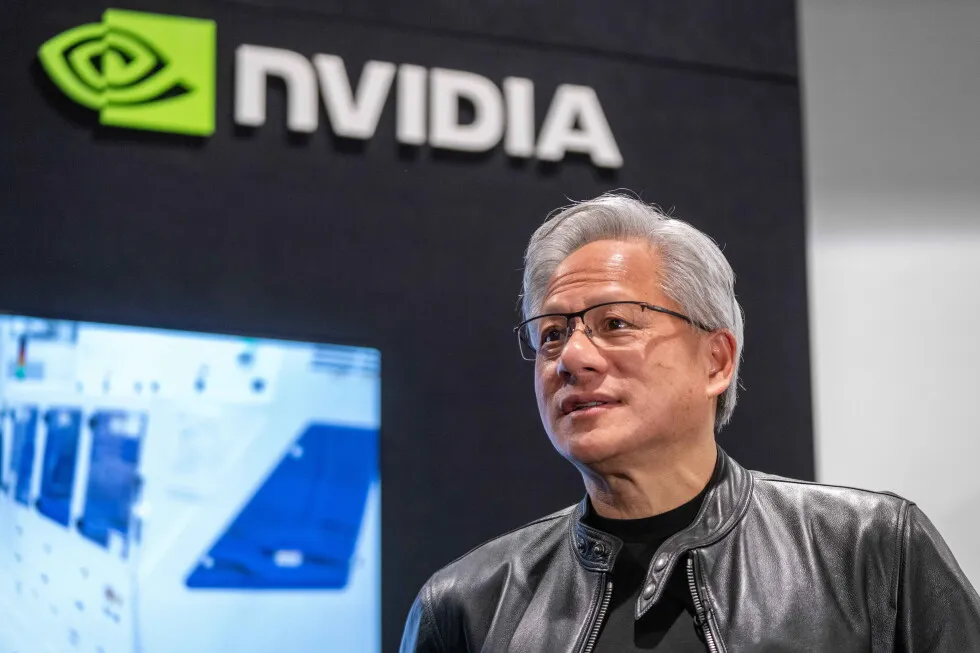
Strong AI chip demand fuels Nvidia’s Q2 results well beyond Wall Street’s expectations 1 of 2 | Jensen Huang, president and CEO of Nvidia, waits for a groundbreaking ceremony for an expansion of Coherent’s manufacturing facility to begin on June 16, 2026, in Sherman, Texas. (AP Photo/Jeffrey McWhorter, File) 2 of 2 | Nvidia CEO Jensen Huang talks with Commerce Secretary Howard Lutnick as President Donald Trump speaks in the Oval Office of the White House about Dulles International Airport modernization, Wednesday, July 29, 2026, in Washington. (AP Photo/Julia Demaree Nikhinson) By ALEX VEIGA Updated 11:03 PM MESZ, August 26, 2026 Add AP News on Google Add AP News as your preferred source to see more of our stories on Google. Share Share Facebook Copy Link copied Print Email X LinkedIn Bluesky Flipboard Pinterest Reddit Nvidia’s latest quarterly results once again blew past Wall Street’s expectations as revenue for the computer chip company’s high-end Artificial Intelligence chips soared, the latest sign that AI infrastructure spending remains strong. The company reported on Wednesday net income of $59.69 billion, or $2.46 per share, for the May-July period. That compares to net income of $26.42 billion, or $1.08 per share, in the same quarter last year. Excluding certain items, earnings were $2.22 per share, well above the $2.09 per share consensus forecast by Wall Street analysts, according to FactSet. Revenue more than doubled from a year earlier to $96.22 billion, surpassing analysts’ average forecast of $92.27 billion. The Santa Clara, California, company’s results have regularly cleared the bar set by analysts in the past three years, often by a wide margin, since Nvidia’s high-end chips emerged as AI’s best building blocks. Along with higher profit and revenue, however, Nvidia’s operating expenses surged 55% to $8.41 billion. For the current quarter, Nvidia forecast revenue of about $108 billion. Analysts are forecasting $104.86 billion. If Nvidia hits its revenue target for the August-October period, it will translate into a roughly 89% increase from last year — an indication that Nvidia’s phenomenal growth rate is still accelerating. Samsung reports record profit as South Korean chip giants benefit from global AI boom 3 MIN READ 18 Wall Street’s flip from AI to less-loved stocks accelerates, while oil prices keep easing 2 MIN READ Taiwan charges 9 over illegal AI server exports to China, including Nvidia and Super Micro staff 2 MIN READ The company said it’s not assuming any data center compute revenue from China in its outlook. “AI has reached its inflection point. It’s doing useful work. Its tokens are productive and profitable. Now, compute is revenue,” said CEO Jensen Huang in a statement. Nvidia’s data center segment, which includes its AI data centers and factories business, as well as chip demand from hyperscalers — operators of huge cloud-computing data centers such as Amazon, Meta and Google — reported revenue of $89 billion, up more than twofold from a year earlier. The company’s edge computing segment, which includes chips bringing AI-powered features to computers, game consoles and robotics, among others, posted revenue of $7.2 billion, up 27% from the same period last year. Despite the stellar results and still-rosy outlook, many investors worry about a jarring comedown after a three-year boom that has seen Nvidia’s market value soar from $400 billion at the end of 2022 to roughly $5.2 trillion now. While AI has powered stock market gains and U.S. economic growth in recent years, there’s been growing skepticism about whether AI will justify the trillions of dollars that are being spent to develop the technology. The AI industry is also increasingly facing pushback amid objections to the expansion in data centers and fears that the speed with which AI is being adopted could lead to widespread job losses for many Americans. Nvidia’s shares slipped 0.3% in after-hours trading shortly after it released its latest results. The stock ended the regular trading session 1.6% lower and is up 12.4% so far this year.
SRCAssociated Press (AP)
LANGEN
LEANCenter
WORDS657
ENT12
WED · 2026-08-26 · 20:53 GMTBRIEF NSR-2026-0826-106259
NSR-2026-0826-106259News Report·EN·Technology
Strong AI chip demand fuels Nvidia’s Q2 results well beyond Wall Street’s expectations
Nvidia reported strong Q2 financial results, significantly exceeding Wall Street expectations due to soaring demand for its high-end AI chips. For the May-July period, the company announced net income of $59.69 billion and revenue of $96.22 billion, more than doubling from the previous year.
Associated Press (AP)Filed 2026-08-26 · 20:53 GMTLean · CenterRead · 3 min
Associated Press (AP)FIG 01
Reading time
3min
Word count
657words
Sources cited
3cited
Entities identified
12entities
Quality score
100%
§ 01
Briefing Summary
AI-generatedNEWSAR · AI
Nvidia reported strong Q2 financial results, significantly exceeding Wall Street expectations due to soaring demand for its high-end AI chips. For the May-July period, the company announced net income of $59.69 billion and revenue of $96.22 billion, more than doubling from the previous year. This performance highlights continued robust spending on AI infrastructure. Nvidia's data center segment, crucial for AI, saw revenue increase more than twofold to $89 billion. The company forecasts revenue of approximately $108 billion for the current quarter, indicating continued growth. Despite these positive results, Nvidia's shares saw a slight decline in after-hours trading.
Confidence 0.90Sources 3Claims 5Entities 12
§ 02
Article analysis
Model · rule-basedFraming
Technology
Economic Impact
Tone
Measured
AI-assessed
CalmNeutralAlarmist
Factuality
0.90 / 1.00
Factual
LowHigh
Sources cited
3
Well sourced
FewMany
§ 03
Key claims
5 extracted01
AI has reached its inflection point and compute is now revenue.
quoteJensen Huang
Confidence
1.00
02
Nvidia forecasts revenue of about $108 billion for the current quarter (August-October).
predictionNvidia
Confidence
1.00
03
Nvidia's operating expenses surged 55% to $8.41 billion in Q2.
statisticNvidia
Confidence
1.00
04
Nvidia's Q2 revenue more than doubled from a year earlier to $96.22 billion, surpassing analysts' average forecast of $92.27 billion.
statisticNvidia
Confidence
1.00
05
Nvidia's Q2 net income was $59.69 billion, or $2.46 per share, compared to $26.42 billion, or $1.08 per share, last year.
statisticNvidia
Confidence
1.00
§ 04
Full report
3 min read · 657 words§ 05
Entities
12 identifiedKey playerOppositionContextPositiveNeutralNegative
People3
Organizations2
Locations6
§ 06
Keywords & salience
10 termsnvidia
1.00
ai chip demand
1.00
q2 results
0.90
artificial intelligence
0.90
revenue
0.80
ai infrastructure spending
0.70
wall street expectations
0.70
net income
0.60
growth rate
0.50
operating expenses
0.40
§ 07
Topic connections
Interactive graph Network visualization showing 51 related topics
View Full Graph Person Organization Location Event|Click node to navigate|Edge numbers = shared articles