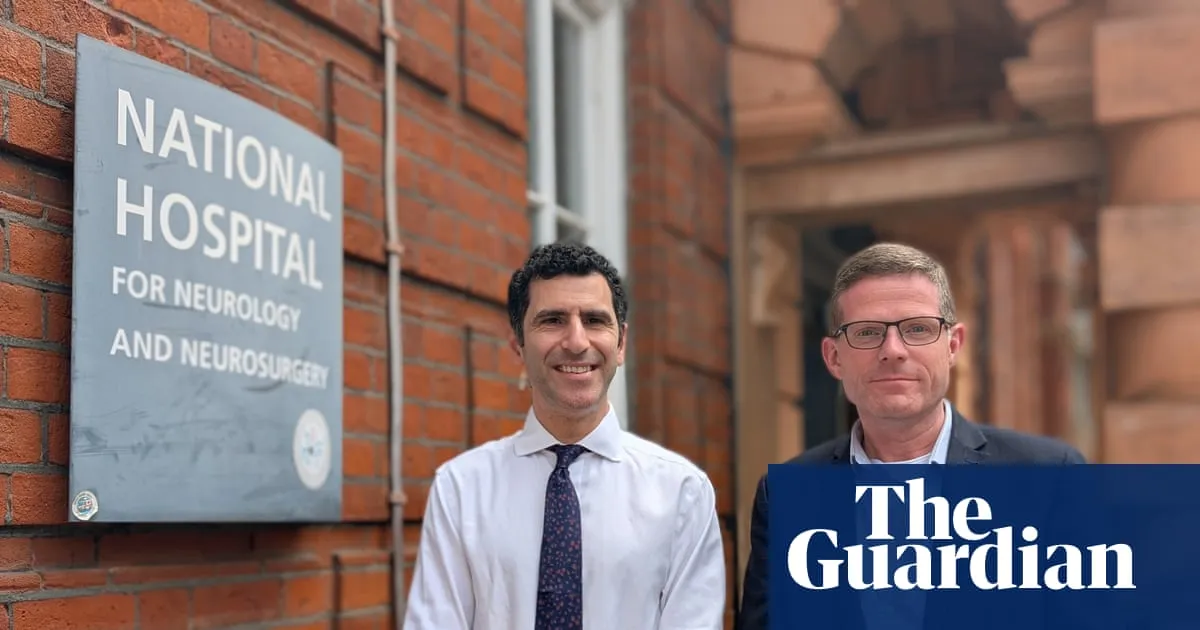
Neurosurgeons in London have performed the world’s first successful AI-assisted operation to remove a brain tumour, saving the sight of a 48-year-old man, health officials have said.The surgery was performed in May at the National Hospital for Neurology and Neurosurgery (NHNN), part of London" class="entity-link entity-location" data-entity-id="2807" data-entity-type="location">University College London hospitals NHS foundation trust, but details were kept secret until Thursday while the patient, Rhys Hibbert, recovered.While the surgical team remained in full control, the AI system analysed live camera footage during the operation, helping identify key structures such as nerves and blood vessels that should be avoided near the 11mm (0.4in) tumour on Hibbert’s pituitary gland.“When I came round … I could see everything in the room clearly,” said Hibbert, who was able to walk independently without glasses or sticks within a week of the surgery.He has since returned to work as a customer service manager. “It feels like I’ve got a 360‑degree panoramic view of everything around me,” he said.The surgeons operated on Hibbert using new AI technology which helps to identify tiny anatomy in the brain by colour-coding important structures to help surgeons recognise them safely.The hospital had previously used the technology as a research tool but the operation was the first time it had been used on a patient.The pituitary gland, blood vessels and nerves controlling vision are tightly packed together, and “going a millimetre wrong can make a critical difference”, health officials said, potentially leading to blindness, stroke or death.Dr Sophia Bano, an associate professor in robotics and AI at UCL and the technical lead for the AI system, said: “By learning from hundreds of surgical videos, [the system] has been exposed to a breadth of surgical examples that would take a surgeon many years to encounter.“It is designed to help recognise critical anatomy, surgical instruments and tissue interactions in real time, supporting the surgeon during highly delicate procedures.”Initially managed without surgery, Hibbert’s symptoms had worsened since his diagnosis in 2024, and included severe hormone imbalance and vision problems. Without the operation, he faced going blind, health officials said.Hibbert, from Bedfordshire, said: “The NHNN was founded in 1859 … and was the world’s first dedicated neurosurgical hospital. So to me, it seems very fitting that the same hospital should also be the world’s first to carry out an AI-assisted neurosurgery.”Prof Mike Lewis, the scientific director for innovation at the National Institute for Health and Care Research (NIHR), which funded the operation as part of a clinical trial, said the “pioneering surgery” highlighted the potential of advanced AI to support surgeons and improve patient care.
SRCThe Guardian - World News
LANGEN
LEANCenter-Left
WORDS425
ENT9
WED · 2026-08-26 · 23:01 GMTBRIEF NSR-2026-0827-106270
NSR-2026-0827-106270News Report·EN·Technology
London neurosurgeons perform first successful AI-assisted operation to remove brain tumour
Neurosurgeons at London's National Hospital for Neurology and Neurosurgery (NHNN) have performed the world's first successful AI-assisted operation to remove a brain tumor. The surgery, conducted in May on 48-year-old Rhys Hibbert, utilized an AI system that analyzed real-time camera footage to identify critical anatomy near the tumor on his pituitary gland, helping surgeons avoid damaging nerves and blood vessels.
Andrew Gregory Health editorThe Guardian - World NewsFiled 2026-08-26 · 23:01 GMTLean · Center-LeftRead · 2 min
The Guardian - World NewsFIG 01
Reading time
2min
Word count
425words
Sources cited
4cited
Entities identified
9entities
Quality score
100%
§ 01
Briefing Summary
AI-generatedNEWSAR · AI
Neurosurgeons at London's National Hospital for Neurology and Neurosurgery (NHNN) have performed the world's first successful AI-assisted operation to remove a brain tumor. The surgery, conducted in May on 48-year-old Rhys Hibbert, utilized an AI system that analyzed real-time camera footage to identify critical anatomy near the tumor on his pituitary gland, helping surgeons avoid damaging nerves and blood vessels. This technology, which color-codes important structures, was previously used as a research tool but this marks its first patient application. Hibbert's sight was saved, and he has since recovered fully. The AI system was trained on hundreds of surgical videos, providing real-time recognition of anatomy and instruments to support surgeons in delicate procedures. The operation was funded by the National Institute for Health and Care Research (NIHR) as part of a clinical trial.
Confidence 0.90Sources 4Claims 5Entities 9
§ 02
Article analysis
Model · rule-basedFraming
Technology
Human Interest
Tone
Measured
AI-assessed
CalmNeutralAlarmist
Factuality
0.80 / 1.00
Factual
LowHigh
Sources cited
4
Well sourced
FewMany
§ 03
Key claims
5 extracted01
The operation was funded by the National Institute for Health and Care Research (NIHR) as part of a clinical trial.
factualProf Mike Lewis
Confidence
1.00
02
The AI system learned from hundreds of surgical videos to recognize critical anatomy in real time.
factualDr Sophia Bano
Confidence
1.00
03
The patient, Rhys Hibbert, could see everything clearly after the surgery and has returned to work.
factualRhys Hibbert
Confidence
1.00
04
The AI system analyzed live camera footage during the operation, helping identify key structures near the tumour.
factual
Confidence
1.00
05
London neurosurgeons performed the world's first successful AI-assisted operation to remove a brain tumour.
factualhealth officials
Confidence
1.00
§ 04
Full report
2 min read · 425 words§ 05
Entities
9 identifiedKey playerOppositionContextPositiveNeutralNegative
People3
Organizations2
Locations3
§ 06
Keywords & salience
9 termsai-assisted surgery
1.00
brain tumour removal
0.90
neurosurgery
0.80
artificial intelligence
0.70
pituitary gland
0.60
medical technology
0.50
vision preservation
0.50
national hospital for neurology and neurosurgery
0.40
ucl
0.40
§ 07
Topic connections
Interactive graph Network visualization showing 51 related topics
View Full Graph Person Organization Location Event|Click node to navigate|Edge numbers = shared articles