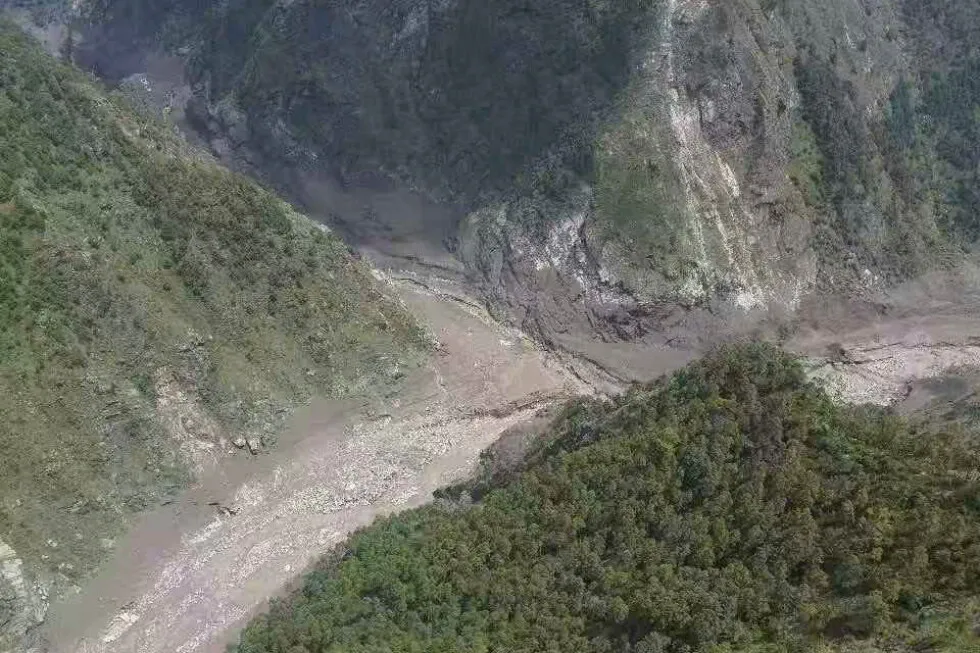
What to know about Mount Kailash, a sacred site for pilgrims missing after floods in Nepal and Tibet 1 of 3 | This photo released by Xinhua News Agency, shows a mudslide-hit area near Gyirong Port in southwestern China’s Tibetan Autonomous Region on Wednesday, Aug. 26, 2026. (Xinhua via AP) 2 of 3 | Nepalese policemen watch as earthmovers clear the debris of flash flooding in Nepal’s Nuwakot district, Thursday, Aug. 27, 2026. (AP Photo/Niranjan Shrestha) 3 of 3 | Damage in the aftermath of flash floods in Devighat in the Nuwakot district in Nepal, Thursday, Aug 27, 2026. (AP Photo/Niranjan Shrestha) 1 of 3 | This photo released by Xinhua News Agency, shows a mudslide-hit area near Gyirong Port in southwestern China’s Tibetan Autonomous Region on Wednesday, Aug. 26, 2026. (Xinhua via AP) 1 of 3 This photo released by Xinhua News Agency, shows a mudslide-hit area near Gyirong Port in southwestern China’s Tibetan Autonomous Region on Wednesday, Aug. 26, 2026. (Xinhua via AP) Add AP News on Google Add AP News as your preferred source to see more of our stories on Google. Share 2 of 3 | Nepalese policemen watch as earthmovers clear the debris of flash flooding in Nepal’s Nuwakot district, Thursday, Aug. 27, 2026. (AP Photo/Niranjan Shrestha) 2 of 3 Nepalese policemen watch as earthmovers clear the debris of flash flooding in Nepal’s Nuwakot district, Thursday, Aug. 27, 2026. (AP Photo/Niranjan Shrestha) Add AP News on Google Add AP News as your preferred source to see more of our stories on Google. Share 3 of 3 | Damage in the aftermath of flash floods in Devighat in the Nuwakot district in Nepal, Thursday, Aug 27, 2026. (AP Photo/Niranjan Shrestha) 3 of 3 Damage in the aftermath of flash floods in Devighat in the Nuwakot district in Nepal, Thursday, Aug 27, 2026. (AP Photo/Niranjan Shrestha) Add AP News on Google Add AP News as your preferred source to see more of our stories on Google. Share Updated [hour]:[minute] [AMPM] [timezone], [monthFull] [day], [year] BEIJING (AP) — More than 100 of the nearly 1,300 people missing after massive floods in a border area of Nepal and China were on a pilgrimage to Mount Kailash, a sacred site in the Himalayas. The disaster left at least 168 people dead and displaced hundreds of people across the Himalayan region.Here’s what to know about the mountain and its centuries-old role as a pilgrimage site.A sacred mountain for several religious traditionsMount Kailash is a Himalayan peak in southwestern Tibet, near China’s borders with Nepal and India. It rises more than 6,400 meters (21,000 feet) above sea level and lies close to Lake Manasarovar. Both have long been part of Sanskrit religious and literary traditions.Mount Kailash holds sacred significance for Hinduism, Buddhism, Jainism and the Tibetan Bon tradition. Each associates the mountain with different beliefs and sacred histories.According to the International Centre for Integrated Mountain Development, the mountain is considered the home of Shiva, the Hindu god of destruction, and Parvati, a Hindu goddess associated with marriage, fertility and motherhood. Followers of the Tibetan Bon tradition regard it as a seat of spiritual power and associate the region with Tonpa Shenrab, the tradition’s founder.Geographer Emily Yeh, a professor at the University of Colorado Boulder, who has conducted research in Tibet, wrote in 2017 that Kailash is associated with the mythical Mount Meru, considered the center of the world in Hindu and Buddhist cosmology. 2 MIN READ 5 MIN READ 1 MIN READ The surrounding landscape also figures in local legends and Himalayan traditions. “Shared Sacred Landscapes,” a book published by ICIMOD in 2017, gathers some of them.One story tells of Guru Nanak, the founder of Sikhism, who visits villagers longing to make the pilgrimage to Mount Kailash. Nanak teaches them that the true pilgrimage is a spiritual journey within themselves. Pilgrims travel to Kailash for a journey of purificationAccording to India’s Ministry of External Affairs, pilgrims can reach Mount Kailash by crossing the Lipulekh Pass from Uttarakhand into Tibet.India’s government operates an official Kailash Manasarovar pilgrimage from June through August or September each year, with routes through the states of Uttarakhand and Sikkim. Private operators also organize pilgrimages through Nepal. Pilgrims traditionally walk around Mount Kailash rather than climb it, completing a roughly 33-mile (53-kilometer) circuit around the mountain.The journey around the peak is believed to cleanse pilgrims of their sins and can take about three days to complete. Hindus and Buddhists traditionally circle the mountain clockwise, while followers of Bon travel counterclockwise.At nearby Lake Manasarovar, some Hindu pilgrims bathe in its waters as a ritual of spiritual purification.Yeh wrote that Tibetan pilgrims stop at monasteries and other sacred sites along the route, touching prayer beads or their foreheads to features believed to bear sacred imprints. Other rituals are meant to test a pilgrim’s merit, sin or fortune. Pilgrims among hundreds missing after floodsThe disaster has left at least 165 dead and 826 people missing in Nepal, and three dead and 558 missing in Tibet, authorities said. Hundreds of those missing were foreigners.Nepal’s tourism board said 179 of those missing were from India. Officials said most were on pilgrimage to Mount Kailash. Also missing were 65 from the United States, 35 from Australia, 33 from Britain and 25 from Canada.Indian spiritual guru Jaggi Vasudev, also known as Sadhguru, said in a post on X that 77 people returning from the mountain with groups organized by his Isha Foundation were at an immigration center in Gyirong, Tibet, when the floods struck.The floods followed a glacier collapse that sent debris rushing downstream through communities on both sides of the border. Similar flash floods have struck the region as warming temperatures increasingly destabilize Himalayan ice.___Associated Press religion coverage receives support through the AP’s collaboration with The Conversation US, with funding from Lilly Endowment Inc. The AP is solely responsible for this content. Hernández is a multimedia reporter for AP’s Global Religion team. She is based in Beijing and covers the intersection of faith, culture and spirituality across Asia. Before moving to China, she was based in Mexico.
SRCAssociated Press (AP)
LANGEN
LEANCenter
WORDS1 012
ENT12
THU · 2026-08-27 · 08:53 GMTBRIEF NSR-2026-0827-106420
NSR-2026-0827-106420News Report·EN·Human Interest
What to know about Mount Kailash, a sacred site for pilgrims missing after floods in Nepal and Tibet
Massive floods in a border area of Nepal and China have resulted in over 100 pilgrims to Mount Kailash among the nearly 1,300 people missing. The disaster has caused at least 168 deaths and displaced hundreds.
By
MARÍA TERESA HERNÁNDEZAssociated Press (AP)Filed 2026-08-27 · 08:53 GMTLean · CenterRead · 5 min
Associated Press (AP)FIG 01
Reading time
5min
Word count
1 012words
Sources cited
1cited
Entities identified
12entities
Quality score
100%
§ 01
Briefing Summary
AI-generatedNEWSAR · AI
Massive floods in a border area of Nepal and China have resulted in over 100 pilgrims to Mount Kailash among the nearly 1,300 people missing. The disaster has caused at least 168 deaths and displaced hundreds. Mount Kailash, a sacred Himalayan peak in Tibet, holds religious significance for Hinduism, Buddhism, Jainism, and the Tibetan Bon tradition, often considered the home of deities or a spiritual power center. Pilgrims traditionally circumambulate the mountain, a journey believed to cleanse sins. The floods followed a glacier collapse, with similar events occurring due to warming temperatures destabilizing Himalayan ice.
Confidence 0.90Sources 1Claims 5Entities 12
§ 02
Article analysis
Model · rule-basedFraming
Human Interest
Environmental
Tone
Measured
AI-assessed
CalmNeutralAlarmist
Factuality
0.80 / 1.00
Factual
LowHigh
Sources cited
1
Limited
FewMany
§ 03
Key claims
5 extracted01
Mount Kailash holds sacred significance for Hinduism, Buddhism, Jainism and the Tibetan Bon tradition.
factual
Confidence
1.00
02
Mount Kailash is a Himalayan peak in southwestern Tibet, near China’s borders with Nepal and India.
factual
Confidence
1.00
03
Massive floods in a border area of Nepal and China have left at least 168 people dead.
factual
Confidence
1.00
04
Over 100 people missing after floods in Nepal and China were on a pilgrimage to Mount Kailash.
factual
Confidence
1.00
05
The mountain is considered the home of Shiva, the Hindu deity.
factualInternational Centre for Integrated Mountain Development
Confidence
0.90
§ 04
Full report
5 min read · 1 012 words§ 05
Entities
12 identifiedKey playerOppositionContextPositiveNeutralNegative
Organizations2
Locations7
Topics1
§ 06
Keywords & salience
8 termsmount kailash
1.00
floods
0.90
pilgrimage
0.80
sacred site
0.70
tibet
0.60
nepal
0.60
missing people
0.50
himalayas
0.40
§ 07
Topic connections
Interactive graph No topic relationship data available yet. This graph will appear once topic relationships have been computed.