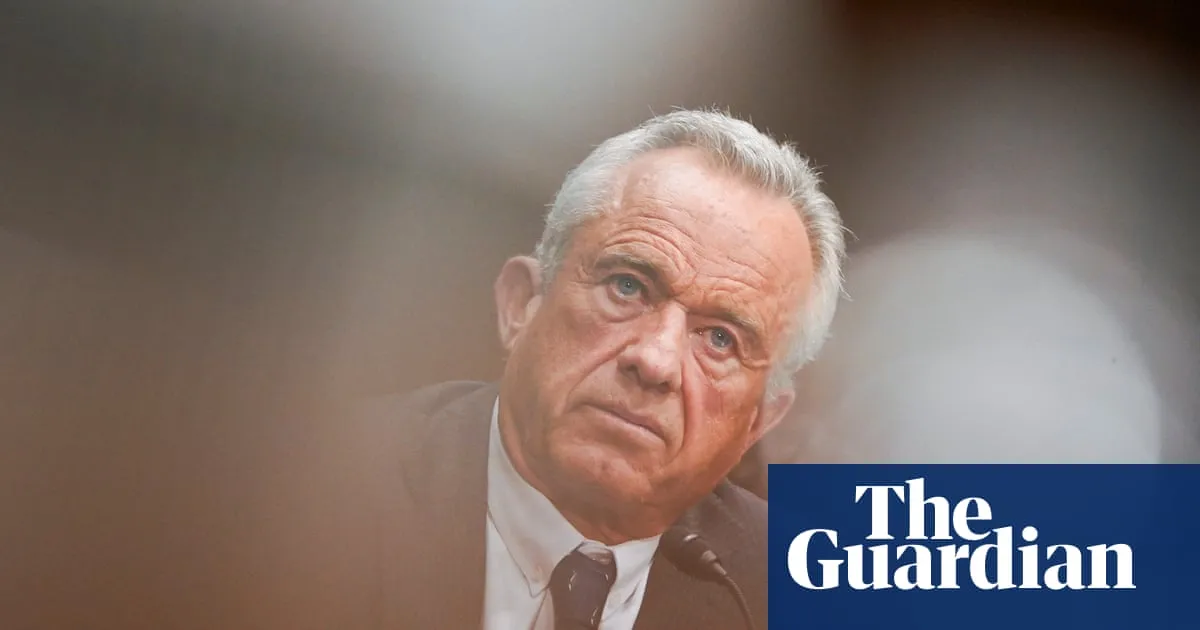
Newly obtained documents indicate that the US health secretary, Robert F Kennedy Jr, lied during two congressional hearings last year, when he told lawmakers who held the key to his confirmation that a 2019 visit to Samoa had “nothing to do with vaccines”.Letters obtained by the Guardian and the Associated Press contradict that testimony. In one he wrote to the Samoan prime minister before the trip, Kennedy explicitly said he wanted to study the measles, mumps and rubella vaccine in the Pacific island nation. In it, he used the words vaccine or vaccination eight times.“I am writing this letter to you in the hope that we might be helpful to the people of your great nation,” he wrote, adding that he believed the deaths of two children there after an MMR vaccine could have resulted from manufacturing issues.“I would propose my team conduct detailed health informatics assessment in Samoa of what happened with your MMR vaccines,” Kennedy wrote.Kennedy’s Samoa visit – just months before a measles outbreak swept through the island, killing 83 people – has become one of the most controversial events in his career. At the time, he was leading a nonprofit known for its anti-vaccine activism. The visit was seen by critics as having emboldened anti-vaccine activists in Samoa.Beyond shedding light on the intent of Kennedy’s visit, the letter raises questions about the health secretary’s integrity and how truthful he was in testimony before Congress. During the confirmation process Kennedy also pledged to maintain vaccine policies that, once in office, he moved to change.Fake gravestones to signify the Samoa measles victims of 2019 sit in the grass outside the US Capitol ahead of Robert F Kennedy Jr’s confirmation hearings in Washington, on 29 January 2025. Photograph: The Washington Post/Getty ImagesKnowingly giving material false testimony to Congress is a crime that carries a possible prison sentence, though it is rarely prosecuted.Attorneys with expertise in Senate procedure said that if Democrats win control of the House or Senate in November’s elections, they could use Kennedy’s statements as grounds for hearings, an impeachment inquiry or create other obstacles for the Trump administration.A spokesperson for the Department of Health and Human Services (HHS) said in a statement: “Secretary Kennedy’s visit to Samoa in 2019 was unrelated to vaccines. Any claim or insinuation based on these letters that Secretary Kennedy lied under oath or to Congress is not only false but outright defamatory.”Kennedy was not under oath during the two confirmation hearings.The Guardian asked HHS to provide an explanation of the contradiction between Kennedy’s claim that the 2019 trip had nothing to do with vaccines, and his letter to the Samoan prime minister. It did not provide any response to that question.The White House did not respond to a request for comment.Kennedy for years was chair and chief legal counsel of the anti-vaccine group Children’s Health Defense (CHD). The group turned its attention to Samoa in July 2018, when two young children died after being given an improperly mixed MMR vaccine. The two nurses involved were criminally charged the month after the children died, ultimately pleading guilty to manslaughter.Meanwhile, the Samoan government halted all vaccinations for 10 months, until April 2019. Vaccination rates plummeted.During that time, CHD started contacting the Samoan government, according to emails previously obtained by the Guardian and the AP as the result of a freedom of information lawsuit against the US state department brought with the aid of the Reporters Committee for Freedom of the Press.In the newly obtained letter from Kennedy, dated 20 January 2019, he addressed then Prime Minister Tuilaepa Sailele Malielegaoi and described his desire to study “what happened” with Samoa’s use of the MMR vaccine.Kennedy speculated that the deaths in Samoa may have been caused by issues with different vaccine lots. Writing on CHD letterhead, he said his team wanted to evaluate whether that was the case through a “detailed health informatics assessment”.He expressed his belief that it was difficult and time consuming in most of the world to investigate “adverse health events associated with vaccines” and said health information systems are rarely designed to quickly study links “between diagnoses and specific vaccination events”.The prime minister responded a month later, saying Samoa could benefit from CHD’s assessment of MMR vaccines.Prime Minister Tuilaepa Sailele Malielegaoi, right, shakes hands with Robert F Kennedy Jr at the the 57th Independence celebration in Mulinu’u, Samoa, on 1 June 2019. Photograph: Misiona Simo/AP“It is certainly beneficial for Samoa to have the benefit of your Team’s independent health assessment of our MMR vaccines and I would welcome with much anticipation your Team’s proposed visit to our islands,” he wrote, including a representative from the US embassy on his communication.In a separate email from Kennedy’s CHD colleague, Dr Michael Graven, to Samoan officials in May 2019, Graven wrote that the team was traveling there as part of a vaccine-related “mission”.Kennedy, his wife, actor Cheryl Hines, and Graven took their trip to Samoa in May and June of that year. By then, vaccinations had resumed and Samoa’s top health official had publicly announced that human error, not a vaccine issue, was responsible for the child deaths.While Kennedy was there, he met with anti-vaccine activists, including one who helped arrange the trip with a US embassy employee, the Guardian and AP previously reported.Months later, with vaccination rates still dangerously low, measles broke out, sickening thousands. In the end, 83 people died, mostly children under five.Public health experts have said their efforts to address the outbreak were hampered by anti-vaccine activists, some of whom they claim were emboldened by Kennedy’s visit.Under repeated questioning during his Senate confirmation hearings, Kennedy insisted vaccines were not the purpose of the trip.Kennedy also said his visit did not influence people’s decisions on whether to vaccinate, telling senators last year: “I never gave any public statement about vaccines. You cannot find a single Samoan who will say I didn’t get a vaccine because of Bobby Kennedy.”Several times, he flatly denied the trip had anything to do with vaccines.When it came up during questioning by Democratic senator Ron Wyden of Oregon, Kennedy replied: “I went there, nothing to do with vaccines. I went there to introduce a medical informatics system that would digitalize records in Samoa and make health delivery much more efficient.”The following day, when Democratic senator Edward Markey of Massachusetts asked about it, Kennedy said: “My purpose in going down there had nothing to do with vaccines.”Upon further questioning, Kennedy again denied it had anything to do with vaccines before adding: “My purpose in the trip was not to – I ended up having conversations with people, some of whom I never intended to meet.”Robert F. Kennedy Jr. answers questions on Samoan measles outbreak during confirmation hearingsThe Senate confirmed Kennedy on a 52-48 vote.In 2021, Kennedy explained in a blog post on the CHD website that he went to Samoa to attend an Independence Day celebration and to discuss “the introduction of a medical informatics system” to track drug safety. He said Samoan officials “were curious to measure health outcomes following the ‘natural experiment’ created by the national respite from vaccines”.Kennedy, who has a license to practice law, has signaled an appetite for bringing criminal charges against at least one congressional witness. He suggested last month that former health official Dr Anthony Fauci could face perjury charges when called before a Senate committee to testify about Covid-19.The federal statute of limitations for lying to Congress is five years, meaning a new justice department under the next president in 2029 could theoretically investigate the case.The Guardian and AP previously reported that officials with the state department and Unicef privately discussed that the trip was about vaccines. In response, some Democratic politicians have said Kennedy lied or misled the Senate, including Wyden and Markey.
SRCThe Guardian - World News
LANGEN
LEANCenter-Left
WORDS1 294
ENT11
THU · 2026-08-27 · 12:00 GMTBRIEF NSR-2026-0827-106495
NSR-2026-0827-106495News Report·EN·Public Health
RFK Jr lied in Senate confirmation hearings, newly revealed documents indicate
Newly obtained documents suggest US Health Secretary Robert F. Kennedy Jr.
Michelle R SmithThe Guardian - World NewsFiled 2026-08-27 · 12:00 GMTLean · Center-LeftRead · 6 min
The Guardian - World NewsFIG 01
Reading time
6min
Word count
1 294words
Sources cited
3cited
Entities identified
11entities
Quality score
100%
§ 01
Briefing Summary
AI-generatedNEWSAR · AI
Newly obtained documents suggest US Health Secretary Robert F. Kennedy Jr. may have misled Congress regarding a 2019 visit to Samoa. Letters obtained by The Guardian and AP indicate Kennedy explicitly stated his intention to study the measles, mumps, and rubella (MMR) vaccine in Samoa prior to his trip, contradicting his testimony that the visit had "nothing to do with vaccines." Kennedy, then leading an anti-vaccine nonprofit, wrote to the Samoan prime minister proposing a health informatics assessment of the MMR vaccine, referencing two child deaths after vaccination. The Samoan prime minister welcomed the proposed assessment. A spokesperson for the Department of Health and Human Services stated Kennedy's visit was unrelated to vaccines and any claims of him lying are false and defamatory.
Confidence 0.90Sources 3Claims 5Entities 11
§ 02
Article analysis
Model · rule-basedFraming
Public Health
Legal & Judicial
Tone
Mixed Tone
AI-assessed
CalmNeutralAlarmist
Factuality
0.70 / 1.00
Factual
LowHigh
Sources cited
3
Well sourced
FewMany
§ 03
Key claims
5 extracted01
Kennedy was not under oath during the two confirmation hearings.
factual
Confidence
1.00
02
A spokesperson for HHS stated that any claim Kennedy lied under oath or to Congress is false and defamatory.
quoteDepartment of Health and Human Services (HHS) spokesperson
Confidence
1.00
03
Knowingly giving material false testimony to Congress is a crime that carries a possible prison sentence.
factual
Confidence
1.00
04
A letter from Kennedy to the Samoan prime minister explicitly stated his desire to study the measles, mumps, and rubella vaccine in Samoa.
factualThe Guardian and the Associated Press
Confidence
0.95
05
Newly obtained documents indicate Robert F Kennedy Jr lied during congressional hearings about his 2019 visit to Samoa having 'nothing to do with vaccines'.
factualThe Guardian and the Associated Press
Confidence
0.90
§ 04
Full report
6 min read · 1 294 words§ 05
Entities
11 identifiedKey playerOppositionContextPositiveNeutralNegative
Organizations4
§ 06
Keywords & salience
8 termsrobert f kennedy jr
1.00
vaccine testimony
1.00
congressional hearings
0.90
samoa visit
0.80
anti-vaccine activism
0.70
health secretary
0.60
mmr vaccine
0.50
oath
0.40
§ 07
Topic connections
Interactive graph Network visualization showing 39 related topics
View Full Graph Person Organization Location Event|Click node to navigate|Edge numbers = shared articles