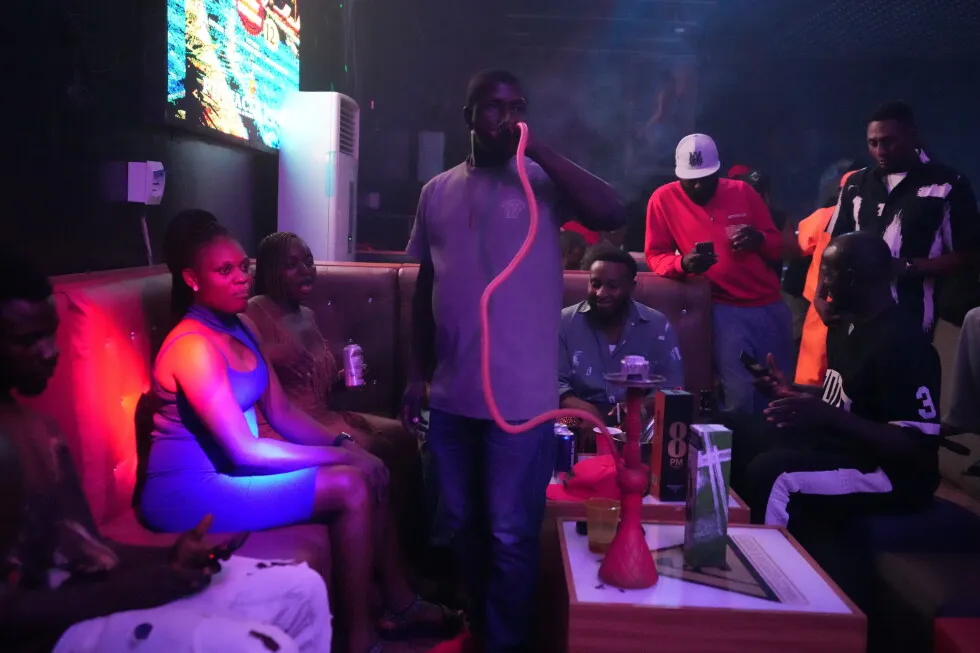
In Nigeria’s troubled north, a bustling nightlife lives with a morality police and insecurity 1 of 5 | Vincent Tabat smokes a waterpipe inside a nightclub in Sokoto, Nigeria, July 18, 2026. (AP Photo/Sunday Alamba) 2 of 5 | A DJ plays music inside a nightclub in Sokoto, Nigeria, July 18, 2026. (AP Photo/Sunday Alamba) 3 of 5 | A partygoer dances to Afrobeats inside a nightclub in Sokoto, Nigeria, July 18, 2026. (AP Photo/Sunday Alamba) 4 of 5 | A bartender prepares an alcoholic drink inside a nightclub in Sokoto, Nigeria, July 18, 2026. (AP Photo/Sunday Alamba) 5 of 5 | Partygoers dance to Afrobeat music inside a nightclub in Sokoto, Nigeria, July 18, 2026. (AP Photo/Sunday Alamba) By Ope Adetayo Updated 6:56 AM MESZ, August 28, 2026 Add AP News on Google Add AP News as your preferred source to see more of our stories on Google. Share Share Facebook Copy Link copied Print Email X LinkedIn Bluesky Flipboard Pinterest Reddit Sokoto, Nigeria (AP) — Multicolored strobe lights sweep across a dance floor soon to throng with sweaty revelers and shrilling voices singing along to Afrobeats in a nightclub that is thriving despite being in one of northern Nigeria’s most deeply conservative states. As the DJ prepared his set and attendants arranged bottles of expensive liquor on tables, Vincent Tabat joined those streaming into the venue, which is one of a handful along a street in Sokoto state. It was an ironic scene given that the conservative Sokoto is known as the “seat of the caliphate” for its storied place in the birth and propagation of Islam in West and Central Africa. Despite its reputation, there is a thriving nightlife alongside strict religious codes, a morality police, and security challenges fueled by attacks by jihadi groups. “This is nearly 2 a.m., and as you can see, everyone is outside to have fun,” Tabat told The Associated Press. Tabat was fired up by the booming music all night, dancing with female companions as he portioned out drinks into emptying cups on the table. At the center of northern Nigeria’s strict religious code is the local Islamic police, known as the Hisbah force, whose personnel are tasked with upholding public morals across some of the region’s 19 states. They often patrol cities and raid key spots to enforce Shariah and local laws, such as dress codes, haircuts and alcohol bans, with seized bottles often destroyed. Partygoers, however, say they are not deterred. Authorities say 10 Nigerian police officers were killed in gunbattle with rebels in the north 1 MIN READ Nigerian president hails ‘largest ever’ single-day rescue as 308 abductees freed in country’s north 1 MIN READ ‘We saw death and suffering’: Dozens of Nigerians freed after 6 months in jihadi captivity 1 MIN READ For frequent reveler Benjamin Danjuma, weekend outings are nearly sacrosanct. The few clubs and bars in Sokoto city are his haunts, and the scene for him is no different from those in the more liberal southern Nigeria. “We are living our life more than anybody’s expectation in this state,” he said. “There is so much groove going on. We are not left behind.” Gone are the days when nightlife and partying were considered taboo in conservative Nigerian society, as people have been partying for a long time, said Oluwamayowa Idowu, founder of Culture Custodian, a leading culture publication based in Lagos. Amid the security crisis and its fallout of economic hardship in the region, nightlife offers people an escape from the tough realities, said Idowu. “The north has been ravaged by insecurity, but people still live there, and people still participate in life there daily,” he said. Both Tabat and Danjuma said they are not bound by Hisbah’s rules as non-Muslims, but they acknowledged that there have been run-ins with the group. This represents the dynamics of Nigeria’s religious composition in one of the few places in the world where the population is almost evenly split between Christians, who live predominantly in the south, and Muslims, mostly in the north. For decades, non-Muslims have been caught up in Hisbah’s enforcement, which the force says is to promote morality. Following the return of Nigeria to democracy in 1999, several states in the northern region advocated for Shariah, revealing the fault lines of Nigeria’s federalism and status as a secular state. The matter was not resolved at the Supreme Court, leaving it as an open-ended legal question to date, and subsequent governments have not sought legal means to resolve it. Hisbah is often accused of extreme policies and abuses In many northern states, the laws being applied in Islamic courts are enforced by Hisbah. The group was disbanded in Sokoto in 2017, in part due to public complaints about alleged high-handed practices, before being reestablished in 2024. The morality police, which are often accused of extreme policies, recently announced a statewide ban in Sokoto on the use of DJs at events, as well as inappropriate haircuts, extravagant bridal gifts and playing music on public transport. Hisbah members also face widespread allegations of rights abuses in their enforcement operations, including subjecting offenders to dehumanizing punishments such as public beatings or shaming. Fu’ad Lawal, executive director at Archivi.ng, a Lagos-based digital historical database, said the force altered the meaning of Nigeria’s federalism and its secular nature. “When it (Shariah) became a law, it basically extended (beyond) criminal law and, perhaps more consequential, led to the regulation of public life,” said Lawal. The morality police say they only seek to ensure “peace and stability through moral justice” and are not “enforcing Sharia law per se.” “Every citizen needs to fulfill his or her moral obligation,” Usman Abdullahi Jatau, commander of the Sokoto State Hisbah, told the AP. Delicate balance sought between religion and nightlife The nightclub where Tabat was partying has posted a list of banned items, including veils, and it turns away women wearing them. Almost everywhere else in the city, women would need one — except at this venue, which tries to not upset the precarious balance of the religion-nightlife cohabitation. The strict social codes can eventually wear on a society battling yearslong jihadi and rebel violence, analysts say. Ibrahim Nuhu, a banker who was transferred from the more cosmopolitan Plateau state to Sokoto, has seen the city evolve in recent years from a drab scene to a lively experience on weekends. At first, he was worried about leaving his more cosmopolitan life behind, but admits he has grown enamored of the growing nightlife in Sokoto. “People see Sokoto from outside; I see it from the inside,” he said. Ope Adetayo Adetayo is a West and Central Africa reporter for The Associated Press. He covers news and regional development across West and Central Africa. twitter facebook mailto
SRCAssociated Press (AP)
LANGEN
LEANCenter
WORDS1 129
ENT10
FRI · 2026-08-28 · 05:23 GMTBRIEF NSR-2026-0828-106750
NSR-2026-0828-106750News Report·EN·Human Interest
In Nigeria’s troubled north, a bustling nightlife lives with a morality police and insecurity
In Sokoto, Nigeria, a deeply conservative state known as the "seat of the caliphate," a vibrant nightlife thrives despite strict religious codes, a morality police force called the Hisbah, and ongoing insecurity from jihadi groups. Nightclubs are popular gathering spots, offering residents an escape from economic hardship and security challenges.
Associated Press (AP)Filed 2026-08-28 · 05:23 GMTLean · CenterRead · 5 min
Associated Press (AP)FIG 01
Reading time
5min
Word count
1 129words
Sources cited
2cited
Entities identified
10entities
Quality score
100%
§ 01
Briefing Summary
AI-generatedNEWSAR · AI
In Sokoto, Nigeria, a deeply conservative state known as the "seat of the caliphate," a vibrant nightlife thrives despite strict religious codes, a morality police force called the Hisbah, and ongoing insecurity from jihadi groups. Nightclubs are popular gathering spots, offering residents an escape from economic hardship and security challenges. The Hisbah force enforces Shariah and local laws, including bans on alcohol and dress code violations, though partygoers, particularly non-Muslims, report not being deterred. The coexistence of nightlife and strict religious enforcement highlights the complex religious dynamics in Nigeria. The Hisbah, previously disbanded in Sokoto due to public complaints, was reestablished and continues to enforce moral codes, sometimes facing accusations of abuses.
Confidence 0.90Sources 2Claims 4Entities 10
§ 02
Article analysis
Model · rule-basedFraming
Human Interest
Conflict
Tone
Measured
AI-assessed
CalmNeutralAlarmist
Factuality
0.70 / 1.00
Factual
LowHigh
Sources cited
2
Limited
FewMany
§ 03
Key claims
4 extracted01
Sokoto is known as the 'seat of the caliphate' and has strict religious codes, a morality police (Hisbah force), and security challenges.
factual
Confidence
1.00
02
A nightclub is thriving in Sokoto, one of northern Nigeria's most deeply conservative states.
factual
Confidence
1.00
03
Ten Nigerian police officers were killed in a gunbattle with rebels in the north.
factualAuthorities
Confidence
0.90
04
Partygoers in Sokoto are not deterred by the Hisbah force and continue to engage in nightlife activities.
quotePartygoers
Confidence
0.90
§ 04
Full report
5 min read · 1 129 words§ 05
Entities
10 identifiedKey playerOppositionContextPositiveNeutralNegative
People3
Organizations4
Topics1
§ 06
Keywords & salience
10 termsmorality police
1.00
nightlife
1.00
insecurity
0.90
northern nigeria
0.90
sokoto
0.80
religious codes
0.70
shariah
0.60
afrobeats
0.50
hisbah force
0.50
jihadi groups
0.40
§ 07
Topic connections
Interactive graph No topic relationship data available yet. This graph will appear once topic relationships have been computed.