Shortages leave Gaza’s lifeguards without essential rescue equipment, as Palestinians flock to one of the few leisure activities available.Gaza’s lifeguards monitor swimmers along the coast, as Palestinians flock to the sea during summer to escape the heat in the tents most live in [Abdelhakim Abu Riash/Al Jazeera]Published On 28 Aug 2026Gaza City, Gaza Strip – Ahmed Abu Haseira stands waist-deep among swimmers, scanning the crowded water and gesturing with his hands, moving people away from any potential dangers.The lifeguard moves along the Gaza City shoreline, keeping a close eye on children and tracking swimmers as they disappear beneath the waves and re-emerge.Recommended Stories list of 3 itemslist 1 of 3Three killed in strikes on Gaza as Israel renews threats over kite-flyinglist 2 of 3Israeli strike kills ‘newlywed’ woman in south Lebanon, wounds otherslist 3 of 3Burnham’s expected UK ban on Israeli settlement goods draws broad supportend of listWhen he needs anyone’s immediate attention, he blows a whistle – one that is shared between lifeguards as they change shifts.The 33-year-old used to have one of his own, but it is now buried beneath his home. An Israeli attack in August 2024 destroyed the house, killing Abu Haseira’s wife, three of his children, his father and other members of his family.He was at the home when the attack happened, having finished a shift at the beach just half an hour before.After surviving his injuries, he returned to the water.This is one of the few places Palestinians can enjoy life in a Gaza battered by Israel’s genocidal war. For an afternoon, people can enjoy the beaches, seeking relief from the heat, displacement and the pressures of the ongoing war.Abu Haseira and his colleagues spend long hours watching over them, often without the equipment that once made the job possible.The lifeguards don’t have loudspeakers, rescue buoys or watchtowers, and rely largely on their eyes, voices and hand signals to keep swimmers safe.“We try to make an extra effort so that all the children and young people are monitored and kept safe,” Abu Haseira says.Gaza’s lifeguards help prevent drownings by closely monitoring swimmers along the crowded coast during the summer [Abdelhakim Abu Riash/Al Jazeera]A crowded sea, a depleted rescue systemAbout 120 lifeguards are currently employed along the beaches covered by Gaza Municipality, according to Ibrahim Shamlakh, the head of the municipality’s marine rescue department. Before the war, the number was closer to 140.The lifeguards work in two shifts, from 8am to 2pm and from 2pm to 8pm.Shamlakh, who has worked in marine rescue for about 27 years, says the team has tried to beef up its presence this summer, despite losing much of the infrastructure and equipment they once relied on as a result of a war that has devastated much of Gaza.“This year we deployed more lifeguards and strengthened the areas where there are crowds,” Shamlakh says. “We organised our teams better with the resources available to us.”Before the war, the coastline had a network of elevated lifeguard towers, positioned roughly every 200 metres. Each tower was about 3.3 metres high and equipped with sound systems, communication equipment and rescue gear.Now, most of those towers are gone.Lifeguards work from ground-level tents or from makeshift structures, leaving them with a much narrower field of vision.“If someone stands in front of us in the tent, they block our vision,” Shamlakh says. “The ground-level tent gives us almost no visibility.”The boats that once helped lifeguards reach emergencies farther offshore were also destroyed.Shamlakh says lifeguards deal with between 20 and 50 rescue incidents on an average day, with the number rising sharply when the beach is particularly crowded.On one Friday, he says, they responded to 165 cases.Since the beginning of the current season, two people have drowned outside areas covered by the lifeguards, including a young child.Bilal Bakar, a Gaza lifeguard for 15 years, watches over swimmers [Abdelhakim Abu Riash/Al Jazeera]From watchtowers to whistlesBilal Bakar, 33, has spent 15 years working as a lifeguard. He arrives at the beach early and spends long hours watching swimmers under the summer sun.He says he’s finding it difficult to do his job properly without the equipment his department once had.“People can barely hear us,” he says. “We call out, we shout, we blow our whistles, but they still don’t hear us.”Lifeguards use flags to distinguish areas where swimming is permitted from those considered dangerous.“We put up red flags, but some people still insist on swimming,” Bakar says. “We are trying to protect them. We are looking out for their own safety.”Whistles are the main alternative.This year, the municipality managed to obtain about 50 whistles, but Shamlakh says they are more expensive than before the war – as is the case with almost everything in Gaza as a result of Israeli import restrictions.“The whistle used to cost 25 shekels ($8) before the war,” he says. “Today it costs 100 shekels ($34).”Rescue buoys are also scarce. A lifeguard would ideally have one available for every rescue, but teams sometimes have to respond without enough equipment.“If four or five people start drowning at the same time, we don’t have enough buoys for all of them,” Bakar says. “We rely on ourselves and on the strength of the young men to bring them back.”The physical demands are compounded by financial uncertainty. Bakar says lifeguards can receive about 25 shekels for a six-hour shift, but payments are irregular. He says the team once worked for 75 days without being paid.“I have three children, and with my wife, we are five,” he says. “All the young men are struggling. There is no money, and there are no regular salaries.”Many are also fishermen who can no longer work at sea, leaving lifeguarding as one of the few ways they can earn a living.“The lifeguards are struggling just like everyone else,” Shamlakh says.Beach watchtowers have been destroyed during Israel’s war, forcing lifeguards to use tents [Abdelhakim Abu Riash/Al Jazeera]Still watching the waterDespite the shortages, lifeguards continue to extend their working hours. Shamlakh says some, including himself, arrive before their official shifts start to cover the early morning period.“We go down voluntarily from 6 to 8 in the morning,” he says. “We cover that time so that we don’t have any drowning incidents.”For Abu Haseira, the motivation goes beyond money. “For me, saving a life is a great honour and gives me comfort,” he says. “When I save a life, I feel like I am saving myself.”He says the work also connects him emotionally to the family he lost.“I feel I’m giving it to the souls of my children and wife,” he says.Even when he is not officially on duty, he says, he continues to watch the water.Bakar describes the same commitment among his colleagues.After 15 years on the coast, he says he and his colleagues have continued to return each summer, passing the responsibility from one generation to the next.“Every year, they ask us if we are ready to come back and work in rescue,” he says. “We tell them: yes, we are ready.”
SRCAl Jazeera
LANGEN
LEANCenter
WORDS1 165
ENT8
FRI · 2026-08-28 · 06:45 GMTBRIEF NSR-2026-0828-106765
NSR-2026-0828-106765News Report·EN·Human Interest
Armed with a whistle, Gaza’s lifeguards do what they can to save swimmers
Gaza's lifeguards are struggling to protect swimmers due to severe shortages of essential rescue equipment. Palestinians are flocking to the beaches as one of the few available leisure activities, seeking relief from the heat and the pressures of the ongoing war.
Maram HumaidAl JazeeraFiled 2026-08-28 · 06:45 GMTLean · CenterRead · 5 min
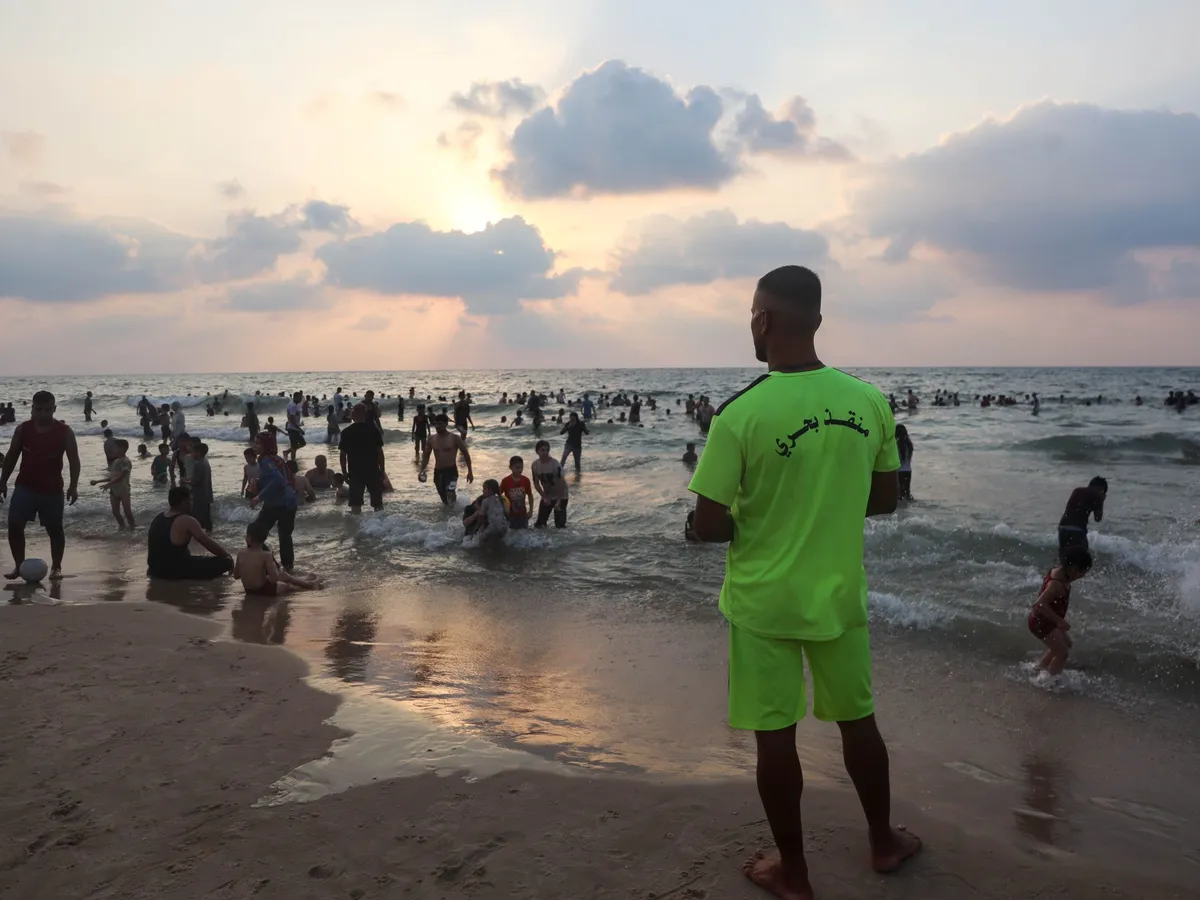
Al JazeeraFIG 01
Reading time
5min
Word count
1 165words
Sources cited
2cited
Entities identified
8entities
Quality score
100%
§ 01
Briefing Summary
AI-generatedNEWSAR · AI
Gaza's lifeguards are struggling to protect swimmers due to severe shortages of essential rescue equipment. Palestinians are flocking to the beaches as one of the few available leisure activities, seeking relief from the heat and the pressures of the ongoing war. Lifeguards, like Ahmed Abu Haseira, who lost family in an Israeli attack, now rely on their eyes, voices, and shared whistles to monitor swimmers. The destruction of watchtowers and boats has significantly reduced their visibility and ability to respond to emergencies. Despite these challenges, the municipality has increased the number of lifeguards and improved team organization with limited resources. The lack of equipment, including loudspeakers and rescue buoys, makes it difficult for lifeguards to effectively communicate and ensure safety, though they continue to make extra efforts to protect swimmers.
Confidence 0.90Sources 2Claims 4Entities 8
§ 02
Article analysis
Model · rule-basedFraming
Human Interest
Conflict
Tone
Measured
AI-assessed
CalmNeutralAlarmist
Factuality
0.70 / 1.00
Factual
LowHigh
Sources cited
2
Limited
FewMany
§ 03
Key claims
4 extracted01
The number of lifeguards employed by Gaza Municipality has decreased from approximately 140 before the war to about 120 currently.
statisticIbrahim Shamlakh
Confidence
1.00
02
Palestinians in Gaza use the beaches as one of the few available leisure activities to escape heat, displacement, and the pressures of the ongoing war.
factualarticle
Confidence
1.00
03
An Israeli attack in August 2024 destroyed Ahmed Abu Haseira's home, killing his wife, three children, father, and other family members.
factualAhmed Abu Haseira
Confidence
1.00
04
Gaza's lifeguards are operating with severe shortages of essential rescue equipment, including whistles, loudspeakers, rescue buoys, and watchtowers.
factualarticle
Confidence
1.00
§ 04
Full report
5 min read · 1 165 words§ 05
Entities
8 identifiedKey playerOppositionContextPositiveNeutralNegative
§ 06
Keywords & salience
8 termsgaza lifeguards
1.00
rescue equipment shortages
0.90
gaza war
0.80
palestinian leisure
0.70
swimmer safety
0.60
israeli attack
0.60
heat relief
0.50
displacement
0.40
§ 07
Topic connections
Interactive graph Network visualization showing 51 related topics
View Full Graph Person Organization Location Event|Click node to navigate|Edge numbers = shared articles