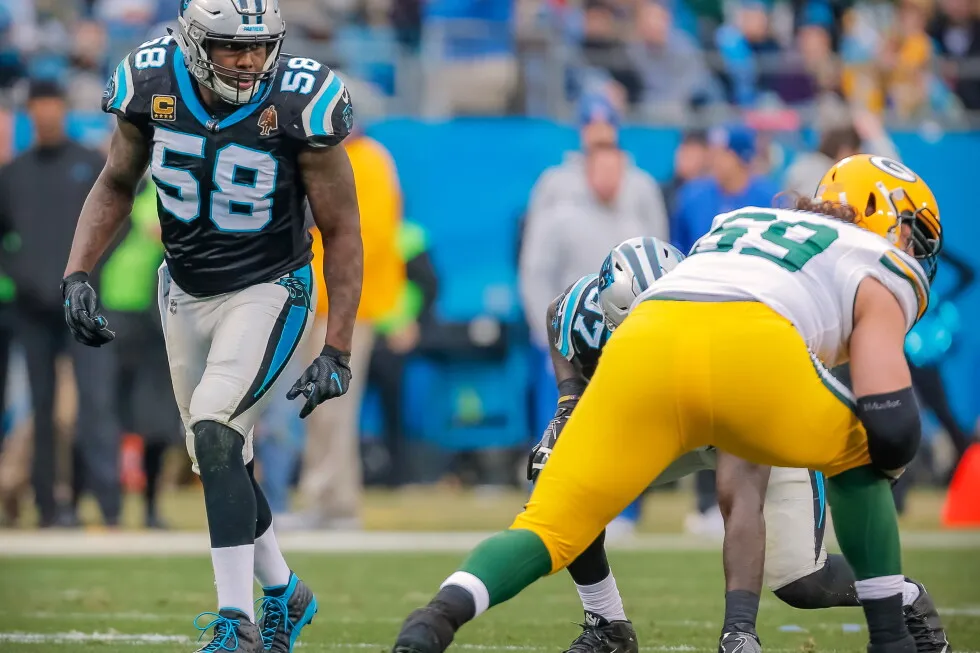
Panthers LB Thomas Davis suffered Opioid addiction that opened the door to sprawling drug case 1 of 2 | Carolina Panthers’ Thomas Davis (58) waits for the snap during the second half of an NFL football game against and the Green Bay Packers in Charlotte, N.C., Dec. 17, 2017. (AP Photo/Bob Leverone, File) 2 of 2 | Washington linebacker Thomas Davis Sr. (58) arrives for practice at the team’s NFL football training facility, Thursday, Aug. 20, 2020, in Ashburn, Va. (AP Photo/Alex Brandon, File) 1 of 2 | Carolina Panthers’ Thomas Davis (58) waits for the snap during the second half of an NFL football game against and the Green Bay Packers in Charlotte, N.C., Dec. 17, 2017. (AP Photo/Bob Leverone, File) 1 of 2 Carolina Panthers’ Thomas Davis (58) waits for the snap during the second half of an NFL football game against and the Green Bay Packers in Charlotte, N.C., Dec. 17, 2017. (AP Photo/Bob Leverone, File) Add AP News on Google Add AP News as your preferred source to see more of our stories on Google. Share 2 of 2 | Washington linebacker Thomas Davis Sr. (58) arrives for practice at the team’s NFL football training facility, Thursday, Aug. 20, 2020, in Ashburn, Va. (AP Photo/Alex Brandon, File) 2 of 2 Washington linebacker Thomas Davis Sr. (58) arrives for practice at the team’s NFL football training facility, Thursday, Aug. 20, 2020, in Ashburn, Va. (AP Photo/Alex Brandon, File) Add AP News on Google Add AP News as your preferred source to see more of our stories on Google. Share Updated [hour]:[minute] [AMPM] [timezone], [monthFull] [day], [year] Charlotte, N.C. (AP) — Nobody could overlook the off-the-field community work — bankrolling a college scholarship endowment, a Thanksgiving food drive, a Christmastime gift giveaway — that cast Thomas Davis of the Carolina Panthers as one of the true good guys around Charlotte and across the NFL.But what really turned Davis into royalty in North Carolina was how tough he was. A legend was born when the linebacker who had already come back from a torn ACL in the same knee three times — and seemed to get better after each comeback — suited up and played in the 2016 Super Bowl despite a freshly broken arm.Turns out, all those comebacks from all that pain took their toll and led to a deeper and more troubling story: As his career wound down, Davis became dependent on opioids, an addiction he blames for the unseemly breakup with his wife, Kelly, and the sullying of his once-pristine reputation. The Associated Press found that it was prescriptions filled to feed Davis’ addiction that led to the downfall of Joan Rubinger, a self-styled healer who listed Davis among her dozens of high-profile pro-athlete clients who swore by her pain-relief miracles.“I live my life in a way that I wanted my kids to always be proud of me,” said Davis, a father of four, in a recent episode of The Pivot Podcast. where he discussed his drug problem publicly for the first time. “That was something that was extremely important to me. And some of the things that happened, it made it extremely hard for them to ever be proud of the man that I had started to become.” Davis did not respond to several calls and texts from AP and no one answered his door in North Carolina when visited by an AP reporter. Requests for comment were also made through his representatives. 3 MIN READ 3 MIN READ 4 MIN READ A Man of the Year and a sturdy presence at outside linebackerThe high point of Davis’ career might have been 2014 — the season he was honored as the NFL’s Walter Payton Man of the Year. The award, which comes with a trophy and a patch the player wears on his uniform for the rest of his career, recognizes the winner for his “community service, charity work and good play on the field.” There was plenty of good play. A college All-American at Georgia, Davis might have been voted to more than three NFL Pro Bowls and named to more than one AP first All-Pro team had he played in a bigger market — or maybe not shared the limelight with Luke Kuechly, the linebacker who was inducted into the Pro Football Hall of Fame earlier this month and name checked his good buddy, Davis, as part of his induction speech.“I couldn’t have asked for a better person to start my playing career than next to Thomas,” Kuechly said. “He taught me about effort, toughness, competitiveness, and most of all, having joined the game of football.”But Davis never lacked for accolades in the town where he played the first 14 of his 16 NFL seasons. He played nine of those years after his third knee surgery. All his best seasons came during that stretch. Off the field, he was a constant presence at charity events, many of which he sponsored. Davis, his wife and kids painted the picture of a family that had deep, meaningful connections to the heartbeat of this burgeoning southern metropolis in NASCAR country that, like so many cities, places its sports stars on a pedestal. All of this fit into Davis’ wider life story. Raised in a one-parent house in Shellman — a rural farming town in southwest Georgia — his mother moved 40 miles away to Eufala, Alabama, for a higher-paying job when Davis was in 11th grade to help pay the bills. Davis stayed behind and moved in with an older cousin so he could keep playing at Randolph-Clay High in nearby Cuthbert, where, he said, he had carved out his niche on the football field as “The Man.”“My mom allowed me, in that moment, to say, ‘Hey, I’m establishing myself,’” Davis said. “I had a goal. She had trust in me that I was going to make the right decisions.” Davis’ drive to show comebacks were possible paid offFor more than a decade, he did. The multiple comebacks from knee surgeries — he’s believed to be the first and only NFL player to play on after tearing the same ACL three times — made him larger than life in North Carolina. “I didn’t want to be that token, like, mascot for ACL recoveries,” Davis said. “I wanted to be the person that came back and showed every NFL club that you don’t have to give up on your players when they face injuries.”His first-team All Pro honor (2015), three Pro Bowls (2015-17) and that larger-than-life trip to the Super Bowl (2016) all came after the knee surgeries. “The guy has been through a lot and is the heart and soul of our team,” teammate Dwan Edwards said in the leadup to Carolina’s 24-10 loss to Denver in the title game. “He’s our emotional leader, our playmaker on the field.” The first crack in this storybook tale came in 2018 when Davis was handed a four-game ban for violating the NFL’s performance-enhancer policy after testing positive for a banned estrogen blocker, the likes of which can be used to mask steroid use. He said he didn’t cheat, had been using the same supplements as always, but did not protest the ban.Davis said the ban caused him to rethink his plans to retire. He spent 2019 with the Chargers and 2020 in Washington. That year, the head trainer of the Commanders was found to have been illegally distributing oxycodone to players — an unsettling reminder of the NFL’s difficult history with painkillers. The league spent around 10 years defending a lawsuit accusing its teams of over-prescribing opioids and other painkillers. The lawsuit was eventually dismissed in 2023 because of what a judge said was its overly sprawling nature. One of the revelations that came out during that period was a study of former players, 52% of whom said they’d used prescription opioids during their career.The NFL Players Association did not want to offer comment about this story. The league, which has enhanced its monitoring of prescriptions since the lawsuit, said it was unaware of Rubinger. It referenced a study from 2021-22 that showed only 10% of players received prescriptions for opioids.A drug investigation and the downfall of one of Charlotte’s beloved familiesBut it was in 2022 that the Drug Enforcement Administration opened its investigation after Kelly Davis accused Rubinger, the “pain doctor,” of fueling her husband’s Opioid addiction. Authorities alleged Davis received more than 13,000 pills for Oxycodone and Percocet from November 2019 through March 2024.“She preyed on these guys’ pain,” Kelly Davis told AP. “They had money, they had injuries, they had mental-health issues.” Davis’ addiction casts a different light on the couple’s separation, their eventual divorce and the mini-scandal that erupted when news broke of Kelly Thomas’ 2025 arrest for assaulting a woman she believed was sleeping with her husband. These days, Davis is still a presence around the Panthers facility, where the memories of all the good he did for the team and the community live on. But, he concedes, he’s been chastened by his stunning downfall. Davis said he has gotten the help he needs, and that his focus is on trying to make things right with his children, the oldest of whom, Thomas Davis Jr., is a freshman linebacker at Notre Dame. Davis Sr. says he places blame on nobody but himself, but is well aware of the toll drugs took. “I take full ownership of every single component of everything that’s happened in my life,” he said. “But at the end of the day, I know there were some factors that took place that ultimately led me to a space that I didn’t anticipate being” in.___Mustian reported from Charlotte. AP Sports Writer Steve Reed in Charlotte contributed.___See AP’s full NFL coverage here Mustian is an Associated Press investigative reporter for breaking news. Goodman is a Miami-based investigative reporter who writes about the intersection of crime, corruption, drug trafficking and politics in Latin America. He previously spent two decades reporting from South America.
SRCAssociated Press (AP)
LANGEN
LEANCenter
WORDS1 670
ENT10
FRI · 2026-08-28 · 07:23 GMTBRIEF NSR-2026-0828-106782
NSR-2026-0828-106782News Report·EN·Human Interest
Panthers LB Thomas Davis suffered opioid addiction that opened the door to sprawling drug case
Carolina Panthers linebacker Thomas Davis developed an opioid addiction as his career wound down, which he attributes to the breakup of his marriage and damage to his reputation. An investigation by the Associated Press revealed that prescriptions filled to feed Davis' addiction led to the downfall of Joan Rubinger, a healer who treated him and other athletes.
By
EDDIE PELLS, JIM MUSTIAN and JOSHUA GOODMANAssociated Press (AP)Filed 2026-08-28 · 07:23 GMTLean · CenterRead · 7 min
Associated Press (AP)FIG 01
Reading time
7min
Word count
1 670words
Sources cited
2cited
Entities identified
10entities
Quality score
100%
§ 01
Briefing Summary
AI-generatedNEWSAR · AI
Carolina Panthers linebacker Thomas Davis developed an opioid addiction as his career wound down, which he attributes to the breakup of his marriage and damage to his reputation. An investigation by the Associated Press revealed that prescriptions filled to feed Davis' addiction led to the downfall of Joan Rubinger, a healer who treated him and other athletes. Authorities allege Davis received over 13,000 opioid pills between November 2019 and March 2024. Davis, who previously received accolades for his community work and toughness on the field, including playing through injuries, has publicly discussed his drug problem for the first time and takes full responsibility for his actions.
Confidence 0.90Sources 2Claims 5Entities 10
§ 02
Article analysis
Model · rule-basedFraming
Human Interest
Public Health
Tone
Mixed Tone
AI-assessed
CalmNeutralAlarmist
Factuality
0.70 / 1.00
Factual
LowHigh
Sources cited
2
Limited
FewMany
§ 03
Key claims
5 extracted01
Davis discussed his drug problem publicly for the first time on The Pivot Podcast.
factualThe Associated Press
Confidence
1.00
02
Joan Rubinger listed Davis among dozens of high-profile pro-athlete clients.
factualThe Associated Press
Confidence
0.90
03
Prescriptions filled to feed Davis' addiction led to the downfall of Joan Rubinger.
factualThe Associated Press
Confidence
0.90
04
Thomas Davis suffered opioid addiction as his NFL career wound down.
factualThomas Davis
Confidence
0.90
05
Davis' opioid addiction is blamed for his breakup with his wife, Kelly.
factualThomas Davis
Confidence
0.80
§ 04
Full report
7 min read · 1 670 words§ 05
Entities
10 identifiedKey playerOppositionContextPositiveNeutralNegative
Organizations3
§ 06
Keywords & salience
10 termsthomas davis
1.00
opioid addiction
1.00
drug case
0.90
carolina panthers
0.80
nfl
0.70
pain
0.60
reputation
0.50
career
0.50
community work
0.40
super bowl
0.40
§ 07
Topic connections
Interactive graph Network visualization showing 3 related topics
View Full Graph Person Organization Location Event|Click node to navigate|Edge numbers = shared articles