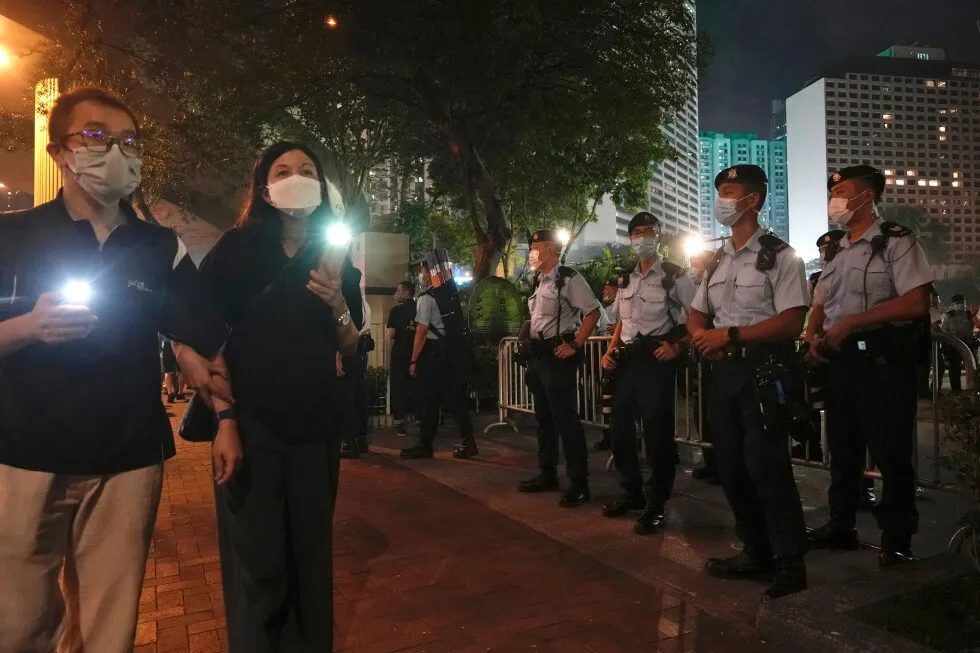
Hong Kong court hears arguments over sentencing for former Tiananmen vigil organizers 1 of 4 | People hold candles walk past police officers near Hong Kong Victoria Park, a place in the past years for people to gather during a candlelight vigil to mark the anniversary of the military crackdown on a pro-democracy student movement in Beijing, in Hong Kong, on June 4, 2021. (AP Photo/Vincent Yu, File) 2 of 4 | Chow Hang-tung, vice chairperson of the Hong Kong Alliance in Support of the Democratic Patriotic Movements of China, poses after an interview in Hong Kong on May 24, 2021. (AP Photo/Vincent Yu, File) 3 of 4 | Pro-democracy lawmakers Lee Cheuk-yan, right, and Albert Ho, pose after a press conference in Hong Kong, on April 15, 2016. (AP Photo/Kin Cheung, File) 4 of 4 | Pro-democracy candidate Lee Cheuk-yan reacts after losing a seat at the legislative council elections in Hong Kong, on Sept. 5, 2016. (AP Photo/Kin Cheung, File) 1 of 4 | People hold candles walk past police officers near Hong Kong Victoria Park, a place in the past years for people to gather during a candlelight vigil to mark the anniversary of the military crackdown on a pro-democracy student movement in Beijing, in Hong Kong, on June 4, 2021. (AP Photo/Vincent Yu, File) 1 of 4 People hold candles walk past police officers near Hong Kong Victoria Park, a place in the past years for people to gather during a candlelight vigil to mark the anniversary of the military crackdown on a pro-democracy student movement in Beijing, in Hong Kong, on June 4, 2021. (AP Photo/Vincent Yu, File) Add AP News on Google Add AP News as your preferred source to see more of our stories on Google. Share 2 of 4 | Chow Hang-tung, vice chairperson of the Hong Kong Alliance in Support of the Democratic Patriotic Movements of China, poses after an interview in Hong Kong on May 24, 2021. (AP Photo/Vincent Yu, File) 2 of 4 Chow Hang-tung, vice chairperson of the Hong Kong Alliance in Support of the Democratic Patriotic Movements of China, poses after an interview in Hong Kong on May 24, 2021. (AP Photo/Vincent Yu, File) Add AP News on Google Add AP News as your preferred source to see more of our stories on Google. Share 3 of 4 | Pro-democracy lawmakers Lee Cheuk-yan, right, and Albert Ho, pose after a press conference in Hong Kong, on April 15, 2016. (AP Photo/Kin Cheung, File) 3 of 4 Pro-democracy lawmakers Lee Cheuk-yan, right, and Albert Ho, pose after a press conference in Hong Kong, on April 15, 2016. (AP Photo/Kin Cheung, File) Add AP News on Google Add AP News as your preferred source to see more of our stories on Google. Share 4 of 4 | Pro-democracy candidate Lee Cheuk-yan reacts after losing a seat at the legislative council elections in Hong Kong, on Sept. 5, 2016. (AP Photo/Kin Cheung, File) 4 of 4 Pro-democracy candidate Lee Cheuk-yan reacts after losing a seat at the legislative council elections in Hong Kong, on Sept. 5, 2016. (AP Photo/Kin Cheung, File) Add AP News on Google Add AP News as your preferred source to see more of our stories on Google. Share Updated [hour]:[minute] [AMPM] [timezone], [monthFull] [day], [year] Hong Kong (AP) — Three former organizers of Hong Kong’s annual vigils in remembrance of the 1989 Tiananmen Square crackdown returned to court Friday to argue over their sentences after being convicted of inciting subversion under a national security law imposed by China.Lee Cheuk-yan, Chow Hang-tung and Albert Ho, former leaders of the Hong Kong Alliance in Support of Patriotic Democratic Movements of China, were charged in 2021 under the law that has effectively stifled the city’s previously thriving pro-democracy movement. Lee and Chow, who pleaded not guilty, were convicted Aug. 21. Ho earlier entered a guilty plea, which often can result in a reduced sentence. They face a maximum prison term of 10 years and are expected to be sentenced at a later date. Alex Lee, one of the judges, said they would be sentenced within two weeks. The disbanded alliance also was found guilty on the same charge. It was best known for organizing the only large-scale public commemoration in China that drew tens of thousands of people annually for three decades to remember the 1989 crackdown’s victims. The verdict has drawn concerns from foreign governments. Critics say the case illustrates a decline in freedoms Beijing promised to maintain when the former British colony returned to Chinese rule in 1997. But the Hong Kong government insisted the court only considered the laws and evidence and that many rights and freedoms are not absolute. Chow argues they did not deserve prison term Three government-approved judges ruled the trio of former vigil organizers had intentionally encouraged supporters of the alliance to wait for the right time to carry out “end one-party dictatorship,” one of the group’s core demands, through unlawful means.The judges said the call carried the notion of overthrowing or undermining the ruling Communist Party’s leadership status, adding that the defendants have long held enmity against the party and they did not genuinely believe their words and deeds would not violate the security law. 4 MIN READ Erik Shum, a lawyer representing Lee and Ho, told the judges that China’s fundamental system did not change because of the alliance members’ promotional work and the Communist Party was still stable and carrying out its duties, while the defendants’ advocacy work did not involve violence. Chow, a barrister who represented herself, insisted she did not do anything wrong and did not deserve even one day in prison. She argued the verdict was saying that pursuing democracy is a crime. “If the law truly has no room for our beliefs, then I would rather be a criminal than be a fake person,” she said. In a post Friday on social media site Patreon, Chow said regardless of whether she is in or outside prison, she would persistently strive to vindicate the 1989 pro-democracy movement, end one-party dictatorship and build a democratic Hong Kong and China, among other goals. The security law calls for sentences of between five and 10 years for convictions of inciting subversion, if the offense is deemed serious. If the circumstances are considered minor, sentences should not be more than five years, short-term detention or other restrictions.Many leading activists have been jailed under the security law, including former media tycoon Jimmy Lai. But China said the security law was necessary for Hong Kong’s stability.
SRCAssociated Press (AP)
LANGEN
LEANCenter
WORDS1 094
ENT10
FRI · 2026-08-28 · 06:53 GMTBRIEF NSR-2026-0828-106785
NSR-2026-0828-106785News Report·EN·Legal & Judicial
Hong Kong court hears arguments over sentencing for former Tiananmen vigil organizers
Three former organizers of Hong Kong's annual Tiananmen Square crackdown vigils are awaiting sentencing after being convicted of inciting subversion under China's national security law. Lee Cheuk-yan, Chow Hang-tung, and Albert Ho, leaders of the now-disbanded Hong Kong Alliance, were found guilty in August 2023.
By
KANIS LEUNGAssociated Press (AP)Filed 2026-08-28 · 06:53 GMTLean · CenterRead · 5 min
Associated Press (AP)FIG 01
Reading time
5min
Word count
1 094words
Sources cited
0cited
Entities identified
10entities
Quality score
100%
§ 01
Briefing Summary
AI-generatedNEWSAR · AI
Three former organizers of Hong Kong's annual Tiananmen Square crackdown vigils are awaiting sentencing after being convicted of inciting subversion under China's national security law. Lee Cheuk-yan, Chow Hang-tung, and Albert Ho, leaders of the now-disbanded Hong Kong Alliance, were found guilty in August 2023. The court ruled their calls to "end one-party dictatorship" constituted encouraging unlawful means to undermine the ruling Communist Party. Lee and Chow pleaded not guilty, while Ho pleaded guilty. They face up to 10 years in prison, with sentencing expected within two weeks. The convictions have raised international concerns about Hong Kong's declining freedoms, though the government maintains the court acted based on law and evidence.
Confidence 0.90Claims 4Entities 10
§ 02
Article analysis
Model · rule-basedFraming
Legal & Judicial
Social Justice
Tone
Measured
AI-assessed
CalmNeutralAlarmist
Factuality
0.80 / 1.00
Factual
LowHigh
Sources cited
0
No named sources
FewMany
§ 03
Key claims
4 extracted01
Lee Cheuk-yan and Albert Ho are identified as pro-democracy lawmakers.
factual
Confidence
1.00
02
Chow Hang-tung is identified as the vice chairperson of the Hong Kong Alliance in Support of the Democratic Patriotic Movements of China.
factual
Confidence
1.00
03
The Tiananmen Square vigil was a gathering to mark the anniversary of the military crackdown on a pro-democracy student movement in Beijing.
factual
Confidence
1.00
04
A Hong Kong court is hearing arguments regarding the sentencing of former organizers of the Tiananmen Square vigil.
factual
Confidence
1.00
§ 04
Full report
5 min read · 1 094 words§ 05
Entities
10 identifiedKey playerOppositionContextPositiveNeutralNegative
People3
Organizations2
Locations4
§ 06
Keywords & salience
8 termstiananmen vigil
1.00
sentencing arguments
0.90
hong kong court
0.80
pro-democracy movements
0.70
candlelight vigil
0.60
military crackdown
0.50
victoria park
0.40
hong kong alliance
0.40
§ 07
Topic connections
Interactive graph Network visualization showing 51 related topics
View Full Graph Person Organization Location Event|Click node to navigate|Edge numbers = shared articles