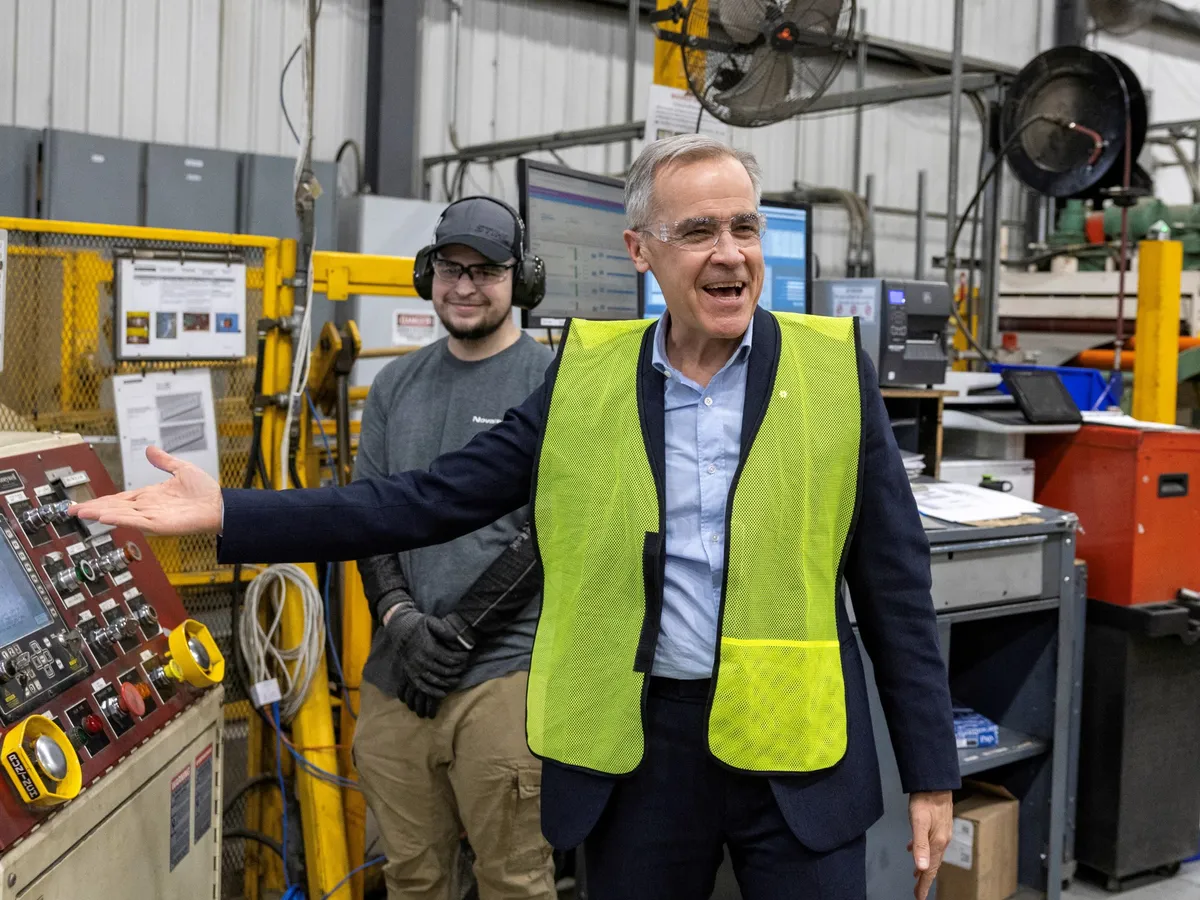
Healthy domestic demand, led by consumer spending and business investment, shows Canada was brushing off stresses from past US tariffs.Canada's Prime Minister Mark Carney walked away from trade negotiations with the US last week, saying a bad deal was worse than no deal [File: Carlos Osorio/Reuters]Published On 28 Aug 2026Canada’s economy has rebounded sharply in the second quarter after six months of virtually no growth, aided by a strong jump in exports and solid domestic demand, though a new round of tariffs from the United States brings renewed uncertainty.The economy grew at an annualised rate of 3.3 percent in the second quarter, the fastest rate since 2023, after a revised 0.3 percent increase in the first quarter, Canada" class="entity-link entity-organization" data-entity-id="5737" data-entity-type="organization">Statistics Canada said on Friday.Recommended Stories list of 4 itemslist 1 of 4‘Barrier lake’ triggers fresh floods, halts rescue at Nepal-China borderlist 2 of 4US Open 2026: All to know about the schedule, top seeds and favouriteslist 3 of 4After six months of war, what have US, Iran gained and lost?list 4 of 4US ICE agency to spend $16.7m on electric shock glovesend of listThe upward revision to first-quarter growth means Canada was not in a technical recession, usually defined as two straight quarters of contraction.Healthy domestic demand, led by consumer spending and business investment, signals the economy is slowly brushing off the impacts of more than 18 months of US import tariffs that upended North American supply chains and increased costs.Renewed tariff disputeA strong domestic consumption and expenditure pattern puts Canada on a firm footing to withstand a new 50 percent US import tariff that President Donald Trump imposed this week on $20bn of Canadian exports. Canada retaliated with its own countermeasures on US imports.“It seems like households and businesses were beginning to find ways of navigating the trade-related uncertainty before the latest round of tariffs,” Royce Mendes, managing director and head of macro strategy at Desjardins, wrote in a note.“While it helps that the economy was on stronger footing heading into August, the fresh wave of protectionism injects a significant amount of uncertainty into the outlook,” Mendes said.Michael Davenport, senior Canada economist at Oxford Economics, said in a note to Al Jazeera that while the gross domestic product (GDP) growth was along expected lines, “the economy is set to slow in the coming quarters amid escalating US-Canada trade policy uncertainty, new bilateral tariffs, and a shrinking population”.The Canadian dollar weakened slightly after the GDP data, with the loonie trading down 0.01 percent at 72.17 US cents.On a quarterly basis, GDP grew 0.8 percent for the period ended June, from an upwardly revised 0.1 percent in the previous quarter.Second-quarter annualised growth was higher than the Bank of Canada’s July forecast of 2.5 percent growth.Higher exports were one of the main contributing factors for the second-quarter growth, with outbound shipments growing 3.6 percent, the biggest increase in over three years, Canada" class="entity-link entity-organization" data-entity-id="5737" data-entity-type="organization">Statistics Canada (StatsCan) said.Stronger household spendingFinal domestic demand, the sum of all consumption and capital spending and a crucial metric to assess domestic health, rebounded to 1 percent in the second quarter, from a minor contraction in the first quarter.Domestic demand has been muted for several quarters as consumers and businesses remain cautious while Canada navigates its trade war with the US.But household final consumption expenditure, the main indicator of consumer spending, rose 0.8 percent, its highest level in three quarters, highlighting stronger household spending. This was mainly driven by higher wages and government benefits, economists said.Business investment, or business gross fixed capital formation, sprang to a solid 2.3 percent growth in the second quarter from a contraction of 1.3 percent, the first time in the last year and a half that business investment has expanded.That growth was led by investment in both residential and non-residential structures, machinery and equipment, StatsCan said.However, the general gross fixed capital formation, essentially government expenditure for creating assets, continued to decline with a second-quarter contraction of 2.9 percent, after shrinking 2.6 percent in the previous quarter.On a month-to-month basis, GDP for June grew 0.3 percent against a forecast of 0.2 percent, and an advance indicator showed that the economy was largely flat in July, the statistics agency said.
SRCAl Jazeera
LANGEN
LEANCenter
WORDS691
ENT12
FRI · 2026-08-28 · 16:59 GMTBRIEF NSR-2026-0828-106938
NSR-2026-0828-106938News Report·EN·Economic Impact
Canadian economy recovers sharply in Q2 but shadow of US tariffs in future
Canada's economy experienced a significant rebound in the second quarter of 2026, growing at an annualized rate of 3.3 percent. This recovery was driven by strong domestic demand, including increased consumer spending and business investment, which suggests the economy was beginning to overcome the impacts of previous US tariffs.
By ReutersAl JazeeraFiled 2026-08-28 · 16:59 GMTLean · CenterRead · 3 min
Al JazeeraFIG 01
Reading time
3min
Word count
691words
Sources cited
3cited
Entities identified
12entities
Quality score
100%
§ 01
Briefing Summary
AI-generatedNEWSAR · AI
Canada's economy experienced a significant rebound in the second quarter of 2026, growing at an annualized rate of 3.3 percent. This recovery was driven by strong domestic demand, including increased consumer spending and business investment, which suggests the economy was beginning to overcome the impacts of previous US tariffs. Exports also saw a substantial jump, contributing to the growth. However, this positive trend is overshadowed by renewed uncertainty due to a new 50 percent US import tariff imposed on Canadian exports, to which Canada has retaliated. Economists anticipate the economy may slow in coming quarters due to escalating trade policy uncertainty and new tariffs.
Confidence 0.90Sources 3Claims 5Entities 12
§ 02
Article analysis
Model · rule-basedFraming
Economic Impact
Diplomatic
Tone
Measured
AI-assessed
CalmNeutralAlarmist
Factuality
0.70 / 1.00
Factual
LowHigh
Sources cited
3
Well sourced
FewMany
§ 03
Key claims
5 extracted01
Canada's Prime Minister Mark Carney walked away from trade negotiations with the US last week.
factualArticle
Confidence
1.00
02
A new 50 percent US import tariff was imposed this week on $20bn of Canadian exports.
factualArticle
Confidence
1.00
03
The economy was brushing off impacts of US import tariffs before the latest round.
quoteRoyce Mendes
Confidence
1.00
04
Canada's economy rebounded sharply in Q2, growing at an annualized rate of 3.3 percent.
statisticStatistics Canada
Confidence
1.00
05
The economy is set to slow in coming quarters amid escalating US-Canada trade policy uncertainty.
predictionMichael Davenport
Confidence
0.80
§ 04
Full report
3 min read · 691 words§ 05
Entities
12 identifiedKey playerOppositionContextPositiveNeutralNegative
Organizations4
§ 06
Keywords & salience
10 termsus tariffs
1.00
canadian economy
1.00
economic growth
0.90
domestic demand
0.80
consumer spending
0.70
business investment
0.70
trade negotiations
0.60
exports
0.50
protectionism
0.50
gdp growth
0.40
§ 07
Topic connections
Interactive graph Network visualization showing 51 related topics
View Full Graph Person Organization Location Event|Click node to navigate|Edge numbers = shared articles