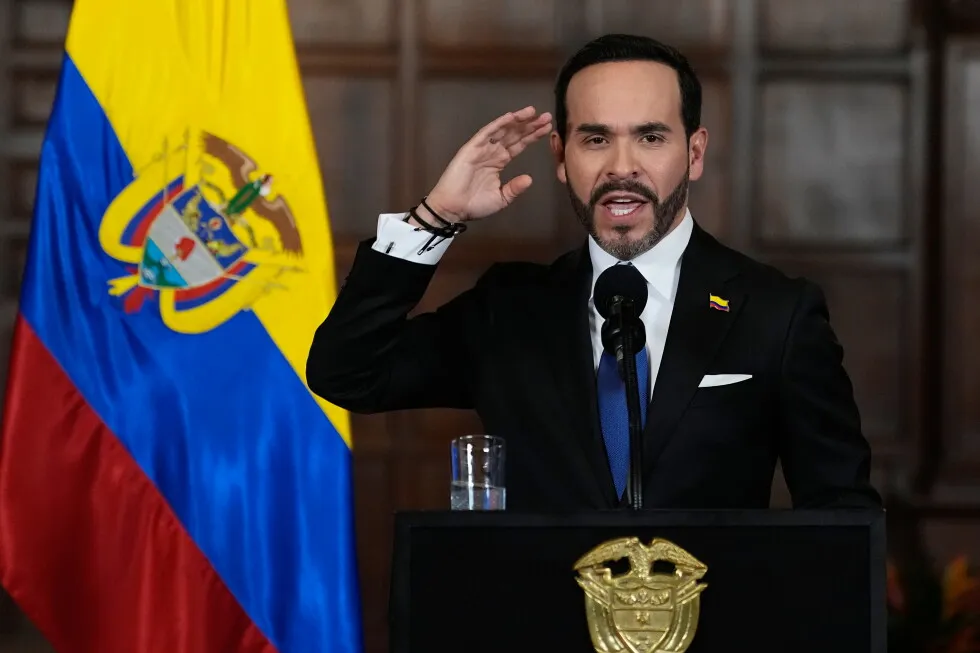
Colombia captures a suspected Tren de Aragua gang leader as US security ties deepen 1 of 3 | Colombia’s President Abelardo De la Espriella announces a joint effort with Bogota’s Mayor Carlos Fernando Galan to strengthen security in the Colombian capital through increased police presence, intelligence, technology, and urban capabilities in Bogota, Tuesday, Aug. 25, 2026. (AP Photo/Fernando Vergara) 2 of 3 | Chief Prosecutor Hector Barros, center, speaks during a press conference in Santiago, Chile, Friday, Aug. 28, 2026, regarding the suspected Tren de Aragua members Rafael Enrique Gámez Salas, known as “El Turko,” and Alfredo Camilo Carrillo Ortiz, known as “El Gocho,” who were extradited from the U.S. and Colombia. (AP Photo/Esteban Felix) 3 of 3 | Chief Prosecutor Hector Barros, left center front, talks with members of his legal team outside a hearing room in Santiago, Chile, Friday, Aug. 28, 2026, as they await the arraignment of suspected Tren de Aragua members Rafael Enrique Gámez Salas, known as “El Turko,” and Alfredo Camilo Carrillo Ortiz, known as “El Gocho,” who were extradited from the U.S. and Colombia. (AP Photo/Esteban Felix) By ASTRID SUÁREZ and ISABEL DEBRE Updated 2:29 AM MESZ, August 29, 2026 Add AP News on Google Add AP News as your preferred source to see more of our stories on Google. Share Share Facebook Copy Link copied Print Email X LinkedIn Bluesky Flipboard Pinterest Reddit Bogota, Colombia (AP) — Colombian security forces captured a suspected senior leader of the Venezuelan gang Tren de Aragua, the U.S. Southern Command announced on Friday, hailing the arrest as a result of stronger military cooperation between the historically close allies. The capture on Thursday of Luis Saúl Pérez Nieto, who Colombian authorities described as having coordinated the gang’s weapons and drug-trafficking networks across the region, offers an early sign of how rapidly the two countries have intensified their joint efforts against organized crime under Colombia’s new conservative president, Abelardo De la Espriella. An admirer of U.S. President Donald Trump, de la Espriella came to power earlier this month promising to crush his country’s powerful drug traffickers with help from Washington. His government has named Medellín, Colombia’s second-largest city, as the hub of Trump’s new regional anti-cartel alliance and welcomed joint operations with the U.S. military on Colombian soil in a sharp break from his progressive predecessor. Join millions who rely on The Associated Press for fast, accurate, nonpartisan reporting. Create a free account Sign in to existing account How we use your information Help with registration Continue without registering “Narco-terrorists have no safe haven in our hemisphere,” the U.S. Southern Command said in its statement on Friday announcing the capture of Pérez Nieto. “We stand united with our partners to dismantle these criminal networks and protect our homeland.” Pérez Nieto, known by the aliases “Páez” and “Nairobi,” was captured in an operation that also involved the U.S. Drug Enforcement Administration (DEA), Colombian police said, without elaborating. Colombian police accused Pérez Nieto of leading the expansion of Tren de Aragua in Peru while coordinating drug and arms trafficking across the continent, helping transform what began as a prison gang operating from Venezuela’s Tocorón penitentiary into a transnational criminal syndicate. From ‘The Lion’ to ‘The Tiger': Conservative Trump allies gain ground in Latin America 1 MIN READ 15 Colombian president orders immigration raids, vows deportations of migrants without legal status 3 MIN READ 153 Truck explodes outside Colombia police base, injuring 11 officers and killing a dog 3 MIN READ 153 In 2023, Pérez Nieto escaped from that prison along with his close confidant, the gang’s leader, Héctor “Niño Guerrero” Guerrero Flores, Colombian police added. Guerrero Flores was killed in a U.S. military strike in a rare collaboration with Venezuela earlier this year. The Trump administration last year designated Tren de Aragua a foreign terrorist organization, part of its effort to treat Latin American cartels as national security threats rather than conventional criminal groups. However, Trump has at times overstated the gang’s connections in an effort to justify deporting Venezuelans, The Associated Press previously reported. “Congratulations to President Abelardo De la Espriella and the Colombian National Police on the capture of Luis Páez Nieto, a senior Tren de Aragua leader,” DEA Administrator Terry Cole said. Colombian and Peruvian authorities said the U.S. had requested Pérez Nieto’s arrest and extradition on charges of terrorism, money laundering, drug trafficking and criminal conspiracy. The Trump administration has not publicly detailed the case against him. The DEA did not respond to questions about the charges against Pérez Nieto in the U.S. or its role in the operation. Increased cooperation at the Colombian-Ecuadorian border Earlier this week, U.S. Southern Command chief Gen. Francis Donovan met Colombia’s defense minister and military leaders in the port city of Tumaco before traveling to Ecuador for regional security talks focused on the volatile border between the two countries, rife with drug smuggling, illegal mining and human trafficking. During his visit, Donovan said that U.S., Ecuadorian and Colombian officials had agreed on a strategy to “hunt cartel leadership, shatter their logistics and permanently deny them safe haven.” “The border between Colombia and Ecuador is a geographic chokepoint that violent cartels have long exploited,” he said. “Today, we are changing the game.” Colombia and Ecuador are among the few regional governments that have agreed to allow joint operations with U.S. forces against criminal groups on their territory, part of the Trump administration’s efforts to extend its lethal campaign against suspected drug smuggling boats to land. Chile celebrates Tren de Aragua extradition as security success It comes as South American voters increasingly elect Trump-aligned conservative leaders who have called for far-reaching security crackdowns. Among them is Chilean President José Antonio Kast, whose government has struggled to deliver on its sweeping promises to curb crime and carry out and mass deportations. But on Friday, Chilean officials celebrated a victory as they announced the arrival of two alleged Tren de Aragua leaders extradited from the U.S. and Colombia to face charges in Chile related to the abduction and killing of former Venezuelan army Lt. Ronald Ojeda in 2024. The body of the Venezuelan dissident, who had sought political asylum in Chile, was found inside a suitcase buried beneath a cement slab in Santiago, the capital. Chilean authorities have charged Rafael Enrique Gámez Salas, the alleged leader of Los Piratas, the main branch of Tren de Aragua in Chile, with kidnapping, extortion and criminal association, among other offenses. The other suspect, Alfredo Camilo Carrillo Ortiz, alias “El Gocho,” was extradited from Colombia. Chilean prosecutors accuse him of helping plan and carry out the killing and running the informal settlement where Ojeda’s body was buried. Chile’s undersecretary for public security, María del Pilar Giannini, called the extraditions “a concrete demonstration” of the Kast government’s crusade against organized crime. “We are going to pursue them to the very end,” she said. U.S. officials praised Gámez’s extradition from California, where he was serving a federal prison sentence for illegally reentering the country. Attorney General Todd Blanche called it “evidence of the strong cooperation with our Chilean partners to combat transnational crime, dismantle foreign terrorist organizations like Tren de Aragua and hold members accountable for their heinous criminal acts.” ISABEL DEBRE DeBre writes about Argentina, Bolivia, Chile, Paraguay and Uruguay for The Associated Press, based in Buenos Aires. Before moving to South America in 2024, she covered the Middle East reporting from Jerusalem, Cairo and Dubai. twitter mailto
SRCAssociated Press (AP)
LANGEN
LEANCenter
WORDS1 238
ENT12
SAT · 2026-08-29 · 00:53 GMTBRIEF NSR-2026-0829-107038
NSR-2026-0829-107038News Report·EN·National Security
Colombia captures a suspected Tren de Aragua gang leader as US security ties deepen
Colombian security forces, in a joint operation with the U.S. Drug Enforcement Administration, captured Luis Saúl Pérez Nieto, a suspected senior leader of the Venezuelan gang Tren de Aragua.
Associated Press (AP)Filed 2026-08-29 · 00:53 GMTLean · CenterRead · 5 min
Associated Press (AP)FIG 01
Reading time
5min
Word count
1 238words
Sources cited
3cited
Entities identified
12entities
Quality score
100%
§ 01
Briefing Summary
AI-generatedNEWSAR · AI
Colombian security forces, in a joint operation with the U.S. Drug Enforcement Administration, captured Luis Saúl Pérez Nieto, a suspected senior leader of the Venezuelan gang Tren de Aragua. The U.S. Southern Command announced the arrest on Friday, highlighting it as a success of intensified military cooperation between the two nations under Colombia's new conservative president, Abelardo de la Espriella. Colombian authorities described Pérez Nieto as having coordinated the gang’s weapons and drug-trafficking networks across the region. The capture is seen as an early indicator of the deepening security ties between Colombia and the U.S. as they collaborate to combat organized crime. This development follows the U.S. designation of Tren de Aragua as a foreign terrorist organization.
Confidence 0.90Sources 3Claims 5Entities 12
§ 02
Article analysis
Model · rule-basedFraming
National Security
Diplomatic
Tone
Measured
AI-assessed
CalmNeutralAlarmist
Factuality
0.80 / 1.00
Factual
LowHigh
Sources cited
3
Well sourced
FewMany
§ 03
Key claims
5 extracted01
Narco-terrorists have no safe haven in our hemisphere.
quoteU.S. Southern Command
Confidence
1.00
02
The arrest is a result of stronger military cooperation between Colombia and the U.S.
factualU.S. Southern Command
Confidence
1.00
03
Colombian security forces captured a suspected senior leader of the Venezuelan gang Tren de Aragua.
factualU.S. Southern Command
Confidence
1.00
04
Colombia's new conservative president, Abelardo de la Espriella, promised to crush drug traffickers with help from Washington.
factualarticle
Confidence
0.90
05
Luis Saúl Pérez Nieto coordinated the gang’s weapons and drug-trafficking networks across the region.
factualColombian authorities
Confidence
0.90
§ 04
Full report
5 min read · 1 238 words§ 05
Entities
12 identifiedKey playerOppositionContextPositiveNeutralNegative
People6
Organizations1
§ 06
Keywords & salience
10 termstren de aragua
1.00
organized crime
0.90
security cooperation
0.80
drug trafficking
0.70
colombia
0.70
us southern command
0.60
abelardo de la espriella
0.50
regional anti-cartel alliance
0.50
military cooperation
0.40
weapons networks
0.40
§ 07
Topic connections
Interactive graph Network visualization showing 51 related topics
View Full Graph Person Organization Location Event|Click node to navigate|Edge numbers = shared articles