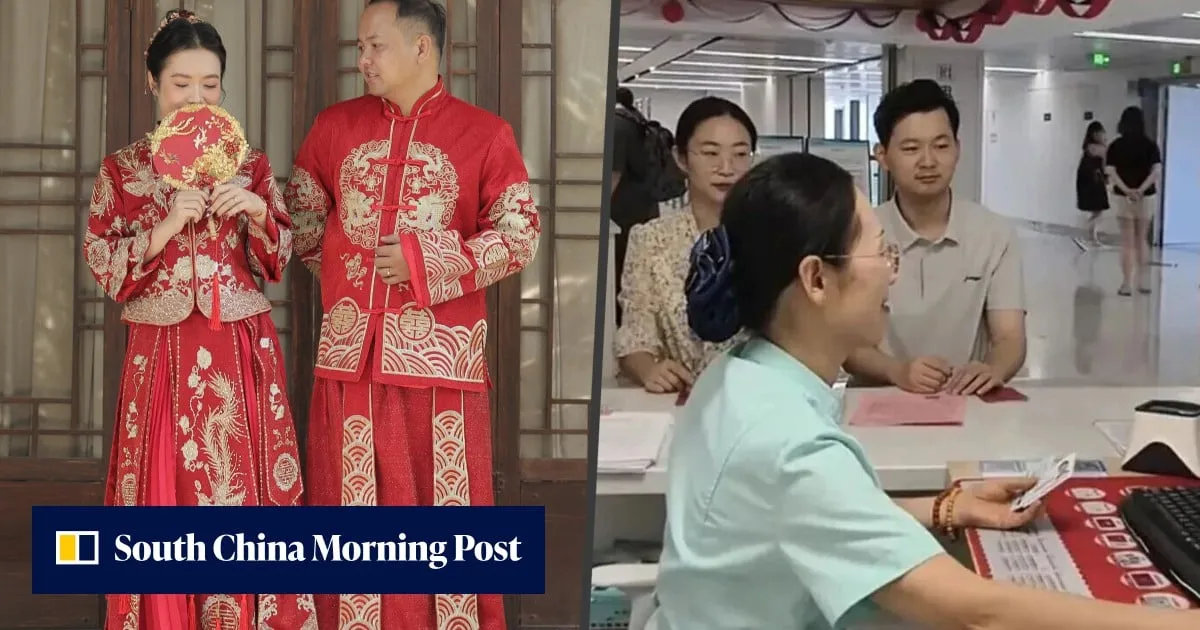
Following temples and nightclubs, a Chinese bank and a hospital have recently begun offering marriage registration services, igniting discussions on the Chinese government’s commitment to promoting nuptials.In August, a branch of the China" class="entity-link entity-organization" data-entity-id="100427" data-entity-type="organization">Postal Savings Bank of China, located in the northern municipality of Tianjin, became the country’s first bank to provide marriage registration services.While online observers mocked the unusual pairing of finance and romance – joking that only nuptials at a hospital could surpass this combination – their humour soon became reality.On August 20, during this year’s Qixi Festival, also known as Chinese Valentine’s Day, the Maternal and Child Health Hospital of Linzi District in Zibo City, Shandong province in eastern China, announced the introduction of marriage registration services at its facility.The hospital claims that this service simplifies the lives of newlyweds by streamlining their marriage registration, premarital examinations, and preconception guidance all in one place.Netizens chimed in, suggesting that law firms, police offices, universities, and airports should also offer marriage registration services to “make life easier for people.”In fact, in January, Guangzhou Baiyun International Airport in southern China’s Guangdong province became the nation’s first airport to issue marriage certificates, while also providing free access to its observation deck, where visitors can closely watch planes take off and land.In May last year, China updated its marriage registration regulations, allowing couples to marry outside their hukou, or household registration, location.Additionally, they no longer need to present their hukou booklets to register their marriage, significantly simplifying the process.These new regulations contributed to the emergence of unconventional marriage registration venues, situated in tourist attractions, public parks, temples, and even metro stations.By May, China had established more than 500 marriage registration spots outside traditional civil affairs bureaus, supplemented by over 1,300 outdoor venues authorised to issue certificates. Photo: SinaIn Beijing and Nanjing, centuries-old temples accommodate couples looking to marry while donning traditional attire.In Hefei, in central China’s Anhui province, a metro station became the first transport facility in the nation to offer marriage registration this August.Further ReadingMeanwhile, in Shanghai, a nightclub partnered with the local civil affairs bureau to hold special certification ceremonies within the club.By May this year, one year after these new regulations were enacted, China reportedly had over 500 marriage registration sites set up outside civil affairs bureaus, along with more than 1,300 outdoor locations collaborating with the bureau to issue marriage certificates.While the streamlined procedures apply to divorce as well, many outdoor marriage registration sites do not provide divorce services, citing the need for more extensive documentation.The diverse range of marriage registration venues is perceived by the public as the government’s urgent attempt to increase marriage rates.Initial results appear promising. In the third quarter of last year, 1.61 million couples registered their marriages nationwide, representing a 22.5 per cent year-on-year increase.Overall, the country saw 6.76 million marriage registrations last year, an increase of 657,000 compared to the previous year.Marriage anywhere? China’s flexible new registration rules have sparked a boom in stunning, unconventional wedding destinations across the country. Photo: SinaHowever, in the first half of this year, marriages in China dropped by 7.5 per cent year-on-year, with 3.28 million couples tying the knot.On social media, some dismissed the convenient marriage registration initiatives as “futile.”“Do people not get married because they can’t find a place to register?” one user quipped.“I suggest the civil affairs bureau establish divorce services on top of Mount Everest,” another mocked.“What holds young people back from marriage is not complicated procedures, but the confidence to face the life challenges they may encounter in the coming decades,” remarked a third commenter.“People are simultaneously fearful of the financial burdens, family conflicts, and loss of personal freedom that marriage entails, while no longer viewing marriage as a necessary life milestone,” added another.
SRCSouth China Morning Post
LANGEN
LEANCenter-Right
WORDS621
ENT12
SAT · 2026-08-29 · 02:00 GMTBRIEF NSR-2026-0829-107067
NSR-2026-0829-107067News Report·EN·Human Interest
China hospital joins nightclubs in offering marriage services to fight low wedding rates
China is seeing an increase in unconventional marriage registration locations, including a bank and a hospital, as the government attempts to boost declining marriage rates. Following relaxed regulations in May 2023 that simplified the process, venues like temples, nightclubs, and even airports have begun offering marriage registration services.
Fran LuSouth China Morning PostFiled 2026-08-29 · 02:00 GMTLean · Center-RightRead · 3 min
South China Morning PostFIG 01
Reading time
3min
Word count
621words
Sources cited
0cited
Entities identified
12entities
Quality score
100%
§ 01
Briefing Summary
AI-generatedNEWSAR · AI
China is seeing an increase in unconventional marriage registration locations, including a bank and a hospital, as the government attempts to boost declining marriage rates. Following relaxed regulations in May 2023 that simplified the process, venues like temples, nightclubs, and even airports have begun offering marriage registration services. The Maternal and Child Health Hospital of Linzi District, for example, now provides registration alongside premarital and preconception guidance. While these initiatives have led to a rise in registrations, some social media users question their effectiveness in addressing the underlying reasons for young people's reluctance to marry, such as financial concerns and perceived life challenges. Despite a year-on-year increase in 2023, marriage registrations saw a slight decrease in the first half of this year.
Confidence 0.90Claims 5Entities 12
§ 02
Article analysis
Model · rule-basedFraming
Human Interest
Social Justice
Tone
Measured
AI-assessed
CalmNeutralAlarmist
Factuality
0.80 / 1.00
Factual
LowHigh
Sources cited
0
No named sources
FewMany
§ 03
Key claims
5 extracted01
A nightclub partnered with the local civil affairs bureau to hold special certification ceremonies within the club.
factual
Confidence
1.00
02
Guangzhou Baiyun International Airport became the nation's first airport to issue marriage certificates.
factual
Confidence
1.00
03
China updated marriage registration regulations in May last year, allowing couples to marry outside their hukou location and simplifying the process.
factual
Confidence
1.00
04
A Chinese hospital has begun offering marriage registration services to simplify the process for newlyweds.
factualMaternal and Child Health Hospital of Linzi District
Confidence
1.00
05
Over 500 marriage registration spots have been established outside traditional civil affairs bureaus by May this year.
statistic
Confidence
0.90
§ 04
Full report
3 min read · 621 words§ 05
Entities
12 identifiedKey playerOppositionContextPositiveNeutralNegative
Organizations3
Locations5
§ 06
Keywords & salience
10 termsmarriage registration services
1.00
low wedding rates
0.90
unconventional venues
0.80
government promotion
0.70
hukou regulations
0.60
china
0.50
hospitals
0.40
nightclubs
0.40
banks
0.40
qixi festival
0.40
§ 07
Topic connections
Interactive graph No topic relationship data available yet. This graph will appear once topic relationships have been computed.