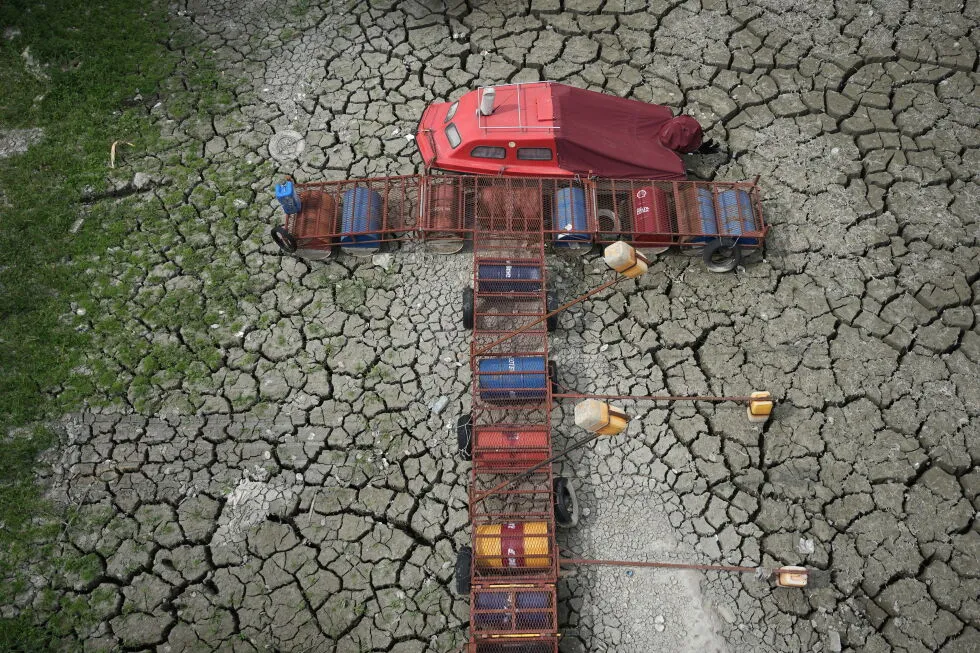
Europe’s summer Drought threatens fish in rivers, lakes and farms 1 of 5 | A boat sits on dry ground as water levels have dropped on the Danube River in Petrovaradin, Serbia, Tuesday, Aug. 25, 2026. (AP Photo/Darko Vojinovic) 2 of 5 | Fish swim in a pond as water levels have dropped on the Danube River in Petrovaradin, Serbia, Tuesday, Aug. 25, 2026. (AP Photo/Darko Vojinovic) 3 of 5 | A fisherman takes part in a fish haul of the Kanov pond near the town of Trebon, Czech Republic, Wednesday, Aug. 26, 2026. (AP Photo/Petr David Josek) 4 of 5 | Fishermen pull in a net during a fish haul of the Kanov pond near the town of Trebon, Czech Republic, Wednesday, Aug. 26, 2026. (AP Photo/Petr David Josek) 5 of 5 | Fishermen pull in a net during a fish haul of the Kanov pond near the town of Trebon, Czech Republic, Wednesday, Aug. 26, 2026. (AP Photo/Petr David Josek) By MARKO DROBNJAKOVIC and JOVANA GEC Updated 7:33 AM MESZ, August 29, 2026 Add AP News on Google Add AP News as your preferred source to see more of our stories on Google. Share Share Facebook Copy Link copied Print Email X LinkedIn Bluesky Flipboard Pinterest Reddit NOVI SAD, Serbia (AP) — Small boats stand idle on cracked ground in a shriveled side channel of the Danube River in northern Serbia, where the water has receded into a couple of shrinking ponds under pressure from extreme Drought and heat. Fish circle in the shallow waters. “This is all we have, these two little ponds that are full of juvenile fish,” fisherman Dusan Jovanovic said. He said the fish are in danger because there is too little water and its temperature is over 30 degrees Celsius (86 degrees Fahrenheit). “If they start to die, they will all die at once,” Jovanovic said. Persistent Drought and scorching heat this summer have ravaged ecosystems and businesses across the region, from a lake in Slovenia and the side channel of the Danube in Serbia, to fish farms in Bosnia, the Czech Republic, Romania and Hungary. The fish industry has been hit especially hard, with damage estimated in the millions of euros (dollars). This is adding to the already high toll caused by problems with energy and water supplies, devastated crops, losses in river traffic and trade. Finding themselves unprepared for this year’s crisis, countries and businesses are now pondering ways to minimize the effects of future extreme weather events that scientists have tied to human-induced Climate Change. Hungary’s fish die as entire country faces extreme Drought Around 99% of Hungary’s lands are currently under severe or extreme Drought conditions, according to the national meteorological service. Desertification, a process where vegetation recedes because of high heat and low rainfall, threatens much of the Great Hungarian Plain. Among the most affected are Hungary’s roughly 27,000 hectares (67,000 acres) of fish ponds. The country’s Agriculture and Food Economy Ministry said last week that “persistent heat and water shortages” had led to 1,588 hectares (3,924 acres) of those ponds drying out, causing the deaths of nearly 280 metric tons of fish at 20 farms. The estimated revenue loss from the damage was 1.3 billion forints ($4.2 million), the ministry said. Producers say replacing lost fish could take years. Sometimes, operators were forced to drain one pond and divert its water to save fish in another, the Hungarian Aquaculture and Fisheries Inter-branch Organization said in early August. Serbia races to contain wildfires as Europe’s blistering heat wave grips the Balkans 5 MIN READ Record low Danube levels push some countries in Eastern Europe to the brink of energy emergency 1 MIN READ A historic boat emerges in Serbia as Europe’s rivers run dry from Drought and heat 1 MIN READ Repeated Drought over years hurts Romanian fish farmers For fish farmers in Romania, especially those cultivating carp, this year’s blistering heatwave follows severe droughts in 2023 and 2024, the effects of which are still being felt, says Catalin Platon, president of ROMFISH National Association of Fish Producers. In carp production, Platon said, the production cycle is three or four years. “So what we lost in 2023 has (had an) impact every year since,” he explained. Water-use policies that prioritized irrigation for agriculture during the previous droughts, “left us with no water for the fish,” Platon complained. Fish farmers across the Czech Republic have taken various emergency measures: reducing or suspending feeding to reduce oxygen use, aerating the ponds or draining them when necessary. The Czech Fishing Association officials say sustained rainfall could ease the immediate crisis, but long-term measures are needed to retain more water in the landscape. Jan Sokolik, a technician at the Rybarstvi Trebon fishery, explained that “some ponds that were actually low on water have already been fished, but they were all marginal ponds.” “Now we’re just starting to plan what to do with the big ponds,” he said. Bosnian trout breeders ‘looking to survive summer’ Veljko Budjen owns a trout farm near Trebinje in southeast Bosnia. He said hot and dry summers have brought serious problems in the mainly mountainous country famous for its trout restaurants. “Trout is a cold water fish, which requires cold water with a lot of oxygen,” he said. “So during the summer you are forced to reduce trout production and feeding so the business can just barely survive.” One option, he said, is to add liquid oxygen to the water during summer months. Otherwise, he said, “you wait for the first rain.” Slovenians pump water into a lake in an attempt to save fish Emergency teams have been pumping water into Lake Pristava in eastern Slovenia, a favorite spot for fishermen, to try to prevent a mass suffocation of fish from lack of oxygen and water chestnut overgrowing to cover the lake surface. Firefighters have pumped in 8 million liters (2 million gallons) of water but they still fear it’s not enough. “We are surprised that any fish has survived at all,” Danijel Fras, from the Pesnica Lenart Fishing Association, told public broadcaster RTV Slovenia. In Serbia, fishermen said the only solution for the endangered fish in the Danube side channel in Novi Sad is to move them to another location. “The temperatures this year are extreme,” Jovanovic, the Serbian fisherman, said. “No one can remember anything like this.” Justin Spike in Budapest, Hungary, Eldar Emric in Trebinje, Bosnia, Stanislav Hodina in Prague and Steven McGrath in Leamington Spa, England, contributed.
SRCAssociated Press (AP)
LANGEN
LEANCenter
WORDS1 083
ENT12
SAT · 2026-08-29 · 05:53 GMTBRIEF NSR-2026-0829-107070
NSR-2026-0829-107070News Report·EN·Environmental
Europe’s summer drought threatens fish in rivers, lakes and farms
Europe is experiencing a severe summer drought that is critically impacting fish populations in rivers, lakes, and farms. In Serbia, the Danube River has receded significantly, leaving fish in shallow, overheated ponds at risk of mass death.
Associated Press (AP)Filed 2026-08-29 · 05:53 GMTLean · CenterRead · 5 min
Associated Press (AP)FIG 01
Reading time
5min
Word count
1 083words
Sources cited
3cited
Entities identified
12entities
Quality score
100%
§ 01
Briefing Summary
AI-generatedNEWSAR · AI
Europe is experiencing a severe summer drought that is critically impacting fish populations in rivers, lakes, and farms. In Serbia, the Danube River has receded significantly, leaving fish in shallow, overheated ponds at risk of mass death. Fish farms across Hungary, Bosnia, the Czech Republic, Romania, and Hungary are facing millions of euros in damages due to water shortages and extreme heat. Hungary has seen thousands of acres of fish ponds dry up, resulting in substantial fish losses and revenue decline. Romanian fish farmers are struggling with the cumulative effects of repeated droughts. Czech fish farmers are implementing emergency measures like reducing feeding and aerating ponds. This crisis highlights the unpreparedness for extreme weather events, which scientists link to climate change, prompting discussions on future mitigation strategies.
Confidence 0.90Sources 3Claims 5Entities 12
§ 02
Article analysis
Model · rule-basedFraming
Environmental
Economic Impact
Tone
Mixed Tone
AI-assessed
CalmNeutralAlarmist
Factuality
0.80 / 1.00
Factual
LowHigh
Sources cited
3
Well sourced
FewMany
§ 03
Key claims
5 extracted01
Around 99% of Hungary's lands are under severe or extreme drought conditions.
statisticnational meteorological service
Confidence
1.00
02
Water temperatures in affected ponds are over 30 degrees Celsius (86 degrees Fahrenheit), endangering fish.
quoteDusan Jovanovic
Confidence
1.00
03
Europe's summer drought and heat are threatening fish in rivers, lakes, and farms.
factual
Confidence
1.00
04
Scientists have tied extreme weather events to human-induced climate change.
factualscientists
Confidence
0.90
05
The fish industry has suffered damage estimated in the millions of euros (dollars) due to the drought.
statistic
Confidence
0.90
§ 04
Full report
5 min read · 1 083 words§ 05
Entities
12 identifiedKey playerOppositionContextPositiveNeutralNegative
Locations9
Events1
§ 06
Keywords & salience
9 termssummer drought
1.00
fish
0.90
climate change
0.80
extreme heat
0.70
water levels
0.60
fish farms
0.50
danube river
0.50
ecosystems
0.40
river traffic
0.40
§ 07
Topic connections
Interactive graph Network visualization showing 26 related topics
View Full Graph Person Organization Location Event|Click node to navigate|Edge numbers = shared articles