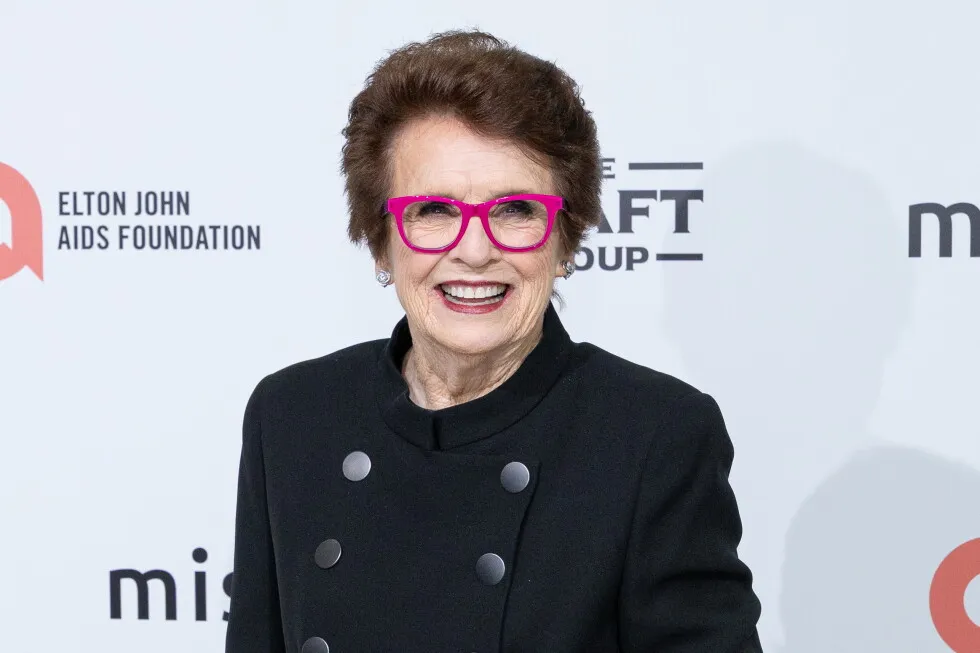
Some 54 years after helping pass Title IX, Billie Jean King’s advocacy continues 1 of 2 | Billie Jean King arrives at the 34th Annual Elton John AIDS Foundation Academy Awards Viewing Party on March 15, 2026, in West Hollywood, Calif. (Photo by Willy Sanjuan/Invision/AP, File) 2 of 2 | Tennis star Billie Jean King speaks about gender equality before the Senate education subcommittee in Washington on Nov. 9, 1973. (AP Photo, File) 1 of 2 | Billie Jean King arrives at the 34th Annual Elton John AIDS Foundation Academy Awards Viewing Party on March 15, 2026, in West Hollywood, Calif. (Photo by Willy Sanjuan/Invision/AP, File) 1 of 2 Billie Jean King arrives at the 34th Annual Elton John AIDS Foundation Academy Awards Viewing Party on March 15, 2026, in West Hollywood, Calif. (Photo by Willy Sanjuan/Invision/AP, File) Add AP News on Google Add AP News as your preferred source to see more of our stories on Google. Share 2 of 2 | Tennis star Billie Jean King speaks about gender equality before the Senate education subcommittee in Washington on Nov. 9, 1973. (AP Photo, File) 2 of 2 Tennis star Billie Jean King speaks about gender equality before the Senate education subcommittee in Washington on Nov. 9, 1973. (AP Photo, File) Add AP News on Google Add AP News as your preferred source to see more of our stories on Google. Share Updated [hour]:[minute] [AMPM] [timezone], [monthFull] [day], [year] For Billie Jean King, the fight for Title IX continues. Some 54 years after the passage of the landmark legislation that banned discrimination in any education program or activity that receives federal funds, King still advocates for women’s sports and equity. There’s a throughline from the passage of the law to the growth women’s sports have seen in recent years. The fruits of King’s activism can be seen in the athletes who populate the WNBA, the National Women’s Soccer League, the Professional Women’s Hockey League, and the other women’s professional sports that have emerged in recent years. “I think the professional part is starting to happen, they can see that if they want to be a big deal, they can see the top. We never had that when we were growing up, but now they can see it, and if you can see it, you can be it,” King said. “They’re going to be able to see these things, and that’s good. But what we need is at the grassroots levels. What I always worry about: you’ve got to keep the girls in the sports.” King, of course, was an accomplished athlete in her own right, with 39 Grand Slam tennis titles. A year after Title IX was passed in 1972, she beat Bobby Riggs in the historic “Battle of the Sexes.” She was awarded the Presidential Medal of Freedom, the nation’s highest civilian honor, in 2009. 1 MIN READ 1 MIN READ 2 MIN READ King runs a foundation in her name dedicated to supporting young people through sports, education and activism. She is also a founder of the Women’s Sports Foundation, established n 1974, which works to expand opportunities for women and girls in sports. And more recently she’s partnered with Dove’s Body Confident Collective with other athletes and leaders, including former soccer star Mia Hamm and South Carolina women’s basketball coach Dawn Staley, to help young girls remain in sports. Title IX is increasingly under fire from many directions. Name, image and likeness deals that have proliferated in college sports are often tilted toward male athletes in the top sports like football and basketball. A landmark NCAA antitrust settlement granted $2.7 billion in back pay for athletes who were barred from making money off their name, image and likeness. Critics argued the settlement should be equally distributed under Title IX. But last year the Department of Education rescinded guidance issued by the Biden Administration that said schools must equitably distribute the payments. And the Trump Administration is moving the arm of the Education Department that enforces Title IX, the Office of Civil Rights, to the Justice Department. The administration has shifted the priorities of the office in an effort to eliminate diversity, equity and inclusion programs. It also moved to rescind guidance from previous administrations that gave Title IX protections to LGBTQ students.“I don’t know what’s going to happen, but we’re going to have to figure it out because I don’t think it’s going to help girls. You know, maybe it is going to help girls, but not to the same extent as the boys. So that’s not right either. It should be equality wherever we go in life,” King said.That are also other potential threats. Recently the Heritage Foundation, which authored Project 2025, published a report, “Title IX’s Failed Experiment: Why Accommodating Sex Differences Beats Engineered Parity.”
SRCAssociated Press (AP)
LANGEN
LEANCenter
WORDS801
ENT12
SAT · 2026-08-29 · 05:53 GMTBRIEF NSR-2026-0829-107071
NSR-2026-0829-107071News Report·EN·Human Interest
Some 54 years after helping pass Title IX, Billie Jean King’s advocacy continues
Billie Jean King, a key figure in the passage of Title IX 54 years ago, continues her advocacy for women's sports and equity. Her activism is credited with contributing to the growth of women's professional leagues like the WNBA and the National Women's Soccer League.
By
ANNE M. PETERSONAssociated Press (AP)Filed 2026-08-29 · 05:53 GMTLean · CenterRead · 4 min
Associated Press (AP)FIG 01
Reading time
4min
Word count
801words
Sources cited
1cited
Entities identified
12entities
Quality score
100%
§ 01
Briefing Summary
AI-generatedNEWSAR · AI
Billie Jean King, a key figure in the passage of Title IX 54 years ago, continues her advocacy for women's sports and equity. Her activism is credited with contributing to the growth of women's professional leagues like the WNBA and the National Women's Soccer League. King emphasizes the importance of grassroots efforts to keep girls involved in sports, noting that while professional opportunities are improving, grassroots support is crucial. Title IX is currently facing challenges, including debates over the equitable distribution of name, image, and likeness (NIL) deals in college sports and shifts in the Department of Education's enforcement of the law. King remains committed to fighting for equality, despite these obstacles.
Confidence 0.90Sources 1Claims 5Entities 12
§ 02
Article analysis
Model · rule-basedFraming
Human Interest
Social Justice
Tone
Measured
AI-assessed
CalmNeutralAlarmist
Factuality
0.70 / 1.00
Factual
LowHigh
Sources cited
1
Limited
FewMany
§ 03
Key claims
5 extracted01
Billie Jean King won 39 Grand Slam tennis titles and beat Bobby Riggs in the 'Battle of the Sexes'.
factual
Confidence
1.00
02
Billie Jean King believes that seeing successful female athletes inspires young girls to pursue sports.
quoteBillie Jean King
Confidence
1.00
03
Title IX banned discrimination in education programs or activities receiving federal funds.
factual
Confidence
1.00
04
Billie Jean King continues to advocate for women's sports and equity 54 years after Title IX's passage.
factual
Confidence
1.00
05
The growth of women's professional sports leagues like the WNBA is a result of activism stemming from Title IX.
factual
Confidence
0.90
§ 04
Full report
4 min read · 801 words§ 05
Entities
12 identifiedKey playerOppositionContextPositiveNeutralNegative
Organizations5
§ 06
Keywords & salience
9 termsbillie jean king
1.00
title ix
1.00
gender equality
0.90
women's sports
0.90
advocacy
0.80
equity
0.70
grassroots levels
0.60
professional sports
0.50
senate education subcommittee
0.40
§ 07
Topic connections
Interactive graph No topic relationship data available yet. This graph will appear once topic relationships have been computed.