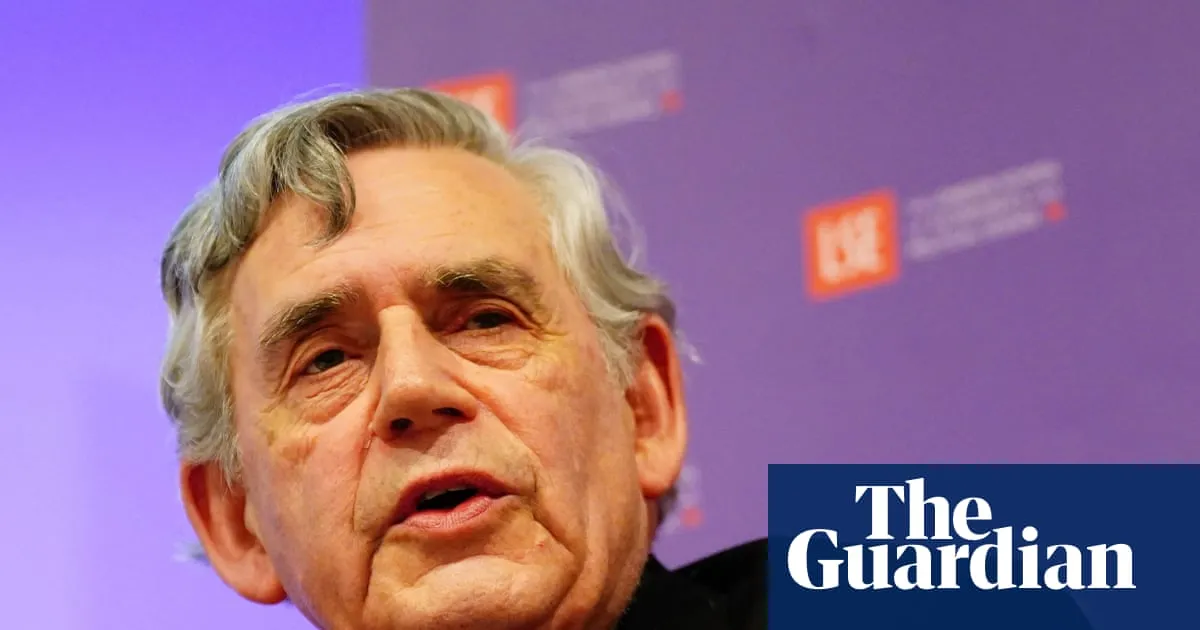
The former prime minister Gordon Brown has said it is inevitable that Ireland will become united at some point in the future, in a wide-ranging interview with the Guardian.While he added that any union would necessarily be “a long process” and based on mutual agreement, Brown’s comments are notable both because of his vehement opposition to Scottish independence, but also because of his involvement in government in efforts to bring peace to Ireland" class="entity-link entity-location" data-entity-id="1853" data-entity-type="location">Northern Ireland.He was Tony Blair’s chancellor when the Good Friday peace agreement was signed in 1998. In 2010, he was prime minister when justice and policing powers were devolved to Ireland" class="entity-link entity-location" data-entity-id="1853" data-entity-type="location">Northern Ireland’s power-sharing government, another major step for reconciliation.But, speaking to the Guardian’s Saturday magazine, Brown argued that Ireland" class="entity-link entity-location" data-entity-id="1853" data-entity-type="location">Northern Ireland had a potentially different position with regards to the rest of the UK than, for example, Scotland.Asked about continued pressure for Scottish independence, Brown said: “Scotland’s got to find a way of living in cooperation with other countries, and independence would not be the right way forward. We’re geographically, economically, socially, culturally linked to the rest of the United Kingdom, whether it’s Wales, England or parts of Ireland.”Questioned about whether the geographical link of Ireland" class="entity-link entity-location" data-entity-id="1853" data-entity-type="location">Northern Ireland with the Ireland" class="entity-link entity-location" data-entity-id="3366" data-entity-type="location">Republic of Ireland meant uniting the two made sense, he replied: “Yes. Well, of course, in the long term, Ireland will be united.”Such a process would be, he added, “a long process where people have got to come together and find a way of agreeing. Basically, that is the issue: whether people can actually agree.”Elsewhere in the interview, coinciding with the publication of Brown’s new book, The Future Starts With Us, he said he did not want “to be a backseat driver” in terms of telling Andy Burnham – who served in his cabinet – what to do.He nonetheless made the case for continued oil and gas drilling in the North Sea, one of the most politically sensitive decisions facing Burnham in the coming months, notably over the Rosebank and Jackdaw fields, consultations on which have now closed.Brown argued that decisions over the North Sea had been incorrectly portrayed as a binary choice between fossil fuels and renewables, when in fact it was a question of helping a transition towards the latter.He said: “I think you can support renewables as the future for British energy and support the development of the North Sea to use some of the existing oil and gas.“And in fact, the way to use the North Sea for hydrogen, for wind – it could be floating wind– and for carbon capture and storage, which are three energy products that could come out of the North Sea, the way to make that happen is to keep the infrastructure and skills that you have in the development of the North Sea for oil and gas.“In other words, the transition to renewables in the North Sea should come from keeping the infrastructure and skills that we have in the first instance for oil and gas, and gradually moving them across to doing wind, hydrogen, and carbon capture.”This transition, he argued, could be managed via a “European consortium” also involving Norway, Germany, the Netherlands, Belgium and Denmark.But more widely, Brown said, environmental policies had “got to be seen as a benefit and not just a cost”.He added: “It’s quite important that renewable costs are coming down all the time. So, 20 years ago it would’ve been cheaper to produce coal and oil and gas, but now of course you have the advantages of solar power and wind power and everything else. So, investing in the environment is potentially a money-saving thing.”
SRCThe Guardian - World News
LANGEN
LEANCenter-Left
WORDS601
ENT12
SAT · 2026-08-29 · 05:00 GMTBRIEF NSR-2026-0829-107087
NSR-2026-0829-107087News Report·EN·Political Strategy
Ireland will be united, says Gordon Brown
In a Guardian interview, former UK Prime Minister Gordon Brown stated that Ireland will eventually be united, describing it as a "long process" requiring mutual agreement. This contrasts with his firm opposition to Scottish independence, which he believes would not be the right path for Scotland due to existing links with the rest of the UK.
Peter Walker and Charlotte EdwardesThe Guardian - World NewsFiled 2026-08-29 · 05:00 GMTLean · Center-LeftRead · 3 min
The Guardian - World NewsFIG 01
Reading time
3min
Word count
601words
Sources cited
1cited
Entities identified
12entities
Quality score
100%
§ 01
Briefing Summary
AI-generatedNEWSAR · AI
In a Guardian interview, former UK Prime Minister Gordon Brown stated that Ireland will eventually be united, describing it as a "long process" requiring mutual agreement. This contrasts with his firm opposition to Scottish independence, which he believes would not be the right path for Scotland due to existing links with the rest of the UK. Brown, who was involved in the Good Friday peace agreement and the devolution of policing powers to Northern Ireland, sees a different dynamic for Ireland compared to Scotland. He also discussed energy policy, advocating for continued North Sea oil and gas development to support the transition to renewables like wind, hydrogen, and carbon capture, potentially through a European consortium.
Confidence 0.90Sources 1Claims 4Entities 12
§ 02
Article analysis
Model · rule-basedFraming
Political Strategy
Diplomatic
Tone
Measured
AI-assessed
CalmNeutralAlarmist
Factuality
0.60 / 1.00
Mixed
LowHigh
Sources cited
1
Limited
FewMany
§ 03
Key claims
4 extracted01
The transition to renewables in the North Sea should come from keeping the infrastructure and skills from oil and gas development.
quoteGordon Brown
Confidence
1.00
02
Scotland's independence would not be the right way forward for Scotland.
quoteGordon Brown
Confidence
1.00
03
Any union of Ireland would necessarily be a long process based on mutual agreement.
quoteGordon Brown
Confidence
1.00
04
Ireland will be united at some point in the future.
predictionGordon Brown
Confidence
0.80
§ 04
Full report
3 min read · 601 words§ 05
Entities
12 identifiedKey playerOppositionContextPositiveNeutralNegative
People3
Organizations1
Locations5
§ 06
Keywords & salience
8 termsirish unification
1.00
northern ireland
0.90
gordon brown
0.80
scottish independence
0.70
good friday agreement
0.60
north sea oil and gas
0.50
energy transition
0.40
peace process
0.40
§ 07
Topic connections
Interactive graph Network visualization showing 13 related topics
View Full Graph Person Organization Location Event|Click node to navigate|Edge numbers = shared articles