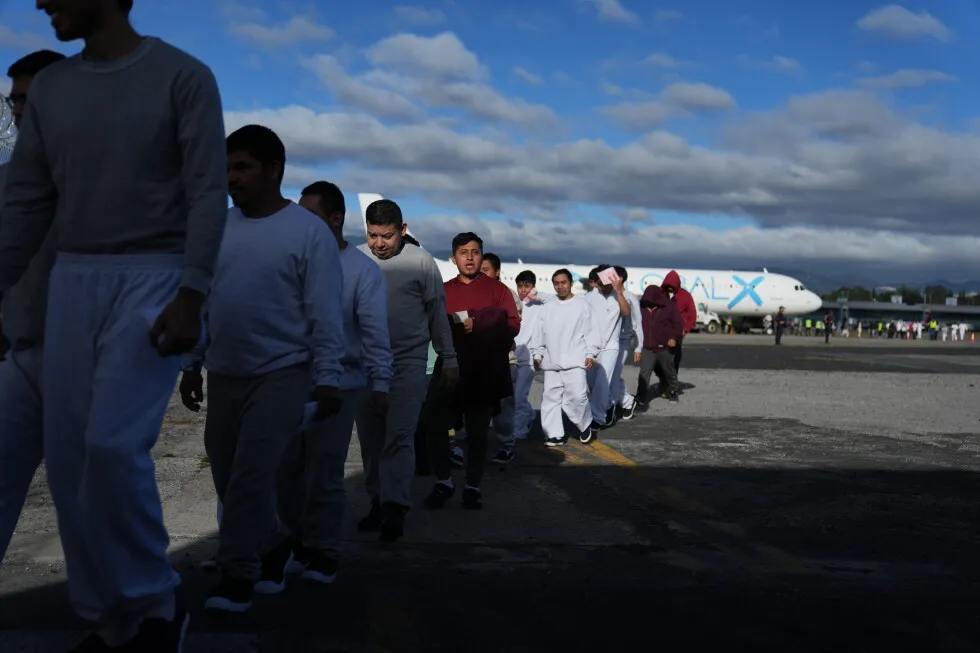
More than 2,300 Mexicans sent to Guatemala and Honduras as Trump ramps up deportations" class="entity-link entity-topic" data-entity-id="189836" data-entity-type="topic">third-country deportations 0 seconds of 52 secondsVolume 0% Press shift question mark to access a list of keyboard shortcuts Keyboard ShortcutsEnabledDisabled Shortcuts Open/Close/ or ? Play/PauseSPACE Increase Volume↑ Decrease Volume↓ Seek Forward→ Seek Backward← Captions On/Offc Fullscreen/Exit Fullscreenf Mute/Unmutem Decrease Caption Size- Increase Caption Size+ or = Seek %0-9 Next Up Dolly Parton, beloved music icon, dies at 80 01:13 Subtitle Settings OffEnglish(US)_v Font Color White Font Opacity 100% Font Size 100% Font Family Arial Character Edge None Edge Color Black Background Color Black Background Opacity 50% Window Color Black Window Opacity 0% Reset WhiteBlackRedGreenBlueYellowMagentaCyan 100%75%50%25% 200%175%150%125%100%75%50% ArialCourierGeorgiaImpactLucida ConsoleTahomaTimes New RomanTrebuchet MSVerdana NoneRaisedDepressedUniformDrop Shadow WhiteBlackRedGreenBlueYellowMagentaCyan WhiteBlackRedGreenBlueYellowMagentaCyan 100%75%50%25%0% WhiteBlackRedGreenBlueYellowMagentaCyan 100%75%50%25%0% 00:00 00:52 00:52 More Videos 01:13 Dolly Parton, beloved music icon, dies at 80 00:52 CCTV footage show floodwaters and debris overtaking Gyirong Port 01:50 Iran's currency hits new record low as US prepares to announce more sanctions 01:11 Residents in Ontario react as tensions on trade tariffs escalate between Canada and US 01:48 Trump awards Artemis II astronauts with the nation's highest space honor 01:39 Seneca Nation calls for reversal of Trump's ‘Lake America’ executive order 00:34 At least 47 people killed, more than 50 kidnapped in gang attack near Haiti's capital 01:55 Tourists embrace hats as Athens swelters in summer sun Close 1 of 6 | Thirty-five Mexicans deported from the United States arrived in Honduras on Thursday, part of a recent shift in which U.S. authorities are increasingly sending Mexican nationals to Central America before their return home. (AP video shot by: Claudio Escalón) More Videos 0 seconds of 38 secondsVolume 90% Press shift question mark to access a list of keyboard shortcuts Keyboard ShortcutsEnabledDisabled Shortcuts Open/Close/ or ? Play/PauseSPACE Increase Volume↑ Decrease Volume↓ Seek Forward→ Seek Backward← Captions On/Offc Fullscreen/Exit Fullscreenf Mute/Unmutem Decrease Caption Size- Increase Caption Size+ or = Seek %0-9 Next Up Amidi says Iraq exploring with Iran 'flexibility' in Hormuz oil exportation 01:08 Auto1080p1080p720p540p360p270p180p 00:00 00:38 00:38 More Videos Close 2 of 6 | Around 600 migrants, some recently deported by Donald Trump’s administration, left Mexico’s southern border region Thursday seeking to continue asylum procedures hoping to find work elsewhere in the country. (AP video shot by: Raúl Mendoza) 3 of 6 | Guatemalans deported from the U.S. arrive at La Aurora airport in Guatemala City, Dec. 30, 2025, after deplaning a repatriation flight. (AP Photo/Moises Castillo, File) 4 of 6 | Journalists take images of a bus transporting migrants deported from the United States following their arrival at the Ramón Villeda Morales Airport in San Pedro Sula, Honduras, Thursday, Aug. 20, 2026. (AP Photo/Delmer Martinez) 5 of 6 | Migrants deported from the United States are transported in a bus after arriving on plane at the Ramon Villeda Morales Airport in San Pedro Sula, Honduras, Thursday, Aug. 20, 2026. (AP Photo/Delmer Martinez) 6 of 6 | Migrants deported from the United States walk to a waiting bus after deplaning at the Ramon Villeda Morales Airport in San Pedro Sula, Honduras, Thursday, Aug. 20, 2026. (AP Photo/Delmer Martinez) By SONIA PÉREZ D., MARÍA VERZA and MARLON GONZÁLEZ Updated 6:42 AM MESZ, August 21, 2026 Add AP News on Google Add AP News as your preferred source to see more of our stories on Google. Share Share Facebook Copy Link copied Print Email X LinkedIn Bluesky Flipboard Pinterest Reddit Guatemala CITY (AP) — The United States has deported nearly 2,300 Mexicans to Guatemala this year and sent at least dozens more to Honduras, according to official data, a shift from the beginning of U.S. President Donald Trump’s second term when such transfers were minimal. Until now, Mexicans deported from the United States were sent almost exclusively back to their country by air and land. Only a handful arrived in other countries. Some civil organizations believe this change reported in recent days is a way to increase pressure on Mexico, whose government has protested the deaths of 17 Mexicans in immigration custody or during enforcement operations. This also comes as Trump has expanded agreements with allied Latin American countries to conduct joint operations in the region against criminal groups and has increased its security demands to Mexico. Sent to Central America by plane and Mexico by bus Guatemalan President Bernardo Arévalo confirmed Wednesday night that, so far this year, 2,284 Mexicans deported from the U.S. have arrived in the country as part of a “transit stopover” before being taken to Mexico as part of an “arrangement” with the Mexican government, and without these individuals being under any refugee or asylum status. Wife of active-duty Army sergeant is deported to Honduras under Trump’s immigration crackdown 2 MIN READ Liberia agrees to take 1,200 third-country deportees from the US 1 MIN READ First group of deportees arrives in troubled Haiti after US ends TPS program 1 MIN READ “They are arriving on planes carrying Guatemalan returnees, and what we have done is bring them in transit so that, in coordination with Mexican immigration authorities, we can return them to Mexican territory within 24 hours of their arrival in the country,” he explained at a press conference. The costs of these operations are covered by the Mexican government or, in some cases, by U.S. funding, he added. Mexico’s National Migration Institute (INM) confirmed to The Associated Press in a brief message that Mexicans have been deported by the Trump administration to Guatemala and Honduras, primarily since April, and are then transported by bus to southern Mexico. “The reason is that the United States wants to prevent them from crossing back into its territory,” the institution said. The INM did not provide figures or further details. Asked about why the Mexicans were sent to Central America and not their own country, and for more details, the U.S. Department of Homeland Security, which oversees immigration enforcement, said in an emailed statement that the administration “is utilizing all lawful options to carry out the largest deportation operation in history, just as President Trump promised.” “The Mexican government has expressed its opposition to this practice to U.S. authorities and has reiterated that every Mexican citizen has the right to enter the country,” the Mexican Foreign Ministry said in a statement on Thursday. It added that Mexico is coordinating with the countries involved to ensure the safe return of Mexican citizens. deportations" class="entity-link entity-topic" data-entity-id="189836" data-entity-type="topic">third-country deportations raise concerns for Mexican migrants Historically, Mexico has always been willing to receive its deported citizens. Since Trump’s first term, it has also accepted deportees from third countries, although the details of immigration agreements with Washington have usually been opaque. In 2025, Mexico received some 12,000 deported foreigners, mostly Cubans and Venezuelans, according to figures provided by Mexican President Claudia Sheinbaum. The government has not updated these figures since December although the practice has continued. Authorities in Honduras also did not respond to requests for comment, but according to official documents from the country accessed by The Associated Press, 82 Mexicans deported from the United States arrived in the Honduran city of San Pedro Sula on two flights on August 13 and 15. An additional 35 arrived on Thursday. Another 165 Mexicans were deported to Honduras between May and mid-July, according to the website Third Country Deportation Watch, run by the NGOs Human Rights First and Refugees International, which track U.S. deportation flights to third countries. The website does not clarify the source of its nationality figures, but both organizations have expressed concern because these transfers could endanger migrants who possibly sought asylum in the U.S. or have few resources in an unknown country. The deportation tactic “seems to be to put pressure on the Mexican government,” said Savitri Arvey of Human Rights First. “They really don’t want any Mexicans crossing the border.” Some of those deported arrived in Honduras on U.S. military flights, she added. At the beginning of his second term, with immigration control as one of his priorities, Trump reached agreements with Mexico, Guatemala, El Salvador, Honduras, Costa Rica and Panama to act as “bridge” or destination countries for migrants from third countries expelled from U.S. territory. These agreements gradually expanded to more countries, including some African ones, most recently Liberia. Until recently, only a handful of Mexicans had been expelled from the U.S. to countries other than Mexico. Arévalo said on Wednesday that Guatemala received 15 Mexicans in 2025. As of February 2026, Honduras had officially reported the arrival of six. Costa Rica has received 11 Mexicans since Trump’s return to the White House, and according to local immigration authorities, they remain in the country. Presumably, these individuals may have requested not to be returned to Mexico out of fear. Immigration lawyers believe that the Trump administration is using deportations to third countries as a legal loophole to indirectly force asylum seekers to return to Mexico when the government cannot send them there because it would violate court orders from immigration judges that recognize the dangers. Organizations and politicians both inside and outside the U.S. have also questioned the use of force by U.S. immigration authorities. Verza reported from Mexico City and González from Tegucigalpa. Follow AP’s Latin America coverage at https://apnews.com/hub/latin-america MARÍA VERZA Verza has focused on immigration, violence and human rights stories in Mexico and Central America for more than a decade twitter instagram mailto
SRCAssociated Press (AP)
LANGEN
LEANCenter
WORDS1 553
ENT8
SAT · 2026-08-29 · 20:23 GMTBRIEF NSR-2026-0829-107235
NSR-2026-0829-107235News Report·EN·Political Strategy
More than 2,300 Mexicans sent to Guatemala and Honduras as Trump ramps up third-country deportations
The United States has deported nearly 2,300 Mexicans to Guatemala and dozens more to Honduras this year, a significant increase from previous years. These deportations are part of a strategy to pressure Mexico, which has protested the deaths of its citizens in U.S.
Associated Press (AP)Filed 2026-08-29 · 20:23 GMTLean · CenterRead · 7 min
Associated Press (AP)FIG 01
Reading time
7min
Word count
1 553words
Sources cited
1cited
Entities identified
8entities
Quality score
100%
§ 01
Briefing Summary
AI-generatedNEWSAR · AI
The United States has deported nearly 2,300 Mexicans to Guatemala and dozens more to Honduras this year, a significant increase from previous years. These deportations are part of a strategy to pressure Mexico, which has protested the deaths of its citizens in U.S. custody. Guatemalan President Bernardo Arévalo confirmed that Mexicans arriving in his country are in transit before being returned to Mexico within 24 hours, without refugee or asylum status. The U.S. Department of Homeland Security stated this is part of the largest deportation operation in history. Mexico's Foreign Ministry has expressed opposition to this practice, asserting every Mexican citizen's right to enter the country. Organizations like Human Rights First are concerned these transfers could endanger migrants.
Confidence 0.90Sources 1Claims 4Entities 8
§ 02
Article analysis
Model · rule-basedFraming
Political Strategy
Human Interest
Tone
Measured
AI-assessed
CalmNeutralAlarmist
Factuality
0.80 / 1.00
Factual
LowHigh
Sources cited
1
Limited
FewMany
§ 03
Key claims
4 extracted01
Around 600 migrants left Mexico's southern border region Thursday to continue asylum procedures.
statisticAP video
Confidence
1.00
02
U.S. authorities are increasingly sending Mexican nationals to Central America before their return home.
factual
Confidence
1.00
03
Thirty-five Mexicans were deported from the U.S. and arrived in Honduras on Thursday.
statisticAP video
Confidence
1.00
04
Over 2,300 Mexicans have been sent to Guatemala and Honduras as part of a U.S. policy shift on deportations.
statistic
Confidence
1.00
§ 04
Full report
7 min read · 1 553 words§ 05
Entities
8 identifiedKey playerOppositionContextPositiveNeutralNegative
Locations4
§ 06
Keywords & salience
8 termsthird-country deportations
1.00
mexican nationals
0.90
guatemala
0.80
honduras
0.80
trump administration
0.70
immigration policy
0.60
central america
0.50
deportation
0.40
§ 07
Topic connections
Interactive graph Network visualization showing 51 related topics
View Full Graph Person Organization Location Event|Click node to navigate|Edge numbers = shared articles