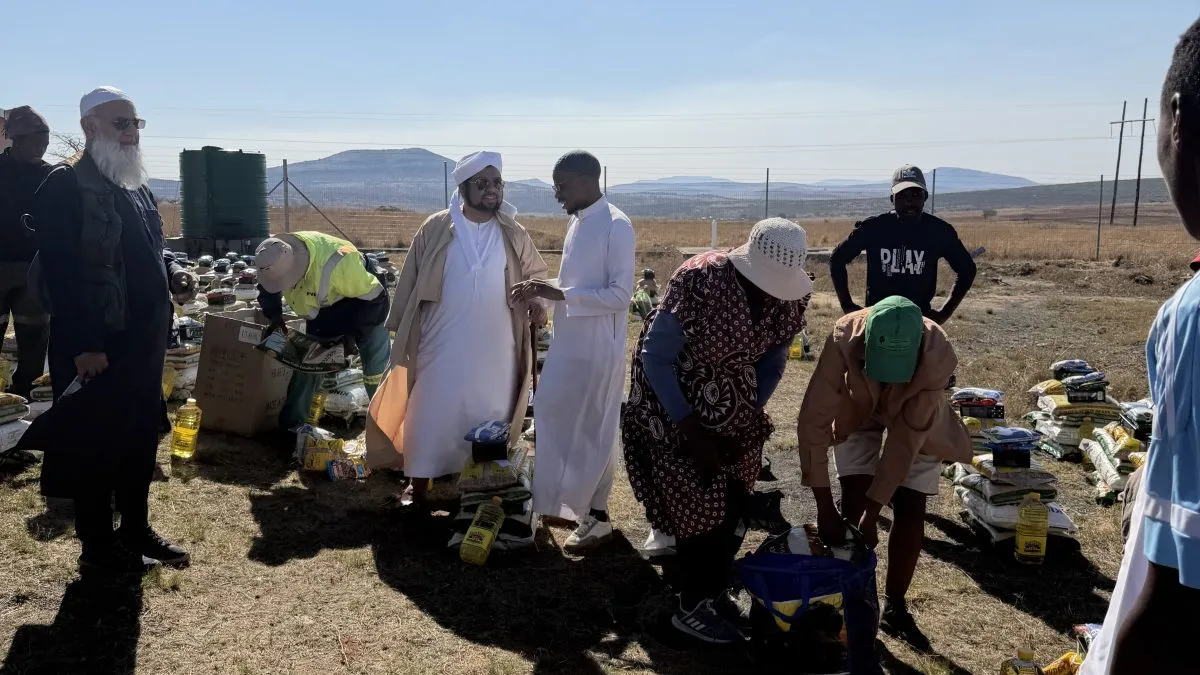
Online anti-Muslim rhetoric is growing, but life on the ground tells a more complicated story.Khethukuthula Dlame distributes aid to members of his community in Nquthu [Qaanitah Hunter/Al Jazeera]Published On 30 Aug 2026Nquthu, South Africa – When Zwelibi Jack Ngubane died at the age of 105, he had already made one thing clear to his family: he wanted to be buried as a Muslim.Hundreds of family and community members gathered for his funeral in Nquthu, a rural part of northern KwaZulu-Natal where Christianity and traditional African beliefs are dominant and Muslims are a tiny minority. Ngubane had converted to Islam late in life after observing the faith of his young grandson.When he died, his family honoured his wishes. His funeral was conducted according to Muslim burial rites before he was laid to rest in the family burial plot in his village. For a community largely unfamiliar with Islamic burial practices, the funeral was a novelty.But it wasn’t a controversy. That distinction has become increasingly important in South Africa.In recent months, anti-Muslim rhetoric has become more visible online, intersecting with a heated national debate about immigration and anti-migrant movements. Posts have accused Muslims of attempting to take over South Africa, questioned their belonging in the country and accused Muslim organisations of using charity and poverty to convert Black South Africans to Islam.One social media post complained that humanitarian organisation Gift of the Givers had been “getting on our nerves with their insistence on pushing their Muslim beliefs in South Africa”. Another claimed: “Most foreigners in South Africa are Muslim and if you look most countries experiencing war are Muslim countries not Christian ones.” Others have accused Muslims of “targeting poverty-stricken communities and converting them to Islam”.But in the rolling hills and villages of Nquthu, the picture is different.For Samukelisiwe Ngubane, her first encounters with Muslims came through Indian shopkeepers in a nearby town. “We have never had a problem. Some people are curious about what they [Muslims] do, but there have been no problems,” she told Al Jazeera.When her brother, Khethukuthula Dlame, converted to Islam in 2012 as a teenager, it was hardly an issue. Dlame, now 26 and one of only a handful of Muslims known in his village, is familiar enough to his neighbours that his Islamic clothing is a source of teasing rather than hostility. One neighbour jokes that he wears a dress.“In these communities, there’s harmony and respect. People really respect my religion,” he told Al Jazeera, standing alongside his grandfather’s gravesite.The contrast raises a question: is South Africa experiencing a rise in Islamophobia, or is social media making a marginal phenomenon appear much larger than it is?Muslims make up a small minority in South Africa. The country’s 2022 census counted less than one million Muslims, or approximately 1.6 percent of the population. South African Muslim leaders give higher estimates, with some putting the country’s Muslim population at between two million and five million people.Samukelisiwe Ngubane, a community activist in Nquthu, holds a photograph of her grandfather, Zwelibi Jack Ngubane [Qaanitah Hunter/Al Jazeera]But Islam’s presence in South Africa stretches back centuries. Muslims came to the Cape through several routes, including enslavement and political exile, from parts of Asia and the Indian Ocean world under Dutch colonial rule from the 17th century. Muslims were already present at the Cape before the arrival in 1694 of Shaykh Yusuf of Macassar, a Muslim scholar and political exile.Today, the community includes descendants of enslaved Muslims brought to the Cape centuries ago, South Africans of Indian ancestry whose families have lived in the country for generations, Black African Muslims, converts and more recent migrants.Dlame believes attempts to mobilise people against Muslims are not primarily emerging from rural communities.“The move to orchestrated hate towards Muslims is not at a community level. If you’re looking at people when they’re mobilising, it’s not people from the villages. It is people in cities and in hostels.”“The people behind this understand the flash points. If you really want to cause divisions, you use tribal rhetoric and the people you mobilise and agitate are in hostels because the living conditions are not good.”South Africa has repeatedly experienced outbreaks of xenophobic violence since the end of apartheid, with migrants from elsewhere on the African continent often bearing the brunt. The question is whether some of that anti-migrant rhetoric is also being directed at Muslims.‘No widespread Islamophobia’Thembisa Fakude, a South African political analyst and journalist who is Muslim, told Al Jazeera that fears of widespread Islamophobia are being overstated.“I’ll argue that there is no widespread or any orchestrated, well-planned Islamophobia directed towards Muslims. We don’t have that.”He acknowledges anti-Muslim rhetoric online, but argues that it should not automatically be interpreted as evidence that South African society itself has become Islamophobic.“It’s true, but it’s not only South Africa. This is global … In South Africa, yes, it’s true. You find that there will always be bigots, you know, and others will be, you know, ultra-Zulu nationalist or ultra-nationalist.”Fakude also argues that Muslim communities need to confront allegations of racism and exploitative labour practices within their own ranks rather than characterising every criticism as religious prejudice.“It is a storm in a teacup. And I think what’s concerning me is this othering by Muslims wanting to position themselves as victims and taking this course by themselves. It’s extremely dangerous.”What starts online does not always stay thereMuslim religious leader Moulana Sulaiman Ravat told Al Jazeera that, while ordinary South Africans are largely not Islamophobic, he is more cautious about what could happen next.“At the same time, I think on the ground, South Africans in the main are not Islamophobic, and there’s a variety of indicators to substantiate that.”Samukelisiwe Ngubane says Muslims have long been part of everyday life in the rural KwaZulu-Natal community [Qaanitah Hunter/Al Jazeera]But Ravat warns that online rhetoric can influence attitudes over time.“I don’t think we can go to the other extreme. We must understand that there are certain global political realities, and the Islamophobia project aligns with those global agendas. And therefore, if we become complacent or nonchalant about it, what people are exposed to online could start impacting their psyche and how they think.”Ravat argues that Muslim identity is sometimes being presented as evidence that a person is somehow less South African. For him, the premise is false.“I would think I would say they are deeply religious and deeply patriotic, and there is no contradiction between the two.”His own children, he said, are fifth-generation South African Muslims of Indian heritage.“They don’t speak the language any more. They are as South African as anyone else.”Two South Africas?Back in Nquthu, Islam does not arrive through a social media algorithm. It arrives through a neighbour, where Dlame’s mother cooks a halal meal for this reporter and other guests. Earlier, at a community meeting, Dlame explained that Muslims, too, believe that Jesus was a prophet of God. Ordinary villagers listened attentively and joined in Zulu melodies in praise of God.For now, the distance between the online conversation and life in communities such as Nquthu remains significant. But Ravat says that does not mean the possibility of deeper hostility should be dismissed.“Better be proactive than reactive. It’s a global reality. It has been for the last 20 years. And the fact that it could increase in South Africa and could have serious consequences, you could argue, is unlikely but not impossible.”
SRCAl Jazeera
LANGSCO
LEANCenter
WORDS1 226
ENT10
SUN · 2026-08-30 · 00:06 GMTBRIEF NSR-2026-0830-107274
NSR-2026-0830-107274News Report·SCO·Human Interest
Online anti-Muslim backlash collides with different reality in South Africa
Online anti-Muslim rhetoric is increasing in South Africa, but the reality on the ground, particularly in rural areas like Nquthu, is more complex. While social media posts accuse Muslims of attempting to take over the country and using charity for conversion, local communities often exhibit harmony and respect.
Qaanitah HunterAl JazeeraFiled 2026-08-30 · 00:06 GMTLean · CenterRead · 5 min
Al JazeeraFIG 01
Reading time
5min
Word count
1 226words
Sources cited
3cited
Entities identified
10entities
Quality score
100%
§ 01
Briefing Summary
AI-generatedNEWSAR · AI
Online anti-Muslim rhetoric is increasing in South Africa, but the reality on the ground, particularly in rural areas like Nquthu, is more complex. While social media posts accuse Muslims of attempting to take over the country and using charity for conversion, local communities often exhibit harmony and respect. For example, a 105-year-old man was buried as a Muslim in Nquthu, a predominantly Christian and traditional African belief area, without controversy. A young Muslim convert in the same village experiences teasing rather than hostility. Experts suggest that orchestrated hate campaigns against Muslims may be more prevalent in urban areas and hostels, potentially leveraging existing anti-migrant sentiments. Muslims constitute a small minority in South Africa, with estimates ranging from 1.6% to potentially several million people, and their presence in the country dates back centuries.
Confidence 0.90Sources 3Claims 5Entities 10
§ 02
Article analysis
Model · rule-basedFraming
Human Interest
Social Justice
Tone
Measured
AI-assessed
CalmNeutralAlarmist
Factuality
0.70 / 1.00
Factual
LowHigh
Sources cited
3
Well sourced
FewMany
§ 03
Key claims
5 extracted01
Muslims constitute a small minority in South Africa, making up approximately 1.6 percent of the population according to the 2022 census.
statisticarticle
Confidence
1.00
02
Zwelibi Jack Ngubane, aged 105, was buried as a Muslim in Nquthu according to his wishes, with his funeral being a novelty but not a controversy.
factualarticle
Confidence
1.00
03
Social media posts have accused humanitarian organisation Gift of the Givers of 'pushing their Muslim beliefs' in South Africa.
quotesocial media post
Confidence
0.90
04
In rural Nquthu, South Africa, life on the ground presents a different reality with harmony and respect between communities, despite Muslims being a tiny minority.
factualarticle
Confidence
0.90
05
Online anti-Muslim rhetoric is growing in South Africa, accusing Muslims of attempting to take over the country and questioning their belonging.
factualarticle
Confidence
0.90
§ 04
Full report
5 min read · 1 226 words§ 05
Entities
10 identifiedKey playerOppositionContextPositiveNeutralNegative
People3
Organizations1
§ 06
Keywords & salience
10 termsanti-muslim rhetoric
1.00
south africa
0.90
muslim community
0.80
online discourse
0.70
rural life
0.60
religious conversion
0.50
cultural integration
0.50
humanitarian aid
0.40
local reality
0.40
immigration debate
0.40
§ 07
Topic connections
Interactive graph Network visualization showing 51 related topics
View Full Graph Person Organization Location Event|Click node to navigate|Edge numbers = shared articles