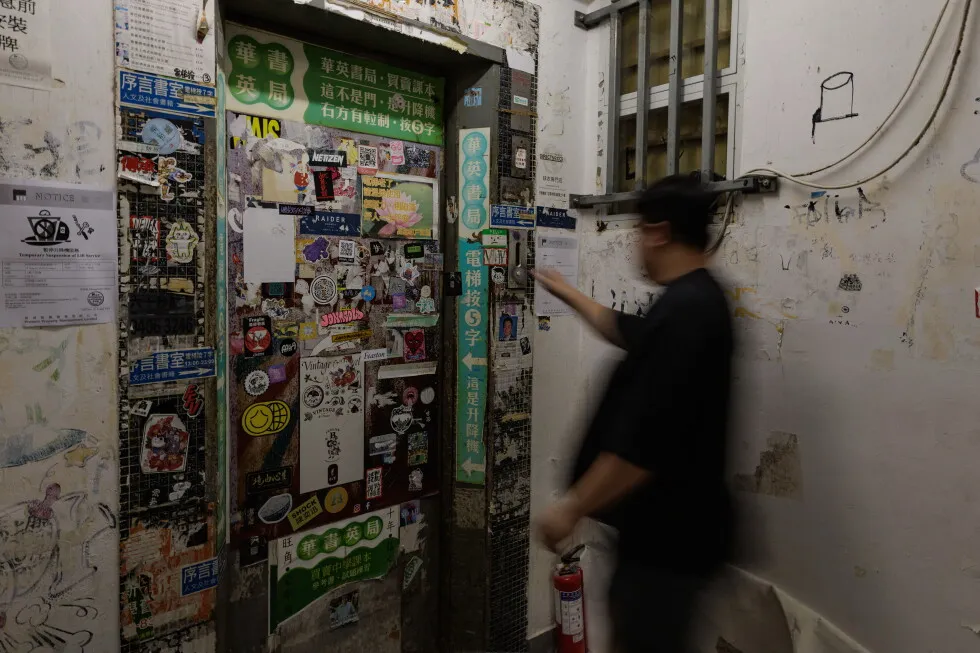
Hong Kong’s independent bookstores, a refuge for Chinese readers, are under threat 0 seconds of 31 secondsVolume 0% Press shift question mark to access a list of keyboard shortcuts Keyboard ShortcutsEnabledDisabled Shortcuts Open/Close/ or ? Play/PauseSPACE Increase Volume↑ Decrease Volume↓ Seek Forward→ Seek Backward← Captions On/Offc Fullscreen/Exit Fullscreenf Mute/Unmutem Decrease Caption Size- Increase Caption Size+ or = Seek %0-9 Next Up Nostalgic spinning top craze whirls through Hong Kong 00:47 00:00 00:31 00:31 More Videos 00:47 Nostalgic spinning top craze whirls through Hong Kong 00:32 European leaders arrive in Kyiv to mark Ukraine's Independence Day 01:26 A surge in Canadian defense spending boosts local military contractors 00:52 A Chinese humanoid robot sets 100-meter sprint record of 8.86 seconds 00:51 'Katyusha', the first panda born in Russia, celebrates 3rd birthday in Moscow Zoo 00:37 Zelenskyy holds bilateral meeting with UK Prime Minister Burnham in Kyiv 01:01 China’s Xi welcomes Jordan’s King Abdullah II in Beijing 01:26 UK to help Ukraine produce long range missiles, UK prime ministser says Close 1 of 6 | Mostly tucked upstairs in tenement buildings above Hong Kong’s busy streets, independent bookstores offer a refuge, serving as a window to a freer world for some mainland Chinese readers seeking ideas suppressed at home. 2 of 6 | A person waits for the lift leading to various shops including Hong Kong Reader Bookstore in Hong Kong, Friday, Aug. 14, 2026. (AP Photo/May James) 3 of 6 | Books including one titled " The CCP’s Plan to Attack Taiwan: A Comprehensive Reveal” can be seen at Greenfield Bookstore in Hong Kong, Friday, Aug. 14, 2026. (AP Photo/May James) 4 of 6 | Pedestrians pass a narrow street entrance leading to Greenfield Bookstore beneath bamboo scaffolding in Hong Kong Friday, Aug. 14, 2026. (AP Photo/May James) 5 of 6 | A staff member opens Hunter Bookstore at noon near a heart-shaped display on the front window in Hong Kong, Friday, Aug. 14, 2026. (AP Photo/May James) 6 of 6 | A pedestrian passes a narrow street entrance leading to Elmbook - an independent bookstore that opened in 1997, in Hong Kong, Friday, Aug. 14, 2026. (AP Photo/May James) By Kanis Leung Updated 4:17 AM MESZ, August 30, 2026 Add AP News on Google Add AP News as your preferred source to see more of our stories on Google. Share Share Facebook Copy Link copied Print Email X LinkedIn Bluesky Flipboard Pinterest Reddit Hong Kong (AP) — Chinese university student Fleming Cheng found the political books he had only glimpsed online in a Hong Kong bookstore last year. Before visiting Greenfield Book Store, Cheng had only managed to see the books’ covers online after bypassing Beijing’s internet censorship using a VPN. At the store, he picked up a title offering a critical account of China. He stood there devouring dozens of pages from another, about a pro-reform Chinese leader who fell from power for sympathizing with the protesters during the Tiananmen Square pro-democracy movement in 1989. Cheng said he saw perspectives diverging from the mainland’s official narrative. Hong Kong’s independent bookstores, many of them tucked away from busy streets inside buildings, have long offered a refuge and a window to a freer world for some mainland Chinese readers seeking ideas suppressed at home. But these spaces now are under threat following a wave of bookseller arrests over alleged sedition under a 2024 national security law. Critics say their plight reflected the city’s broader crackdown on dissent that began after Beijing imposed a separate 2020 security law. Authorities say the two laws are vital to stability. Greenfield was one of four bookstores targeted by police in just four months. Although bail was granted, the 50-year-old shop in July announced it would close at the end of its lease. Another bookstore, Have A Nice Stay, set up by former journalists, had announced plans to shut down Sunday, citing “elusive red lines” and financial challenges, even before its booksellers were arrested on the same day as Greenfield’s. “If the Hong Kong government desperately tries to bring every aspect of the city into close alignment with the mainland, or even to the point where the two become indistinguishable, that would be a tremendous loss for us mainlanders too,” Cheng said. What to know about the trial of former Tiananmen vigil organizers before a verdict 2 MIN READ Hong Kong court hears arguments over sentencing for former Tiananmen vigil organizers 3 MIN READ What to know about the Tiananmen vigil organizers convicted of inciting subversion in Hong Kong 3 MIN READ Booksellers under pressure Hong Kong, a former British colony that returned to China in 1997, was once known for its freedoms of publication and expression. But in 2015, bookseller Lam Wing-kee and four others affiliated with Causeway Bay Books disappeared. The store was known for selling politically sensitive titles. Lam later told reporters he was held by Chinese authorities, providing explosive details that contradicted official Chinese accounts. Gossipy books about Chinese politics soon dwindled on Hong Kong’s shelves. After the 2020 security law, leading activists were arrested and civil society groups disbanded. Titles about the Tiananmen crackdown and works by pro-democracy politicians were pulled from public libraries. At the city’s annual book fair, some smaller book businesses were barred from exhibiting, and a pro-Beijing newspaper labeled an independent book fair a form of “soft resistance.” Despite the pressure and increased official inspections, many pressed on, with some continuing to organize activities alongside selling books. But the arrests hit Book Punch in March, Hunter Bookstore in June, and Greenfield and Have A Nice Stay in July. The authorities accused the booksellers of selling seditious publications, according to government statements and media reports. Cautious booksellers say they struggle to interpret the rules Authorities say statements with “seditious intention” to incite hatred against or the overthrow of the governments of China and Hong Kong are prohibited. But they have not specified the books they consider as “seditious,” leaving observers to find clues in news reports quoting anonymous sources. Secretary for Security Chris Tang said the law is clear about what constitutes seditious intent and reiterated there would be no banned book list. He said booksellers should ensure the titles they sell do not harm national security, just as those selling food need to ensure the food won’t cause a stomach ache or be poisonous. A bookseller, who spoke on condition of anonymity for fear of government retribution, said they struggled to judge what was seditious. Still, they became more cautious about whether to sell certain books on China’s modern politics. Their landlord was also reviewing whether to continue to rent the space to them after being harassed. In an emailed reply, the government condemned any “smearing” and false remarks regarding the work in safeguarding national security. It said the security laws clearly stipulate that human rights, freedoms of speech and publication should be protected. The offenses linked to seditious intention expressly protect expression of opinions or even criticism against government policies, it said. University student Iris Wang from neighboring Guangdong sensed tighter control over Hong Kong. To her, Hunter encouraged people to think, instead of just selling books like its mainland peers. She bought a postcard about being courageous and a manga there. Some mainland readers also visit the stores for non-political reasons, such as for their niche books or simply for their calmness. Hong Konger Brian Leung found companionship in independent bookstores, saying each had its own character. When arrests happened at the shops he visited, he said he felt something he cherished and that Hong Kong deserved was being rejected. “Part of what I have grown used to in Hong Kong is lost again,” he said, adding that the bookshops have not “incited” him because readers can judge for themselves. Concerns over Hong Kong’s access to Taiwanese books In Taiwan, widely seen as the freest publishing hub for Chinese-language books, some publishers have filled the gap as restrictions deepened in Hong Kong after the 2020 security law took effect. Some readers fear one day Taiwan cannot send books to Hong Kong as freely as before. Taiwan’s publishers released six times as many books about Hong Kong between 2020 and 2024 as in the previous five years, according to Cheng Tsu-Bang, a sociology professor at Tunghai University in Taiwan. “The publication of books seems to have become a very important medium of communication between Taiwan and Hong Kong, or a medium of mutual support,” he said. In July, Taiwan’s broadcaster FTV reported that a logistics firm stopped taking orders to ship books from Taiwan to Hong Kong bookstores under investigation. It also demanded a full book list before delivering to other Hong Kong premises, the report added. One Hong Kong author who moved to Taiwan and has published books there is Lee, who spoke on condition of not using their full name out of fear of government retribution. Lee has written about Hong Kong’s pro-democracy movement, saying the independent bookstores served as a bridge to bring works about Hong Kong to the city and connect diaspora writers to their home. The writer compared the collapse of civil society to a boulder rolling downhill, crushing things in its path. Lee said bookstores were a small flower field where people could breathe and try to safeguard what remained. “It’s now like being told very directly and cruelly that perhaps this borrowed time is coming to an end,” Lee said. Kanis Leung Leung covers Hong Kong, Macao and mainland China for The Associated Press. She is based in Hong Kong. twitter
SRCAssociated Press (AP)
LANGEN
LEANCenter
WORDS1 591
ENT12
SUN · 2026-08-30 · 02:23 GMTBRIEF NSR-2026-0830-107286
NSR-2026-0830-107286News Report·EN·Human Interest
Hong Kong’s independent bookstores, a refuge for Chinese readers, are under threat
Hong Kong's independent bookstores, which have served as a refuge for mainland Chinese readers seeking suppressed ideas, are facing significant threats. Following the implementation of a 2024 national security law, several bookstores have been targeted by police raids and bookseller arrests for alleged sedition.
Associated Press (AP)Filed 2026-08-30 · 02:23 GMTLean · CenterRead · 7 min
Associated Press (AP)FIG 01
Reading time
7min
Word count
1 591words
Sources cited
1cited
Entities identified
12entities
Quality score
100%
§ 01
Briefing Summary
AI-generatedNEWSAR · AI
Hong Kong's independent bookstores, which have served as a refuge for mainland Chinese readers seeking suppressed ideas, are facing significant threats. Following the implementation of a 2024 national security law, several bookstores have been targeted by police raids and bookseller arrests for alleged sedition. This crackdown is seen by critics as an extension of broader dissent suppression that began with a 2020 security law. Authorities maintain these laws are crucial for stability. The pressure has led to bookstore closures, with owners citing unclear regulations and financial difficulties. These developments mark a decline in Hong Kong's once-celebrated freedoms of publication and expression, impacting access to diverse perspectives for readers from mainland China.
Confidence 0.90Sources 1Claims 4Entities 12
§ 02
Article analysis
Model · rule-basedFraming
Human Interest
Social Justice
Tone
Measured
AI-assessed
CalmNeutralAlarmist
Factuality
0.70 / 1.00
Factual
LowHigh
Sources cited
1
Limited
FewMany
§ 03
Key claims
4 extracted01
Chinese university student Fleming Cheng found political books in a Hong Kong bookstore that he had only glimpsed online after bypassing Beijing's internet censorship.
quoteFleming Cheng
Confidence
1.00
02
Books with titles critical of the CCP, such as 'The CCP’s Plan to Attack Taiwan: A Comprehensive Reveal', are available in Hong Kong bookstores.
factual
Confidence
0.90
03
Independent bookstores in Hong Kong serve as a refuge and a window to a freer world for mainland Chinese readers seeking suppressed ideas.
factual
Confidence
0.90
04
Independent bookstores in Hong Kong are facing threats.
factual
Confidence
0.80
§ 04
Full report
7 min read · 1 591 words§ 05
Entities
12 identifiedKey playerOppositionContextPositiveNeutralNegative
Organizations6
§ 06
Keywords & salience
8 termsindependent bookstores
1.00
hong kong
0.90
chinese readers
0.80
censorship
0.70
political suppression
0.60
freedom of expression
0.60
cultural refuge
0.50
mainland china
0.40
§ 07
Topic connections
Interactive graph Network visualization showing 51 related topics
View Full Graph Person Organization Location Event|Click node to navigate|Edge numbers = shared articles