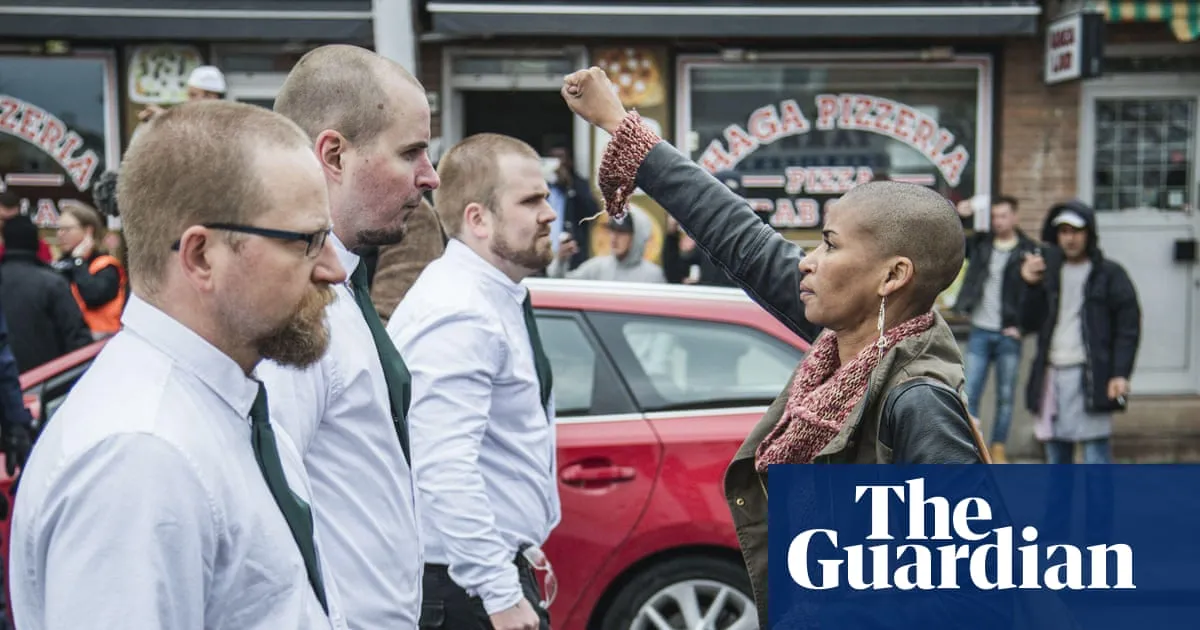
The striking photograph showed a lone Black woman, her fist raised, standing in the path of hundreds of uniformed neo-Nazis on parade in 2016, and it made headlines across the globe.At the time, it was held up as a symbol of the resistance to the far right. But 10 years on, as Sweden gears up for elections in which the far right is expected to emerge as the second most-voted-for party, the woman in the photo sees it as a sign of the bewildering change that has gripped the Scandinavian country.“Ten years ago, people would say, ‘Oh we dislike the far right, the Sweden-democrats" class="entity-link entity-organization" data-entity-id="9626" data-entity-type="organization">Sweden Democrats, we despise Nazis,’” said Tess Asplund, 52. “And now, they’ve become normalised. It’s like, what happened?”Her comments hint at the recent reshaping of Swedish politics, where the far right – once a pariah – has steadily marched into the halls of power. “I’m sad, afraid and ashamed of Swedish citizens,” said Asplund in an interview at a cafe in central Stockholm. “It’s pure racism.”Ahead of a general election on 13 September, polls suggest that the centre-left opposition has a lead over the ruling rightwing coalition, meaning a change of government could be on the cards.But the Sweden-democrats" class="entity-link entity-organization" data-entity-id="9626" data-entity-type="organization">Sweden Democrats, a party with neo-Nazi roots, is expected to garner the second-most votes in the country. In the 2022 elections, it also came second, paving the way for it to play a supporting role in a minority-run coalition.Supporters of Sweden-democrats" class="entity-link entity-organization" data-entity-id="9626" data-entity-type="organization">Sweden Democrats party leader Jimmie Åkesson listen to him at an election campaign event in Huddinge on 18 August. Photograph: Jonathan Nackstrand/AFP/Getty ImagesThe party has long been dogged by accusations of harbouring violent racists and swastika-wearing Nazi sympathisers. It has used its leverage in government to consistently target migrants, including asylum seekers, as well as Muslims, ushering in ultra-restrictive migration policies and a discourse that routinely disparages the millions of people from around the world who have made Sweden their home and seek to contribute to it.Earlier this year, the Swedish prime minister, Ulf Kristersson, mused that if his four-party coalition won the upcoming election, the far right could enter government, in what was seen as a watershed moment for Swedish politics.It was a sharp contrast to the Sweden that Aspland had stood up for on 1 May 2016. She and scores of others had travelled to the central Swedish city of Borlänge to rally against a planned march by the Nordic Resistance Movement, one of the country’s largest neo-Nazi groups.As she faced off against them, her act of defiance was caught on camera by photographer David Lagerlöf of Expo, the anti-racism foundation in Stockholm.It soon went viral, with Swedish media likening it to another iconic image of resistance: a 1985 photo in which photographer Hans Runesson captured a woman taking aim at a skinhead with her handbag in the south-western city of Växjö.A woman takes aim at a skinhead with her handbag in the south-western city of Växjö in 1985. Photograph: Hans RunessonMedia requests poured in from around the world. In Sweden, people began stopping Asplund on the streets, thanking her for her gesture, though she also grappled with a stream of online harassment and death threats on her home telephone line.For Asplund, who has spent much of her life campaigning against racism, it was a sobering frontline encounter with the far-right spectrum of Sweden, which ranges from the extremist Nordic Resistance Movement, which in 2024 was designated as a terror group by the US, to the Sweden-democrats" class="entity-link entity-organization" data-entity-id="9626" data-entity-type="organization">Sweden Democrats, who have long worked to make over their image.A 2023 study noted that the presence of the two groups, both of which have shared roots in their militant opposition to immigration, probably works to bolster their causes by keeping issues of immigration and integration on Sweden’s political agenda.Or, in the words of Mohammad Aluaudt Allah, a Syrian refugee who was kicked unconscious on a street in central Stockholm last year, the politicians who blame immigrants for all of the country’s issues have “created a sense of impunity for violent Nazi groups”.skip past newsletter promotionafter newsletter promotion“They may feel that they are being given permission to exercise their hatred and attack us,” he told newspaper Dagens Nyheter.The view was echoed by Asplund. “The Nordic Resistance Movement, they’re kind of small now, we don’t hear so much about them any more,” she said. “They don’t have to be big because Sweden-democrats" class="entity-link entity-organization" data-entity-id="9626" data-entity-type="organization">Sweden Democrats are big, so they’ve got people doing their work in the government. The Nazis are in the shadows.”The resulting rhetoric had then been amplified by some in media, she said, pointing to those who had uncritically swallowed the far right’s blaming of all social and economic ills on migration.What had emerged was a hardened Sweden, one where, for example, dozens of young people who had lived their whole lives in Sweden had been deported to their parents’ countries of birth after they failed to meet the increased earnings thresholds for migrants. “Thirty years ago, we would be on the street fighting against this. Now it’s like, ‘That’s sad for him or her.’ It’s a shift that really scares me,” she said.“If Olof Palme were alive today, he would turn over in his grave,” she added, citing the assassinated former leader of Sweden’s Social Democratic party, who is credited with many of the progressive policies long associated with Sweden, from the robust social welfare system to a pro-refugee discourse that welcomed those escaping dictatorships and war.She noted, however, that her disappointment and shame did not extend to everyone in Sweden. “We are many, many people here fighting for human rights and against racism,” she said.Police intervene against Tess Apslund during the neo-Nazi parade in 2016. Photograph: TT News Agency/AlamyBut in some ways, the photo – hailed in 2016 for capturing one of the conflicts of our time – seemed to pit Palme’s Sweden against the march of the far right.In the years since, Asplund despaired that it may have been the far right who had emerged victorious.“I’m afraid and heartbroken because when I speak to people they’re like, ‘Oh for God’s sake, forget that. It was 20 years ago that there were Nazis and skinheads, now it’s gone,’” she said. “They’ve normalised it. It’s not my safe Sweden any more, it’s not the Sweden that I’m used to.”
SRCThe Guardian - World News
LANGEN
LEANCenter-Left
WORDS1 048
ENT12
SUN · 2026-08-30 · 07:00 GMTBRIEF NSR-2026-0830-107334
NSR-2026-0830-107334News Report·EN·Social Justice
A lone Black woman’s defiance of Swedish neo-Nazis, 10 years on
Ten years after a striking photograph captured Tess Asplund, a lone Black woman, defiantly facing a neo-Nazi march in Sweden, she views the image as a symbol of significant political change. At the time, her protest was seen as resistance to the far right.
Ashifa Kassam in StockholmThe Guardian - World NewsFiled 2026-08-30 · 07:00 GMTLean · Center-LeftRead · 5 min
The Guardian - World NewsFIG 01
Reading time
5min
Word count
1 048words
Sources cited
3cited
Entities identified
12entities
Quality score
100%
§ 01
Briefing Summary
AI-generatedNEWSAR · AI
Ten years after a striking photograph captured Tess Asplund, a lone Black woman, defiantly facing a neo-Nazi march in Sweden, she views the image as a symbol of significant political change. At the time, her protest was seen as resistance to the far right. However, as Sweden approaches elections, the far-right Sweden Democrats, with neo-Nazi roots, is projected to become the second-largest party, a development Asplund describes as a normalization of racism. This shift has seen the party leverage its influence to implement restrictive migration policies and contribute to a discourse that targets immigrants and Muslims. Asplund believes this political climate has created impunity for extremist groups, allowing their agenda to be advanced through more mainstream channels.
Confidence 0.90Sources 3Claims 5Entities 12
§ 02
Article analysis
Model · rule-basedFraming
Social Justice
Human Interest
Tone
Mixed Tone
AI-assessed
CalmNeutralAlarmist
Factuality
0.70 / 1.00
Factual
LowHigh
Sources cited
3
Well sourced
FewMany
§ 03
Key claims
5 extracted01
Tess Asplund feels the far-right has become normalized in Sweden, expressing sadness, fear, and shame.
quoteTess Asplund
Confidence
1.00
02
A photograph of a lone Black woman, Tess Asplund, confronting neo-Nazis in 2016 became a global symbol of resistance.
factualarticle
Confidence
1.00
03
Swedish Prime Minister Ulf Kristersson suggested the far-right could enter government if his coalition won the upcoming election.
factualarticle
Confidence
0.90
04
The Sweden Democrats have used their political leverage to target migrants and Muslims, implementing restrictive policies.
factualarticle
Confidence
0.90
05
The Sweden Democrats, a party with neo-Nazi roots, is expected to be the second-most voted-for party in upcoming Swedish elections.
predictionarticle
Confidence
0.90
§ 04
Full report
5 min read · 1 048 words§ 05
Entities
12 identifiedKey playerOppositionContextPositiveNeutralNegative
People3
Organizations2
§ 06
Keywords & salience
10 termsfar right
1.00
neo-nazis
1.00
swedish politics
0.90
resistance
0.80
normalization
0.70
sweden democrats
0.70
migration policies
0.60
racism
0.50
defiance
0.40
election
0.40
§ 07
Topic connections
Interactive graph Network visualization showing 51 related topics
View Full Graph Person Organization Location Event|Click node to navigate|Edge numbers = shared articles