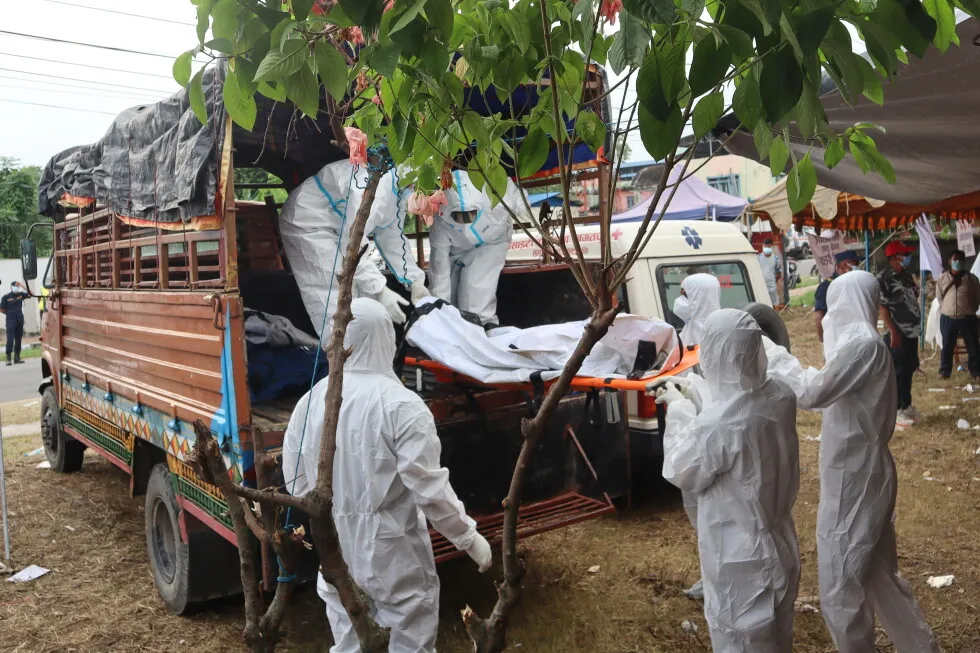
In one Nepal district, flood catastrophe is measured in bodies and burial trenches 1 of 5 | Rescuers carry bodies of flash flood victims for a mass burial in Chitwan, Nepal, Saturday, Aug. 29, 2026. (AP Photo/Nisha Shrestha) 2 of 5 | Rescuers keep bodies of flash flood victims in mortuary before a mass burial in Chitwan, Nepal, Saturday, Aug. 29, 2026. (AP Photo/Nisha Shrestha) 3 of 5 | Rescuers carry bodies of flash flood victims for a mass burial, in Chitwan, Nepal, Saturday, Aug. 29, 2026. (AP Photo/Nisha Shrestha) 4 of 5 | An earthmover digs a burial site for a mass burial of Flash Floods victims, in Chitwan, Nepal, Saturday, Aug. 29, 2026. (AP Photo/Nisha Shrestha) 5 of 5 | People inquire about the bodies of their relatives killed in Flash Floods at a mortuary in Chitwan, Nepal, Saturday, Aug. 29, 2026. (AP Photo/Nisha Shrestha) By Shristi Kafle and Aijaz Hussain Updated 2:45 PM MESZ, August 30, 2026 Add AP News on Google Add AP News as your preferred source to see more of our stories on Google. Share Share Facebook Copy Link copied Print Email X LinkedIn Bluesky Flipboard Pinterest Reddit KATHMANDU, Nepal (AP) — The devastating Flash Floods in the Himalayan region swept so many people downstream that authorities in one Nepalese district have begun burying bodies in temporary graves before they can be identified, prompting accusations that Hindu funeral traditions are being ignored. In south-central Nepal’s Chitwan district, the scale of the catastrophe was evident in some 250 bodies awaiting identification and the hastily dug trenches for their temporary burial following Wednesday’s catastrophic floods and mudslides, which killed at least 800 people and left more than 3,000 missing in Nepal and Tibet. The bodies were carried hundreds of kilometers downstream by the Bhotekoshi River from the flood’s epicenter before being recovered in Chitwan. Authorities carried out a temporary burial of about 100 victims on Saturday, officials said, as forensic teams struggled to cope. A convoy of vehicles carrying bodies entered a lush, forested area as an excavator dug a wide trench in the red earth while officials and media looked on. Anil Thapa, a police inspector coordinating the handling of the bodies, said another 50 bodies were having DNA samples taken ahead of their likely burial Sunday. Authorities preserve the DNA samples, photograph distinguishing facial features and record other identifying details, Thapa said. The bodies are assigned a reference number to help families claim them later. People from more than 30 countries are missing after the Flash Floods in Nepal and China 4 MIN READ Catastrophic floods kill over 390 in Nepal and Tibet, with more than 1,400 missing 5 MIN READ 31 Why a newly formed lake is sparking fears of more flooding along the Nepal-China border 5 MIN READ 31 Thapa said many of the bodies had remained submerged in floodwaters for about four days and were already decomposing by the time they were recovered. Across the region, homes, vehicles and farm tractors still lay partially buried in mud. Limited forensic infrastructure and inadequate morgue capacity in the district further strained efforts to manage the overwhelming number of bodies recovered from the disaster, officials said. High humidity and sweltering heat accelerated decomposition, compounding the challenges as health experts warned that leaving the remains exposed could increase the risk of disease. Fresh landslides in the area on Sunday closed the main highway linking the capital city of Kathmandu and Chitwan, a day after it partially reopened, complicating efforts to move bodies and relief supplies. As survivors grappled with the aftermath, criticism of the burials mounted. Some residents said the dead had waited days for their last rites and were denied dignity in death. Families still waiting to locate missing relatives and some public figures questioned whether authorities moved too quickly. The issue is particularly sensitive in Nepal, a predominantly Hindu nation where the dead are traditionally cremated. Ruby Chaudhary, who has two missing relatives, said the burials should not proceed without families’ consent. “The dead deserve to be treated with dignity,” she said. “Our tradition is to cremate them on the riverbank, surrounded by their immediate family.” A former prime minister, Baburam Bhattarai, said it was inappropriate to dispose of unidentified bodies before search and rescue operations were complete and without broader consultation with families of the missing. If morgues were insufficient, authorities could have mobilized emergency resources to set up temporary morgues or secure cold storage facilities, he said in a social media post Saturday night. Officials said the burials were a temporary measure necessitated by health concerns and limited capacity. “People are worried that this could be a permanent burial, but it is only temporary management,” Thapa said. “If someone is able to verify the identity later using the available information, they can take back the body and perform the appropriate funeral rites.” Amrit Bahadur Rai, Nepal’s foreign secretary, said the temporary burial of unidentified bodies was carried out in line with internationally accepted disaster-management protocols, including those of the International Committee of the Red Cross. “Families can match records later, and will be allowed to exhume (the remains later) for necessary rituals,” Rai said at a press briefing in Kathmandu. Aijaz Hussain Hussain is a senior reporter for The Associated Press covering the Kashmir conflict, Indian politics and strategic affairs, and climate. He has worked for the AP for nearly two decades. twitter mailto
SRCAssociated Press (AP)
LANGEN
LEANCenter
WORDS903
ENT11
SUN · 2026-08-30 · 12:53 GMTBRIEF NSR-2026-0830-107403
NSR-2026-0830-107403News Report·EN·Human Interest
In one Nepal district, flood catastrophe is measured in bodies and burial trenches
In Nepal's Chitwan district, devastating flash floods and mudslides have resulted in the temporary mass burial of approximately 100 unidentified bodies due to the overwhelming number of victims, estimated at 250 awaiting identification. The bodies, carried downstream by the Bhotekoshi River, were recovered in Chitwan after the disaster killed at least 800 people and left over 3,000 missing across Nepal and Tibet.
Associated Press (AP)Filed 2026-08-30 · 12:53 GMTLean · CenterRead · 4 min
Associated Press (AP)FIG 01
Reading time
4min
Word count
903words
Sources cited
1cited
Entities identified
11entities
Quality score
100%
§ 01
Briefing Summary
AI-generatedNEWSAR · AI
In Nepal's Chitwan district, devastating flash floods and mudslides have resulted in the temporary mass burial of approximately 100 unidentified bodies due to the overwhelming number of victims, estimated at 250 awaiting identification. The bodies, carried downstream by the Bhotekoshi River, were recovered in Chitwan after the disaster killed at least 800 people and left over 3,000 missing across Nepal and Tibet. Authorities are preserving DNA samples and identifying features to allow families to claim bodies later, but the rapid decomposition due to heat and humidity, coupled with limited forensic and morgue capacity, necessitated the temporary burials. This practice has drawn criticism from some residents and public figures who feel Hindu funeral traditions are being disregarded and that the burials are premature. Officials maintain these are temporary measures in line with disaster management protocols, allowing for future exhumation.
Confidence 0.90Sources 1Claims 5Entities 11
§ 02
Article analysis
Model · rule-basedFraming
Human Interest
Public Health
Tone
Mixed Tone
AI-assessed
CalmNeutralAlarmist
Factuality
0.80 / 1.00
Factual
LowHigh
Sources cited
1
Limited
FewMany
§ 03
Key claims
5 extracted01
The floods and mudslides killed at least 800 people and left over 3,000 missing in Nepal and Tibet.
statistic
Confidence
1.00
02
Approximately 250 bodies were awaiting identification in Chitwan district following catastrophic floods and mudslides.
statistic
Confidence
1.00
03
Authorities in Nepal's Chitwan district are burying bodies in temporary graves due to the overwhelming number of flood victims.
factual
Confidence
1.00
04
People from over 30 countries are missing after the flash floods in Nepal and China.
factual
Confidence
0.90
05
Many recovered bodies had decomposed due to being submerged in floodwaters for about four days.
factual
Confidence
0.90
§ 04
Full report
4 min read · 903 words§ 05
Entities
11 identifiedKey playerOppositionContextPositiveNeutralNegative
People4
Organizations1
Locations4
§ 06
Keywords & salience
10 termsflash floods
1.00
nepal
0.90
bodies
0.80
burial
0.80
catastrophe
0.70
chitwan district
0.70
identification
0.60
mudslides
0.50
funeral traditions
0.40
dna samples
0.40
§ 07
Topic connections
Interactive graph Network visualization showing 51 related topics
View Full Graph Person Organization Location Event|Click node to navigate|Edge numbers = shared articles