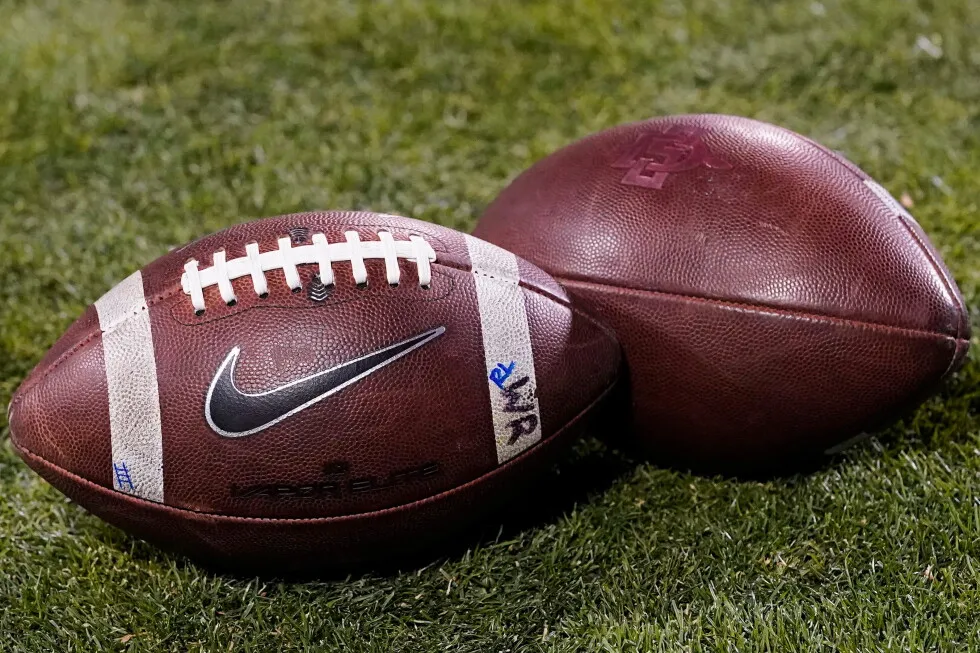
College sports kicks off its season under the long shadow of court fights over eligibility 1 of 2 | Footballs rest on the field in the second half of an NCAA college football game Nov. 28, 2020, in Boulder, Colo. (AP Photo/David Zalubowski, File) 2 of 2 | San Jose State wide receiver Cooper Hoch (13) is greeted by wide receiver Jerry McClure, right, after scoring a touchdown during the second half of an NCAA college football game against Southern California, Saturday, Aug. 29, 2026, in Los Angeles. (AP Photo/William Liang) 1 of 2 | Footballs rest on the field in the second half of an NCAA college football game Nov. 28, 2020, in Boulder, Colo. (AP Photo/David Zalubowski, File) 1 of 2 Footballs rest on the field in the second half of an NCAA college football game Nov. 28, 2020, in Boulder, Colo. (AP Photo/David Zalubowski, File) Add AP News on Google Add AP News as your preferred source to see more of our stories on Google. Share 2 of 2 | San Jose State wide receiver Cooper Hoch (13) is greeted by wide receiver Jerry McClure, right, after scoring a touchdown during the second half of an NCAA college football game against Southern California, Saturday, Aug. 29, 2026, in Los Angeles. (AP Photo/William Liang) 2 of 2 San Jose State wide receiver Cooper Hoch (13) is greeted by wide receiver Jerry McClure, right, after scoring a touchdown during the second half of an NCAA college football game against Southern California, Saturday, Aug. 29, 2026, in Los Angeles. (AP Photo/William Liang) Add AP News on Google Add AP News as your preferred source to see more of our stories on Google. Share Updated [hour]:[minute] [AMPM] [timezone], [monthFull] [day], [year] Imagine the Dallas Cowboys threatening to sue the NFC East, then teams in the division saying they won’t play them unless they remove a player from their roster. No well-run pro sports league would dream of it. College sports? Threats, lawsuits and instability are now as common as play-action passes and handoffs. The week leading to the start of the 2026 season featured LSU and the Southeastern Conference squaring off amid a destabilizing frenzy of lawsuits over eligibility and the mind-bending reality that players who signed on with a pro team, albeit briefly, might soon be suiting up in college again. Two months ago, it was the Big 12 going to court against one of its own teams, Texas Tech.In between: threats about leagues breaking away, talk of “conference-led governance” and a bill meandering through Congress that proposes to fix it all. “We can enjoy the fact that the players can benefit financially from playing in college now,” Duke football coach Manny Diaz said, diagnosing the original reason for the problem. “At the same time, recognize the ultimate truth that we’re not a professional sports franchise. We are a collegiate, scholastic school activity, and we’ve got to rein that in.”Or, as Barbara Osborne, a professor at the North Carolina law school who is an expert on NCAA governance put it: “The difference between a professional sports league and collegiate athletics is literally night and day.”Indeed, most colleges are public institutions whose athletic departments are a small part of the overall equation on their campuses. Unlike pro sports, where finances usually rule the day, decision-makers in college come from classrooms, boardrooms and research programs. Even when teams in a certain conference (like the SEC) or division (like Division I) agree, the decisions don’t always lead to smooth sailing. eligibility issues consistently land the NCAA in courtIn the past week, in the wake of the NCAA’s new five-year eligibility rule that excluded last year’s graduating class from that extra year, the Big Ten and SEC passed rules barring players from returning after leaving for the pros. The Big 12 and ACC quickly passed similar rules.But there were no immediate signs that LSU — the SEC school actually planning on bringing back some pros — was changing its plans. Louisiana’s governor, who keeps his hand in sports at the state’s biggest school, declared: “Don’t hate the player, hate the game.” The Big 12’s lawsuit against its own team, Texas Tech, came in June after quarterback Brendan Sorsby’s admission that he had a gambling addiction. Sorsby eventually withdrew from college and gave up the fight, but the lawsuit lingers on — triggered by a state court order that had temporarily allowed Sorsby to play despite the NCAA longtime ban of players who gamble. On all the different forms the eligibility issue takes, the courts are having quite a say. The smartest plaintiffs’ attorneys are doing a good job shopping for judges sympathetic to their cases — and there are more than 30 at the moment with nearly 400 athletes involved. Most claim it is unfair to exclude high school Class of 2022 athletes the way the NCAA rule did, but it’s also clear that many athletes hoping to come back can count on money — revenue-sharing, NIL deals — that were not available six years ago. “Unfortunately, this is the latest example of member schools weaponizing locally elected judges to skirt member-agreed upon rules,” said NCAA senior vice president Tim Buckley in response to a ruling from a Louisiana judge who sparked the LSU case and keeps finding against the NCAA and SEC. “College sports are supposed to be a launching pad to careers, not a fallback for professional athletes who already competed throughout their time in college.” Lots of ideas to fix problems, no solutions on the horizonSenators, governors, commissioners, judges, lawyers, regents and even the president of the United States have taken cracks at fixing the problems that engulf college sports. None have stemmed the cascade of lawsuits. One of the most pressing issues is a federal antitrust exemption, the likes of which most pro sports have some part of but college does not. Not having it has left the NCAA and its schools open to legal challenges for decades. The most notable — and the genesis of the trouble college sports currently finds itself in — involved players’ right to earn endorsement money. A trio of lawsuits dating to 2009 have, in many ways, settled that debate, forcing schools to open their pocketbooks which, in turn, has made them have to find new ways to generate revenue and control costs. Other issues — namely, those involving eligibility — leave the NCAA open to litigation. “There are certain premises in college athletics that I think the public supports,” said Tyrone Thomas, an attorney at Fox Rothchild who advises universities and pro programs on employment and compliance issues. “We need some rules that are enforceable within the system that we’re in. But we’re in a system that’s only been around for less than a half-dozen years. I think it makes sense to keep the perspective on where we are now, compared to where we were.”The Senate bill seeks to provide the NCAA limited lawsuit protection over issues like rulemaking about eligibility. Absent that passing you get weeks, and summers, like the one we’ve just witnessed. Two of the core principles of college sports is that they are not played by pros; and they cannot be played by players who gamble on the games they play. But even those somewhat uncontroversial ideas have been muddied by the facts that these “amateur” players are getting paid — and that some of the very schools that disdain gambling now have gambling companies as sponsors. Thomas offered a glimmer of hope in the fact that the flurry of court actions involved in the five-year rule have a limited number of potential plaintiffs — only those who graduated high school in 2022 and saw their eligibility run out last spring.“I look at these as maybe not the house-on-fire issue of the day,” he said. “There are definitely ‘fire’ issues. But I don’t look at the essential ‘house-on-fire’ issue that’s going to determine how things move forward.”___AP Sports Writer Aaron Beard in Raleigh, N.C. and Eric Olson in Omaha, Neb. contributed.
SRCAssociated Press (AP)
LANGEN
LEANCenter
WORDS1 342
ENT12
SUN · 2026-08-30 · 14:53 GMTBRIEF NSR-2026-0830-107438
NSR-2026-0830-107438News Report·EN·Legal & Judicial
College sports kicks off its season under the long shadow of court fights over eligibility
College sports are facing significant instability as the new season begins, marked by numerous lawsuits over player eligibility. Recent legal battles include the Big 12 suing Texas Tech and LSU challenging the Southeastern Conference's rules.
By
EDDIE PELLSAssociated Press (AP)Filed 2026-08-30 · 14:53 GMTLean · CenterRead · 6 min
Associated Press (AP)FIG 01
Reading time
6min
Word count
1 342words
Sources cited
2cited
Entities identified
12entities
Quality score
100%
§ 01
Briefing Summary
AI-generatedNEWSAR · AI
College sports are facing significant instability as the new season begins, marked by numerous lawsuits over player eligibility. Recent legal battles include the Big 12 suing Texas Tech and LSU challenging the Southeastern Conference's rules. These disputes stem from evolving eligibility standards, including a new five-year rule and conferences barring players who previously turned professional from returning. While some coaches acknowledge the financial benefits players now receive, they emphasize that college sports remain distinct from professional leagues. Legal challenges are widespread, with many athletes claiming unfair exclusion, while others seek to return to college play, potentially benefiting from NIL deals. Despite various proposals to address these issues, including a bill in Congress, no definitive solutions have emerged, leaving college athletics in a state of ongoing legal contention.
Confidence 0.90Sources 2Claims 5Entities 12
§ 02
Article analysis
Model · rule-basedFraming
Legal & Judicial
Conflict
Tone
Mixed Tone
AI-assessed
CalmNeutralAlarmist
Factuality
0.60 / 1.00
Mixed
LowHigh
Sources cited
2
Limited
FewMany
§ 03
Key claims
5 extracted01
Manny Diaz believes college sports need to be reined in, emphasizing their scholastic nature over professional franchising.
quoteManny Diaz
Confidence
1.00
02
College sports are experiencing instability due to lawsuits over player eligibility.
factual
Confidence
0.90
03
The Big 12 conference went to court against Texas Tech two months prior to the 2026 season start.
factual
Confidence
0.80
04
LSU and the Southeastern Conference were involved in lawsuits over eligibility before the 2026 season.
factual
Confidence
0.80
05
Players who briefly signed with professional teams might be eligible to play college sports again.
factual
Confidence
0.70
§ 04
Full report
6 min read · 1 342 words§ 05
Entities
12 identifiedKey playerOppositionContextPositiveNeutralNegative
Organizations6
Locations1
Events1
§ 06
Keywords & salience
8 termscollege sports
1.00
eligibility disputes
0.90
lawsuits
0.80
ncaa
0.70
player eligibility
0.70
conference governance
0.60
legal challenges
0.50
season start
0.40
§ 07
Topic connections
Interactive graph No topic relationship data available yet. This graph will appear once topic relationships have been computed.