While Roman will look outward into the Universe, Millard said scientists are also anticipating it will find thousands of new worlds in our own galaxy.Getty ImagesNancy Grace Roman (1925-2018) was known as the "mother of Hubble" for her tole in planning the Hubble telescopeThe telescope is named after physicist Nancy Grace Roman, who was Nasa's first chief astronomer in the 1960s and its first female executive.During her career, she was instrumental in getting the Hubble Space Telescope approved by US Congress and later said its most interesting discovery was dark energy.The new telescope is similarly expected to revolutionise our understanding of the Universe, including through investigating dark energy. It has a five-year primary lifespan with a goal to operate for 10 years. Getty ImagesNasa says its "crisp, sweeping surveys will help scientists investigate dark energy and dark matter, discover and characterise exoplanets, map billions of galaxies, study black holes, and explore objects from our own solar system to the edge of the observable Universe."dark matter, which is invisible, acts as a kind of gravitational glue, while dark energy is believed to be a repulsive force driving the Universe's expansion. Together, they are thought to make up about 95% of the Universe.
SRCBBC News - World
LANGEN
LEANCenter
WORDS201
ENT8
SUN · 2026-08-30 · 18:53 GMTBRIEF NSR-2026-0830-107491
NSR-2026-0830-107491News Report·EN·Technology
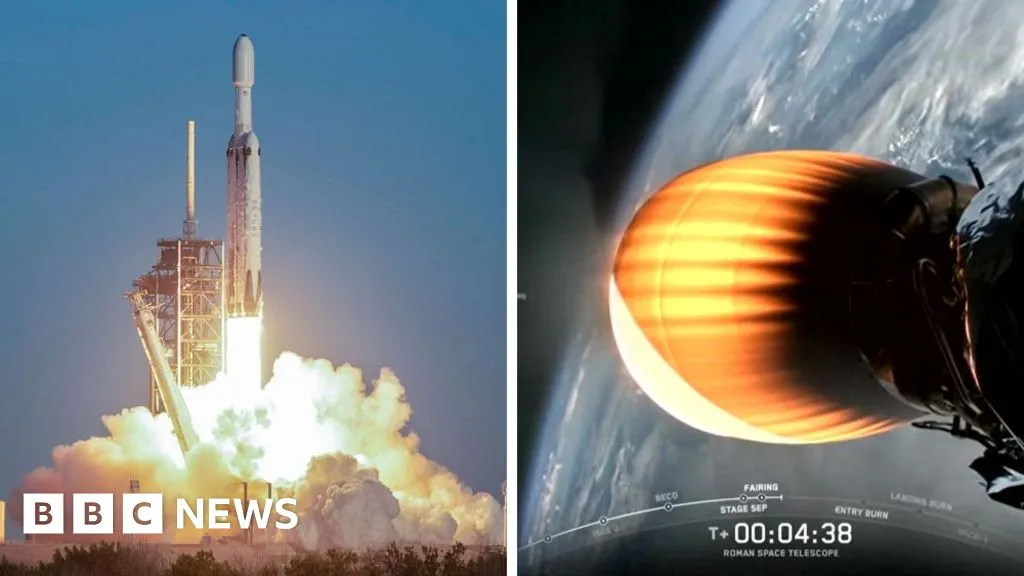
Nasa launches new space telescope able to see 100 times more than Hubble
NASA has launched the Nancy Grace Roman Space Telescope, named after the "mother of Hubble" and NASA's first female executive. This new telescope, designed to operate for at least five years, is expected to significantly advance our understanding of the universe.
1 hour agoShareSaveAdd as preferred on GoogleGrace Eliza GoodwinBBC News - WorldFiled 2026-08-30 · 18:53 GMTLean · CenterRead · 1 min
BBC News - WorldFIG 01
Reading time
1min
Word count
201words
Sources cited
1cited
Entities identified
8entities
Quality score
100%
§ 01
Briefing Summary
AI-generatedNEWSAR · AI
NASA has launched the Nancy Grace Roman Space Telescope, named after the "mother of Hubble" and NASA's first female executive. This new telescope, designed to operate for at least five years, is expected to significantly advance our understanding of the universe. Its mission includes creating a new map of the cosmos, investigating dark energy and dark matter, discovering thousands of new exoplanets in our galaxy, and studying phenomena from our solar system to the edge of the observable universe. The telescope's capabilities are anticipated to be far greater than Hubble's, enabling it to map billions of galaxies and explore black holes.
Confidence 0.90Sources 1Claims 5Entities 8
§ 02
Article analysis
Model · rule-basedFraming
Technology
Human Interest
Tone
Measured
AI-assessed
CalmNeutralAlarmist
Factuality
0.90 / 1.00
Factual
LowHigh
Sources cited
1
Limited
FewMany
§ 03
Key claims
5 extracted01
The telescope has a five-year primary lifespan with a goal to operate for 10 years.
factualNasa
Confidence
1.00
02
Dark matter and dark energy are thought to make up about 95% of the Universe.
statisticNasa
Confidence
1.00
03
The telescope is named after physicist Nancy Grace Roman, Nasa's first chief astronomer and first female executive.
factualArticle
Confidence
1.00
04
The new space telescope is able to see 100 times more than the Hubble telescope.
factualNasa
Confidence
1.00
05
The telescope is expected to find thousands of new worlds in our own galaxy.
predictionMillard
Confidence
0.80
§ 04
Full report
1 min read · 201 words§ 05
Entities
8 identifiedKey playerOppositionContextPositiveNeutralNegative
Organizations4
§ 06
Keywords & salience
10 termsspace telescope
1.00
nancy grace roman
0.90
dark energy
0.90
hubble space telescope
0.80
universe
0.70
dark matter
0.70
exoplanets
0.60
nasa
0.50
galaxies
0.40
black holes
0.40
§ 07
Topic connections
Interactive graph No topic relationship data available yet. This graph will appear once topic relationships have been computed.