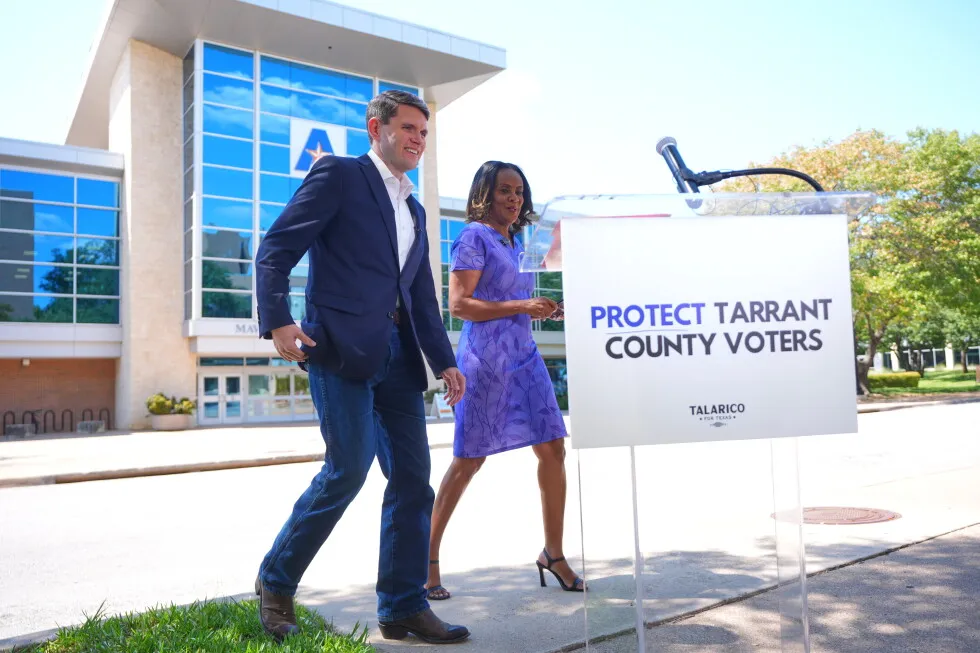
Plan to cut number of polling sites in a major Texas county draws protests as Senate race looms 1 of 3 | Democratic Senate candidate James Talarico, left, and Tarrant County Commissioner Alisa Simmons arrive for a news conference at UTA, Sunday, Aug. 30, 2026, in Arlington, Texas. (AP Photo/LM Otero) 2 of 3 | Tarrant County Commissioner Alisa Simmons, left, speaks as Democratic Senate candidate James Talarico looks on as during a news conference at UTA, Sunday, Aug. 30, 2026, in Arlington, Texas. (AP Photo/LM Otero) 3 of 3 | Democratic Senate candidate James Talarico, right, speaks with Tarrant County Commissioner Alisa Simmons during a news conference at UTA, Sunday, Aug. 30, 2026, in Arlington, Texas. (AP Photo/LM Otero) By Anna Wilder Updated 2:44 AM MESZ, August 31, 2026 Add AP News on Google Add AP News as your preferred source to see more of our stories on Google. Share Share Facebook Copy Link copied Print Email X LinkedIn Bluesky Flipboard Pinterest Reddit AUSTIN, Texas (AP) — A plan in one of Texas’ largest counties to use dozens fewer polling locations than in previous years is drawing protests from Democrats who say the reductions could create confusion in the November midterm elections. The proposal, set for a vote Tuesday, would reduce the number of polling locations across booming Tarrant County, which borders Dallas and includes Fort Worth. County officials say the plan would save resources by eliminating low-turnout sites, noting voters would still have more than 200 locations where they could cast ballots. Texas’ third-largest county is home to more than 2 million people and a key battleground in the U.S. Senate race between Democratic state Rep. James Talarico and Republican Attorney General Ken Paxton. On Sunday, Talarico urged the county to reject the proposal. “The most powerful people in this county, the most powerful people in this country, don’t want us to be able vote easily,” Talarico said at a news conference. If the plan is approved, Tarrant County would have 92 fewer polling locations on Election Day than it did during the 2022 midterms. Closing polling locations in Texas is not a new trend, county elections officials say. The trend has been accelerated by an embrace of countywide voting sites and the difficulty in recruiting poll workers. Other Texas counties have also considered or already reduced the number of polling locations for November while some have added more. “We’re clearly not trying to suppress the vote,” Rep. Matt Shaheen, the Republican chairman of the House Elections Committee, said of polling site reductions in Texas. “That’s a silly accusation.” Democrats are gathering to give final approval to their 2028 presidential primary calendar 1 MIN READ 60 Republican nominee for Maine governor says he wants ICE agents at polling places in the state 3 MIN READ 206 Talarico wants to unearth Paxton’s depositions to keep focus on opponent’s past in Texas Senate race 3 MIN READ 206 County says plan eliminates low-turnout sites Tarrant County Elections Administrator Clint Ludwig has said the reductions would allow the county to eliminate locations that serve few people. Locations near bus stops that complied with federal accessibility laws were prioritized to remain open, according to a county statement. Officials said the average distance between Election Day sites under the plan was 1.5 mile (2.4 kilometers). “All of this is accomplished without the wasteful practice of placing polling sites directly across the street from one other,” said Tarrant County Judge Tim O’Hare, a Republican and the county’s top administrator. Spokespeople for Paxton did not respond to emails seeking comment. This site is protected by reCAPTCHA and the Google and Terms of Service apply. Texas counties determine numb er of polling locations Texas law lets each of the state’s 254 counties decide how many polling places to use. Tarrant County adopted countywide voting in 2019 but didn’t immediately begin reducing the number of polling locations. On Friday, the NAACP and the American Civil Liberties Union joined voting rights groups in signing a letter urging the county to reject the proposal, saying the closures would be strongly felt in areas with high percentages of minority voters. About a third of the county’s residents are Hispanic, and about 19.2% are Black, according to Census data. Bastrop County Elections Administrator Kristin Miles, whose county is outside Austin, said reducing the number of polling sites could make sense, depending on how heavily they are used. Miles noted that there would be little point, for instance, in opening sites in rural areas that may only serve a handful of voters throughout the day. Carol Raburn, who worked the March primaries as an election judge in Tarrant County, called the proposal a form of voter suppression. “Because what happens when people don’t have a convenient place to go vote that’s not too far away from where they are, where they live? They just don’t go vote because they’ve made it so difficult,” she said. Wilder is a corps member for The Associated Press/Report for America Statehouse News Initiative. Report for America is a nonprofit national service program that places journalists in local newsrooms to report on undercovered issues.
SRCAssociated Press (AP)
LANGEN
LEANCenter
WORDS857
ENT12
MON · 2026-08-31 · 01:53 GMTBRIEF NSR-2026-0831-107544
NSR-2026-0831-107544News Report·EN·Political Strategy
Plan to cut number of polling sites in a major Texas county draws protests as Senate race looms
Tarrant County, Texas, a major battleground in the upcoming Senate race, is facing protests over a plan to reduce the number of polling locations by 92 for the November midterm elections. County officials state the proposal aims to save resources by eliminating low-turnout sites, assuring voters will still have over 200 locations available.
Associated Press (AP)Filed 2026-08-31 · 01:53 GMTLean · CenterRead · 4 min
Associated Press (AP)FIG 01
Reading time
4min
Word count
857words
Sources cited
3cited
Entities identified
12entities
Quality score
100%
§ 01
Briefing Summary
AI-generatedNEWSAR · AI
Tarrant County, Texas, a major battleground in the upcoming Senate race, is facing protests over a plan to reduce the number of polling locations by 92 for the November midterm elections. County officials state the proposal aims to save resources by eliminating low-turnout sites, assuring voters will still have over 200 locations available. Democrats, including Senate candidate James Talarico, argue these reductions could cause confusion and suppress votes, particularly in minority communities. While county officials maintain the plan is not intended to suppress voting and prioritizes accessibility, voting rights groups have urged the county to reject the proposal. The trend of reducing polling locations is not unique to Tarrant County, with other Texas counties also considering or implementing similar measures.
Confidence 0.90Sources 3Claims 5Entities 12
§ 02
Article analysis
Model · rule-basedFraming
Political Strategy
Social Justice
Tone
Measured
AI-assessed
CalmNeutralAlarmist
Factuality
0.70 / 1.00
Factual
LowHigh
Sources cited
3
Well sourced
FewMany
§ 03
Key claims
5 extracted01
The proposal, set for a vote Tuesday, would reduce the number of polling locations across Tarrant County.
factual
Confidence
1.00
02
A plan to reduce the number of polling locations in Tarrant County, Texas, is drawing protests from Democrats.
factual
Confidence
1.00
03
If approved, Tarrant County would have 92 fewer polling locations on Election Day than in the 2022 midterms.
statistic
Confidence
0.95
04
Democrats argue the reductions could create confusion in the November midterm elections.
factualDemocrats
Confidence
0.90
05
County officials state the plan would save resources by eliminating low-turnout sites and that voters would still have over 200 locations.
factualCounty officials
Confidence
0.90
§ 04
Full report
4 min read · 857 words§ 05
Entities
12 identifiedKey playerOppositionContextPositiveNeutralNegative
People3
Locations5
Events3
§ 06
Keywords & salience
10 termspolling sites
1.00
tarrant county
0.90
senate race
0.80
voting access
0.70
election
0.60
voter suppression
0.60
democrats
0.50
texas
0.50
midterm elections
0.40
county officials
0.40
§ 07
Topic connections
Interactive graph Network visualization showing 51 related topics
View Full Graph Person Organization Location Event|Click node to navigate|Edge numbers = shared articles