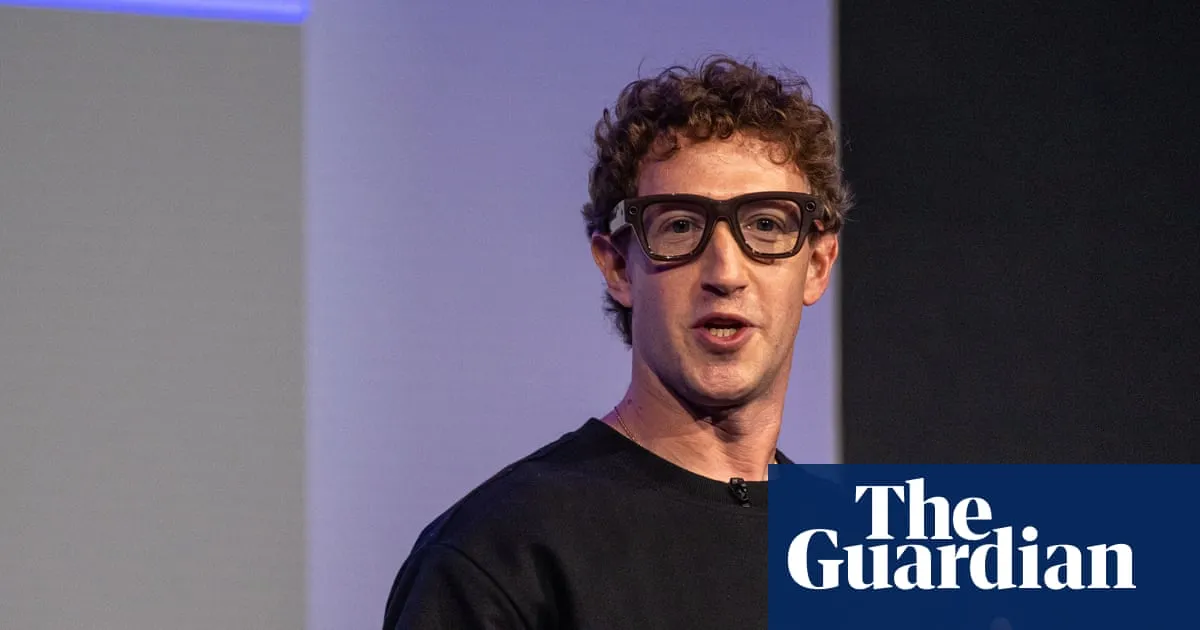
Meta’s Mark Zuckerberg in a pair of the company’s Ray-Ban smartglasses. Australia’s eSafety is urging manufacturers to improve privacy protections around the technology. Photograph: Bloomberg/Getty Images View image in fullscreen Meta’s Mark Zuckerberg in a pair of the company’s Ray-Ban smartglasses. Australia’s eSafety is urging manufacturers to improve privacy protections around the technology. Photograph: Bloomberg/Getty Images smartglasses should automatically blur people’s faces while filming, Australia’s online safety regulator says smartglasses with cameras can benefit the vision impaired but companies might pit ‘accessibility benefits against safety and privacy’, eSafety says Follow our Australia news live blog for latest updates Get our breaking news email, free app or daily news podcast Australia’s online safety regulator has urged smartglasses companies to automatically blur people’s faces filmed on the devices, and make it clearer when someone is filming, as the federal government faces pressure to ban the technology. In advice to industry published on Monday, the office of the eSafety Commissioner warned that while smartglasses with cameras, such as Meta’s Ray-Ban, can offer accessibility benefits to low vision or blind people, companies might pit “accessibility benefits against safety and privacy considerations”, and noted there was already a backlash to the technology. Dubbed “pervert glasses” by some, there are reports of women being filmed without their consent and their interactions with a glasses-wearing influencer posted on social media. The eSafety commission said many companies were placing responsibility on consumers to use the glasses safely but said “asking people to use a product responsibly is not an adequate safety policy”. “It also overlooks how smartglasses are actually used. “The harms linked to covert recording are not hypothetical. They are real and already occurring.” It warned that so-called “pickup artist” content filmed using the glasses often led to misogynistic comments, and the prevalence of this content could normalise watching, recording and controlling women in public without their knowledge. The regulator said developers “have a critical opportunity” to embed safer design practices while the technology is evolving. The design features should include clear visual indicators when recording audio or video that cannot be disabled or obscured, eSafety said. The glasses should also not be able to identify members of the public and should automatically blur people’s faces where they have not provided informed consent. “If we do not act now to prevent design elements from being weaponised to cause harm, we risk unsafe features becoming entrenched,” eSafety said. The eSafety Commissioner currently has no powers to force the companies to make the changes and the federal government is facing pressure to step in as the market for smartglasses grows. The attorney general will separately release an exposure draft for the government’s second round of privacy reforms that will seek to address rules around smartglasses. Guardian Australia understands this will not include a ban on the technology. After Brisbane city council announced plans last week to ban recording devices, including smartglasses, from public pools, the federal assistant minister for technology, Andrew Charlton, told Seven’s Sunrise program the smartglasses were “a really scary thing” as they became cheaper and more accessible. “That raises a lot of understandable fears,” he said. The Australian privacy commissioner, Carly Kind, was asked by the attorney general to assess the privacy implications of the glasses earlier this month, and Charlton said the commissioner could take a number of steps “including banning them”. It is understood the privacy commissioner also does not have powers to ban the devices but there are moves to change this. The ABC reported last week that the Greens, with the support of several crossbenchers, plan to introduce a private member’s bill to ban the glasses for 12 months until privacy law catches up. John Pane, the chair of the digital rights group Electronic Frontiers Australia, said the federal Privacy Act was not designed to cover smartglasses but said state surveillance device laws could be updated. “This could be achieved in 12 months,” he said. “We are supportive of an immediate temporary ban on these covert wearable surveillance devices subject to a specific carve-out on them remaining available to people who are significantly sight impaired.” The push to ban smartglasses began with a petition after Guardian Australia’s report earlier this month that Kmart Anko $89 smartglasses had sold out across the country. Bars, courts, hospitals and other semi-public locations contacted by Guardian Australia this month indicated they did not yet have specific policies regarding smartglasses, with most pointing to existing rules restricting recording. A number of schools have already begun adding wearable devices to mobile phone bans already in place. Device bans in individual institutions won’t solve the issue, and the obligations should sit with the companies making the technology and the retailers selling it, said Victoria University’s associate professor in AI governance in education, Janine Arantes. Arantes said the underlying harms, such as filming without consent, bullying, harassment and privacy violations, must be the policy focus. “The technology changes – discretion, accessibility, speed and eventually the scale of what can be done – but recording isn’t new, cyberbullying isn’t new, harassment isn’t new, smartphones aren’t new,” she said. “Just the capability of the technology through which those behaviours can occur is new – [so] why not address the behaviours?” Explore more on these topics Wearable technology Meta Consumer affairs Privacy news Share Reuse this content
SRCThe Guardian - World News
LANGEN
LEANCenter-Left
WORDS884
ENT10
SUN · 2026-08-30 · 15:00 GMTBRIEF NSR-2026-0830-107555
NSR-2026-0830-107555News Report·EN·Technology
Smartglasses should automatically blur people’s faces while filming, Australia’s online safety regulator says
Australia's online safety regulator, the eSafety commissioner, has advised smartglasses companies to implement automatic face blurring and clear recording indicators. This recommendation comes as the federal government faces pressure to ban the technology, which, while offering accessibility benefits for the visually impaired, raises significant privacy and safety concerns.
Josh Taylor Technology reporterThe Guardian - World NewsFiled 2026-08-30 · 15:00 GMTLean · Center-LeftRead · 4 min
The Guardian - World NewsFIG 01
Reading time
4min
Word count
884words
Sources cited
2cited
Entities identified
10entities
Quality score
100%
§ 01
Briefing Summary
AI-generatedNEWSAR · AI
Australia's online safety regulator, the eSafety commissioner, has advised smartglasses companies to implement automatic face blurring and clear recording indicators. This recommendation comes as the federal government faces pressure to ban the technology, which, while offering accessibility benefits for the visually impaired, raises significant privacy and safety concerns. The regulator highlighted instances of covert filming and the potential for misuse, stating that relying on consumers for responsible use is insufficient. While the eSafety commissioner currently lacks enforcement powers, the government is expected to address smartglasses in upcoming privacy reforms, though a complete ban is not anticipated. Discussions are ongoing regarding potential legislative action, including a temporary ban, to address the privacy implications of these devices.
Confidence 0.90Sources 2Claims 5Entities 10
§ 02
Article analysis
Model · rule-basedFraming
Technology
Social Justice
Tone
Mixed Tone
AI-assessed
CalmNeutralAlarmist
Factuality
0.70 / 1.00
Factual
LowHigh
Sources cited
2
Limited
FewMany
§ 03
Key claims
5 extracted01
The eSafety commissioner currently has no powers to force companies to make changes to smartglasses design.
factual
Confidence
1.00
02
Harms linked to covert recording using smartglasses are real and already occurring.
factualeSafety Commissioner
Confidence
1.00
03
Companies might pit ‘accessibility benefits against safety and privacy considerations’ regarding smartglasses.
quoteeSafety Commissioner
Confidence
1.00
04
Smartglasses should automatically blur people’s faces while filming, Australia’s online safety regulator says.
quoteeSafety Commissioner
Confidence
1.00
05
The prevalence of misogynistic content filmed using smartglasses could normalize watching, recording and controlling women in public without their knowledge.
factualeSafety Commissioner
Confidence
0.90
§ 04
Full report
4 min read · 884 words§ 05
Entities
10 identifiedKey playerOppositionContextPositiveNeutralNegative
Organizations3
Locations1
§ 06
Keywords & salience
9 termssmartglasses
1.00
privacy protections
0.90
face blurring
0.80
online safety regulator
0.70
covert recording
0.70
accessibility benefits
0.60
filming
0.50
ray-ban
0.40
meta
0.40
§ 07
Topic connections
Interactive graph Network visualization showing 51 related topics
View Full Graph Person Organization Location Event|Click node to navigate|Edge numbers = shared articles