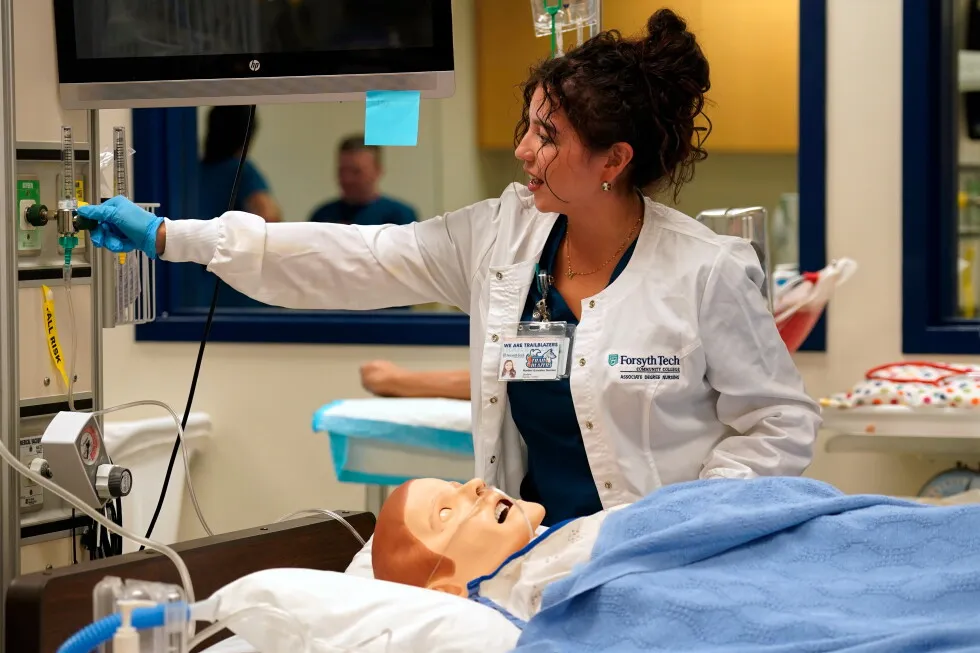
As Pell grants expand, students see openings to afford short-term job training 1 of 5 | Nursing student Maribel Gonzalez Guzman checks a patient manikin in the simulation lab at Forsyth Technical Community College in Winston-Salem, N.C., Thursday, Aug. 20, 2026. (AP Photo/Chuck Burton) 2 of 5 | Instructor Renee McFatridge, center back, directs nursing students in the simulation lab at Forsyth Technical Community College in Winston-Salem, N.C., Thursday, Aug. 20, 2026. (AP Photo/Chuck Burton) 3 of 5 | Nursing Instructor Sherry Troop, back left, speaks to nursing students in the simulation lab at Forsyth Technical Community College in Winston-Salem, N.C., Thursday, Aug. 20, 2026. (AP Photo/Chuck Burton) 4 of 5 | Nursing student Persis Coleman checks a manikin in the simulation lab at Forsyth Technical Community College in Winston-Salem, N.C., Thursday, Aug. 20, 2026. (AP Photo/Chuck Burton) 5 of 5 | Manikins lay in hospital beds in the simulation lab at Forsyth Technical Community College in Winston-Salem, N.C., Thursday, Aug. 20, 2026. (AP Photo/Chuck Burton) 1 of 5 | Nursing student Maribel Gonzalez Guzman checks a patient manikin in the simulation lab at Forsyth Technical Community College in Winston-Salem, N.C., Thursday, Aug. 20, 2026. (AP Photo/Chuck Burton) 1 of 5 Nursing student Maribel Gonzalez Guzman checks a patient manikin in the simulation lab at Forsyth Technical Community College in Winston-Salem, N.C., Thursday, Aug. 20, 2026. (AP Photo/Chuck Burton) Add AP News on Google Add AP News as your preferred source to see more of our stories on Google. Share 2 of 5 | Instructor Renee McFatridge, center back, directs nursing students in the simulation lab at Forsyth Technical Community College in Winston-Salem, N.C., Thursday, Aug. 20, 2026. (AP Photo/Chuck Burton) 2 of 5 Instructor Renee McFatridge, center back, directs nursing students in the simulation lab at Forsyth Technical Community College in Winston-Salem, N.C., Thursday, Aug. 20, 2026. (AP Photo/Chuck Burton) Add AP News on Google Add AP News as your preferred source to see more of our stories on Google. Share 3 of 5 | Nursing Instructor Sherry Troop, back left, speaks to nursing students in the simulation lab at Forsyth Technical Community College in Winston-Salem, N.C., Thursday, Aug. 20, 2026. (AP Photo/Chuck Burton) 3 of 5 Nursing Instructor Sherry Troop, back left, speaks to nursing students in the simulation lab at Forsyth Technical Community College in Winston-Salem, N.C., Thursday, Aug. 20, 2026. (AP Photo/Chuck Burton) Add AP News on Google Add AP News as your preferred source to see more of our stories on Google. Share 4 of 5 | Nursing student Persis Coleman checks a manikin in the simulation lab at Forsyth Technical Community College in Winston-Salem, N.C., Thursday, Aug. 20, 2026. (AP Photo/Chuck Burton) 4 of 5 Nursing student Persis Coleman checks a manikin in the simulation lab at Forsyth Technical Community College in Winston-Salem, N.C., Thursday, Aug. 20, 2026. (AP Photo/Chuck Burton) Add AP News on Google Add AP News as your preferred source to see more of our stories on Google. Share 5 of 5 | Manikins lay in hospital beds in the simulation lab at Forsyth Technical Community College in Winston-Salem, N.C., Thursday, Aug. 20, 2026. (AP Photo/Chuck Burton) 5 of 5 Manikins lay in hospital beds in the simulation lab at Forsyth Technical Community College in Winston-Salem, N.C., Thursday, Aug. 20, 2026. (AP Photo/Chuck Burton) Add AP News on Google Add AP News as your preferred source to see more of our stories on Google. Share Updated [hour]:[minute] [AMPM] [timezone], [monthFull] [day], [year] Sydney Webb scrimped and saved to pay for an eight-week certified nursing assistant program at a North Carolina community college.On top of the $255 registration fee, the 26-year-old bartender also had to pay for a background check, scrubs, a stethoscope, special shoes and a state certification exam — all while working half as much to make time for her classes. “It shocked me a little bit how expensive it was,” said Webb, an aspiring ultrasound operator. Other students in the Forsyth Technical Community College program might soon have access to additional support. The school in Winston-Salem is among many around the country seeking approval for a new federal grant program, Workforce Pell, to aid students enrolled in short-term job training. For decades, Pell grants have helped low- and moderate-income students attend college, but eligible programs had to be at least 15 weeks and a minimum of 600 hours. The expansion makes some shorter-term programs eligible, too. The federal government began accepting applications in July and has approved the first programs — an emergency medical technician program in Iowa and a medical assistant program in Indiana. Dozens of other programs in states including North Carolina, Pennsylvania, Michigan, Louisiana, and Nebraska are awaiting federal approval. They prepare students for careers as truck drivers, electrical line workers, phlebotomists, IT support technicians, firefighters, welders and more. The expense of a short-term class can often be an obstacle for cash-strapped students who need it to get a job or a wage increase, said Chandler LeBoeuf, executive vice president of the Louisiana Community and Technical College System.“That’s what excites me about Workforce Pell,” he said. “Is it every program? No. Are there limitations? Yes. But ultimately, over time, we will be able to work on those aspects where barriers exist.” 7 MIN READ 2 MIN READ 6 MIN READ A lifeline for lower-income students expands to short-term programs Pell grants, which generally do not have to be repaid, are a key to affording higher education for many lower-income students. Nationwide, around a third of undergraduate college students qualify, according to data from the National Center for Education Statistics, with the amount awarded based on factors like family size and income. For full-time students, the largest grant possible this year is $7,395. For the shorter Workforce Pell programs, the maximum award will be $4,310 for a 14-week program and $1,260 for an eight-week program, according to an analysis from New America, a Washington think tank. The expansion of the Pell grants to short-term programs has been a decade in the making, said Jim Hermes, associate vice president of government relations at the American Association of Community Colleges. Concerns about ensuring the quality of the programs were a roadblock, but Workforce Pell had bipartisan support and the backing of the Trump administration, Hermes said. The full rollout of Workforce Pell grants could take years, experts say.To qualify for Pell funding, programs must reach a 70% threshold for student completion and job placement, which many states struggle to track, said Dominique Baker, an associate professor at the University of Delaware who studies education policy. The programs must also lead to higher earnings and provide credentials that are “stackable” — meaning they are immediately useful and can be built upon. The programs must last at least eight weeks but fewer than 15 weeks, and they must have been in operation for a full year, meeting all the requirements, before they can qualify.“I think it’s going to take off pretty slowly, which I would say is more a feature than a bug,” said Robert Kelchen, a University of Tennessee professor who studies higher education. “That way we can make sure these are quality programs, they are in need, and they’re not just a pathway for programs to fly by night, take taxpayer dollars and not generate a return to students.” Some schools are waiting to see how it developsSkeptics worry some students will use up their lifetime 12-semester Pell benefits in short-term programs, rather than pursuing a bachelor’s degree, with potentially higher earnings prospects.“There’s been a lot of rhetoric of, ‘Students get their eight-week program and end up making middle-class wages,’” said Wesley Whistle, project director for student success and affordability at New America. “I don’t think that’s actually going to be true generally speaking.” A study from the Association of Community College Trustees found most students boosted their wages after completing short-term programs. But even with the gain, overall annual earnings below $25,000 were common among graduates. Some schools are sitting on the sidelines for now. Around two-thirds of states have a process for colleges to apply for approval, said Carrie Warick-Smith, vice president for public policy for the Association of Community College Trustees. “We would love to be able to utilize it. It’s just, it’s been difficult to implement at this point,” said Grant Carlson, a program coordinator at Johnson County Community College in suburban Kansas City. Not so at Forsyth Tech, where Webb took her nursing class. Devin Purgason, the executive director of marketing, is so excited that he has webpages prepared, touting Workforce Pell funding. If the federal government says yes, he plans to click “publish” as quickly as a Taylor Swift fan trying to nab concert tickets.“Like I’m in the Ticketmaster line right now,” he said. ___The Associated Press’ education coverage receives financial support from multiple private foundations. AP is solely responsible for all content. Find AP’s standards for working with philanthropies, a list of supporters and funded coverage areas at AP.org. Hollingsworth has worked for The AP for 25 years, covering stories of interest in the Midwest and beyond. She is based in Kansas City, Missouri.
SRCAssociated Press (AP)
LANGEN
LEANCenter
WORDS1 522
ENT10
MON · 2026-08-31 · 04:53 GMTBRIEF NSR-2026-0831-107591
NSR-2026-0831-107591News Report·EN·Economic Impact
As Pell grants expand, students see openings to afford short-term job training
Pell grants, traditionally for longer college programs, are expanding to include short-term job training through the new Workforce Pell grant program. This initiative aims to make vocational training more accessible and affordable for low- and moderate-income students, who previously faced significant out-of-pocket costs for programs like certified nursing assistant training.
By
HEATHER HOLLINGSWORTHAssociated Press (AP)Filed 2026-08-31 · 04:53 GMTLean · CenterRead · 7 min
Associated Press (AP)FIG 01
Reading time
7min
Word count
1 522words
Sources cited
0cited
Entities identified
10entities
Quality score
100%
§ 01
Briefing Summary
AI-generatedNEWSAR · AI
Pell grants, traditionally for longer college programs, are expanding to include short-term job training through the new Workforce Pell grant program. This initiative aims to make vocational training more accessible and affordable for low- and moderate-income students, who previously faced significant out-of-pocket costs for programs like certified nursing assistant training. The federal government began accepting applications in July, with initial programs approved in Iowa and Indiana, and many others awaiting approval nationwide. These programs prepare students for careers in fields such as truck driving, welding, and IT support. While the expansion is seen as a positive step, its full implementation may take years, with programs needing to meet specific completion and job placement thresholds to qualify.
Confidence 0.90Claims 3Entities 10
§ 02
Article analysis
Model · rule-basedFraming
Economic Impact
Human Interest
Tone
Measured
AI-assessed
CalmNeutralAlarmist
Factuality
0.70 / 1.00
Factual
LowHigh
Sources cited
0
No named sources
FewMany
§ 03
Key claims
3 extracted01
Nursing students at Forsyth Technical Community College are utilizing simulation labs for training.
factual
Confidence
1.00
02
Short-term job training programs are becoming more accessible to students due to Pell grant expansion.
factual
Confidence
0.90
03
Pell grants are expanding, creating opportunities for students to afford short-term job training.
factual
Confidence
0.90
§ 04
Full report
7 min read · 1 522 words§ 05
Entities
10 identifiedKey playerOppositionContextPositiveNeutralNegative
People5
Organizations2
Topics1
§ 06
Keywords & salience
7 termspell grants
1.00
job training
0.90
short-term training
0.80
affordability
0.70
community college
0.60
nursing students
0.50
forsyth technical community college
0.40
§ 07
Topic connections
Interactive graph Network visualization showing 46 related topics
View Full Graph Person Organization Location Event|Click node to navigate|Edge numbers = shared articles