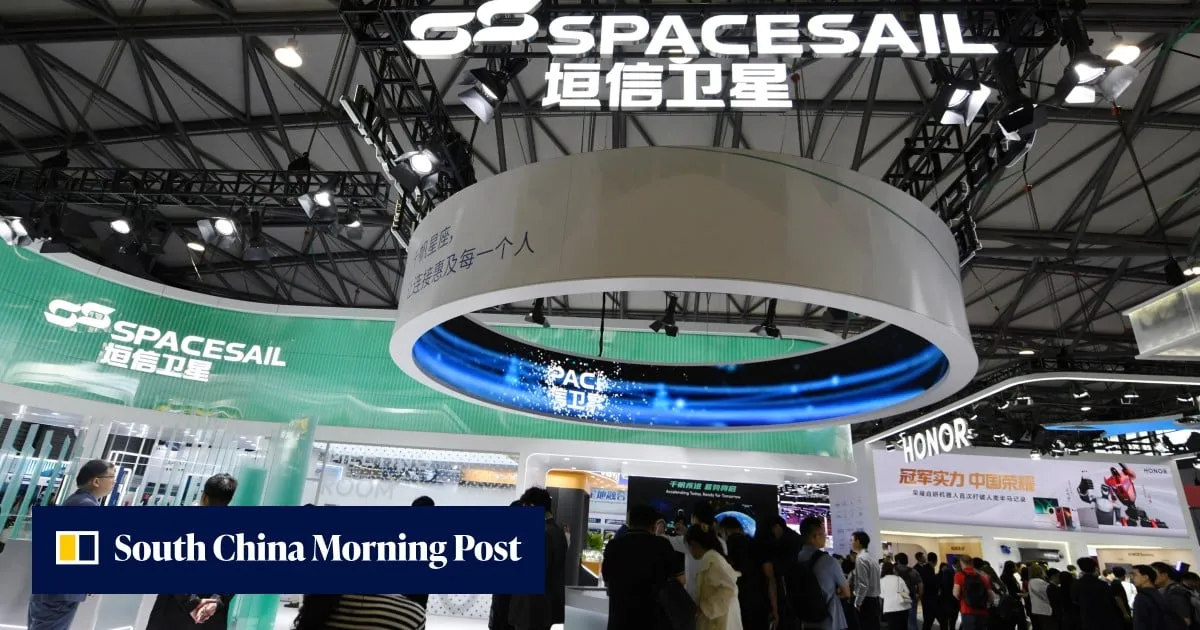
As China ramps up its efforts to build an orbital data ecosystem and counter the US in the commercial space race, Shanghai – home to several major domestic players – has kicked off an inaugural space-computing forum alongside a new industry hub.The dedicated centre in the city’s southwestern Songjiang district, unveiled at the forum on Sunday, brought together aerospace developers, semiconductor makers, artificial intelligence specialists, cloud vendors, as well as researchers and investors to advance in-orbit data processing, local news outlet Shanghai Observer reported.Space computing enables satellites to analyse data in orbit, reducing the need to transmit raw files back to ground stations and speeding up real-time intelligence. More ambitious long-term plans envision orbital data centres powered by solar energy to ease pressure on land-based power grids.Songjiang, which has made commercial space a focal point of its development guidelines, is already a vital link in China’s satellite supply chain. The district is home to SpaceSail, the Shanghai government-backed firm building Qianfan – China’s main low-Earth-orbit challenger to US giant SpaceX’s Starlink.Having launched over 200 satellites to date, SpaceSail aims to deploy a 15,000-satellite mega-constellation by the end of 2030.A Long March-8 carrier rocket blasts off from the Hainan commercial spacecraft launch site in south China’s Hainan, June 5, 2026. Photo: XinhuaSongjiang is also home to satellite manufacturers including Gesi Aerospace and Xuntian Qianhe, as well as the Shanghai Aerospace Precision Machinery Research Institute.
SRCSouth China Morning Post
LANGEN
LEANCenter-Right
WORDS233
ENT12
MON · 2026-08-31 · 09:30 GMTBRIEF NSR-2026-0831-107630
NSR-2026-0831-107630News Report·EN·Technology
As China-US space race heats up, Shanghai unveils space-computing hub
Shanghai has launched a new space-computing hub and an inaugural forum in its Songjiang district to advance China's capabilities in the commercial space race against the US. This initiative aims to foster in-orbit data processing by bringing together aerospace developers, semiconductor makers, AI specialists, cloud vendors, researchers, and investors.
Wency ChenSouth China Morning PostFiled 2026-08-31 · 09:30 GMTLean · Center-RightRead · 1 min
South China Morning PostFIG 01
Reading time
1min
Word count
233words
Sources cited
1cited
Entities identified
12entities
Quality score
100%
§ 01
Briefing Summary
AI-generatedNEWSAR · AI
Shanghai has launched a new space-computing hub and an inaugural forum in its Songjiang district to advance China's capabilities in the commercial space race against the US. This initiative aims to foster in-orbit data processing by bringing together aerospace developers, semiconductor makers, AI specialists, cloud vendors, researchers, and investors. Space computing allows satellites to analyze data in orbit, reducing the need for ground transmission and enabling faster real-time intelligence. Songjiang, a key part of China's satellite supply chain, is home to SpaceSail, developing a low-Earth-orbit constellation to rival SpaceX's Starlink, and other satellite manufacturers. The hub and forum signify China's growing efforts to build an orbital data ecosystem.
Confidence 0.90Sources 1Claims 5Entities 12
§ 02
Article analysis
Model · rule-basedFraming
Technology
Diplomatic
Tone
Measured
AI-assessed
CalmNeutralAlarmist
Factuality
0.80 / 1.00
Factual
LowHigh
Sources cited
1
Limited
FewMany
§ 03
Key claims
5 extracted01
Songjiang district is home to SpaceSail, a firm building Qianfan, a low-Earth-orbit challenger to SpaceX's Starlink.
factual
Confidence
1.00
02
Space computing enables satellites to analyze data in orbit, reducing transmission needs and speeding up real-time intelligence.
factual
Confidence
1.00
03
Shanghai has unveiled a new space-computing hub to advance in-orbit data processing.
factual
Confidence
1.00
04
China is ramping up efforts to build an orbital data ecosystem and counter the US in the commercial space race.
factual
Confidence
0.90
05
SpaceSail aims to deploy a 15,000-satellite mega-constellation by the end of 2030.
predictionSpaceSail
Confidence
0.90
§ 04
Full report
1 min read · 233 words§ 05
Entities
12 identifiedKey playerOppositionContextPositiveNeutralNegative
Organizations4
Locations4
§ 06
Keywords & salience
10 termsspace-computing hub
1.00
china-us space race
0.90
orbital data ecosystem
0.80
in-orbit data processing
0.80
space computing
0.70
mega-constellation
0.60
spacex starlink
0.50
artificial intelligence
0.50
satellite supply chain
0.40
shanghai
0.40
§ 07
Topic connections
Interactive graph Network visualization showing 51 related topics
View Full Graph Person Organization Location Event|Click node to navigate|Edge numbers = shared articles